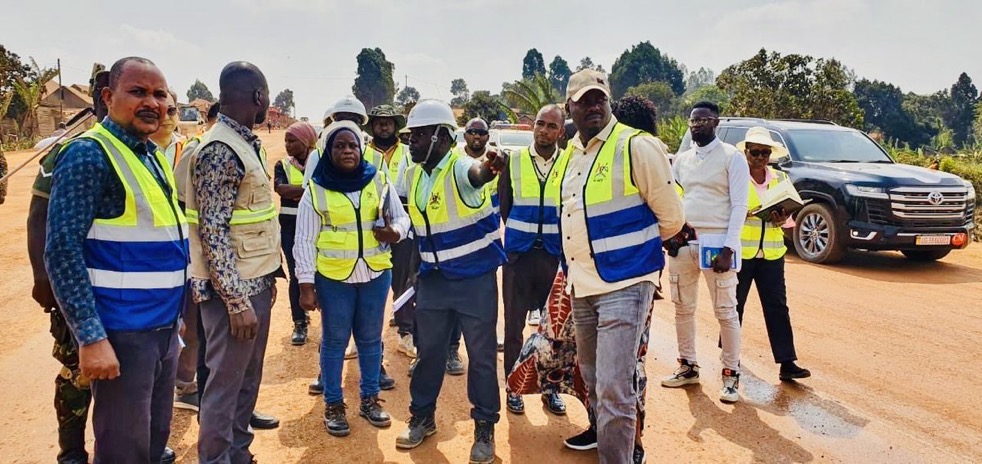

KAMPALA — Minister of Works and Transport Fred Byamukama has expressed concern over the slow progress of the Masaka–Kyotera–Mutukula Road project, directing the contractor to begin tarmacking within 90 days and step up safety measures along one of Uganda’s most strategic transport corridors.
During an inspection visit to the project, Byamukama said the pace of construction was unacceptable, noting that only about 30% of the works have been completed despite just two years remaining on the contract.
The minister warned that the road is too important to Uganda’s economy and regional integration to continue experiencing delays.
“Today, I inspected the ongoing construction works on the Masaka–Kyotera–Mutukula Road, a strategic regional corridor that connects Uganda to the United Republic of Tanzania and serves as a vital route for trade, tourism and cross-border movement,” Byamukama said.
He added that the Ministry of Works and Transport expects a significant improvement in performance, saying the contractor has 90 days to commence tarmacking the road.
Beyond construction delays, the minister raised concerns about safety for motorists and surrounding communities.
He ordered the contractor to intensify dust suppression by regularly watering the entire stretch, saying excessive dust has contributed to a growing number of road crashes and disrupted businesses and residents living along the corridor.
Byamukama also instructed the contractor to address the absence of speed humps in populated trading centres to reduce speeding and improve road safety.
“I directed the contractor to intensify dust suppression by regularly watering the entire corridor to prevent accidents which have become a common occurrence due to the dust and lack of speed humps,” he said.
The minister pledged that the Ministry of Works and Transport will closely monitor implementation of the project to ensure compliance with quality standards and timely completion.
A key regional trade artery
The Masaka–Kyotera–Mutukula Road forms part of the Northern Corridor, one of East Africa’s busiest transport networks linking Uganda with the Port of Dar es Salaam in Tanzania. The highway also provides an alternative trade route that complements the Northern Corridor through Kenya, making it critical for regional commerce under the East African Community (EAC).
The route carries thousands of cargo trucks transporting fuel, agricultural produce, manufactured goods and construction materials between Uganda, Tanzania, Rwanda, Burundi and eastern Democratic Republic of Congo. It also supports passenger travel and tourism, particularly to southwestern Uganda and Tanzania’s northern tourism circuit.
Transport experts say upgrading the road is expected to reduce travel time, lower vehicle operating costs and improve the efficiency of cross-border trade. Better road infrastructure is also expected to strengthen Uganda’s competitiveness under the African Continental Free Trade Area (AfCFTA) by facilitating faster movement of goods across regional markets.
However, prolonged construction has generated complaints from transporters, traders and residents over dust pollution, increased vehicle maintenance costs and safety risks.
With the minister’s latest directive, attention now shifts to whether the contractor can meet the 90-day deadline to begin laying asphalt and accelerate progress on a project regarded as essential to Uganda’s economic growth and regional connectivity.