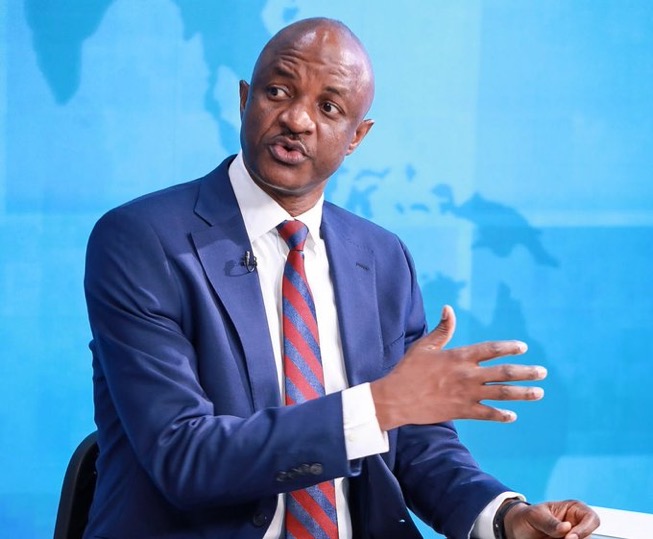

Uganda’s ambition of building a USD 500 billion economy by 2040 has received a significant recalibration. According to Permanent Secretary and Secretary to the Treasury (PSST) Dr. Ramathan Ggoobi, the country’s economy has now expanded to approximately USD 70 billion, reducing the required growth trajectory from the previously envisioned ten-fold expansion to about seven-fold over the next 15 years.
The revised arithmetic is more than a statistical adjustment—it reflects an economy that has expanded faster than earlier projections and signals growing confidence within government that Uganda’s long-term transformation agenda is gaining momentum.
A More Achievable Target
When the Tenfold Growth Strategy was first announced, Uganda’s economy was considerably smaller, making the leap to USD 500 billion appear extraordinarily ambitious. At today’s estimated size of USD 70 billion, however, the challenge, while still formidable, appears increasingly attainable.
Yet the numbers alone tell only part of the story.
For Uganda to reach USD 500 billion by 2040, it will need to sustain high economic growth for more than a decade while ensuring that growth translates into higher productivity, industrialisation, exports and household incomes.
Policy Consensus: Government’s New Confidence
Perhaps Dr. Ggoobi’s most significant argument was not about GDP figures but about governance.
He revealed that, for the first time, government has achieved what he described as policy consensus across ministries, agencies and departments, with similar alignment now emerging among the private sector, financial institutions and development partners.
This alignment is embodied in the recently adopted Fourth National Development Plan (NDP IV), which provides a common roadmap for public investment and economic transformation.
According to Ggoobi, policy inconsistency has historically undermined Uganda’s development ambitions. By pointing to the experiences of the Asian Tiger economies, he argued that coherent and consistent policy implementation—not merely ambitious planning—is what separates successful economic transformations from stalled aspirations.
If maintained beyond political cycles, this policy cohesion could become one of Uganda’s strongest competitive advantages.
Strong Macroeconomic Fundamentals
Ggoobi also highlighted what government considers an unusually resilient economic environment.
Unlike previous election periods that often generated fiscal uncertainty and macroeconomic instability, the country experienced:
- Stable inflation;
- A relatively stable Uganda shilling;
- Strong economic growth;
- Rising export earnings, particularly from coffee.
These indicators suggest increasing macroeconomic discipline, supported by close coordination between the Ministry of Finance and the Bank of Uganda on fiscal and monetary policy.
Such stability is particularly important because sustained investment—both domestic and foreign—depends heavily on predictable economic conditions.
The Revenue Challenge Could Become the Biggest Obstacle
Despite the optimism, Dr. Ggoobi identified one challenge that could derail the entire strategy: domestic revenue mobilisation.
Uganda’s tax-to-GDP ratio remains around 14 percent, significantly below levels seen in many emerging economies.
Government now intends to raise this ratio to 20 percent by 2030, with domestic revenue projected to increase from Shs35.7 trillion in FY2025/26 to Shs45.6 trillion in FY2026/27.
Achieving this target will require more than increasing tax rates.
The real challenge lies in broadening Uganda’s tax base.
A large informal sector means millions of businesses remain outside the tax net, while a relatively small number of compliant taxpayers continue to shoulder much of the burden.
Without successfully formalising more businesses and improving tax administration, financing Uganda’s ambitious infrastructure, industrialisation and social development agenda could become increasingly difficult.
Reform Agenda Signals Shift Toward Efficiency
Beyond taxation, government appears to be shifting attention toward improving how public resources are used.
The reforms outlined by Ggoobi include:
- Strengthening public procurement to reduce corruption;
- Improving implementation of government projects;
- Prioritising concessional financing over expensive commercial borrowing;
- Accelerating value addition in strategic sectors including coffee, minerals, fruits, vegetables, beef and dairy.
These reforms indicate recognition that economic transformation depends not only on raising more revenue but also on spending it more efficiently.
The Road Ahead
Uganda’s economic ambitions are undoubtedly bold.
The country’s economy has grown substantially, macroeconomic stability has improved, exports continue to expand, and government believes policy coordination has reached unprecedented levels.
However, history demonstrates that ambitious national plans often succeed or fail during implementation rather than design.
The next decade will test whether Uganda can convert policy consensus into measurable improvements in productivity, industrialisation, domestic revenue generation and institutional efficiency.
If these reforms are implemented consistently, the country’s USD 500 billion vision may evolve from an ambitious aspiration into a credible development pathway. If not, the target risks remaining another well-crafted strategy constrained by limited fiscal capacity and implementation challenges.