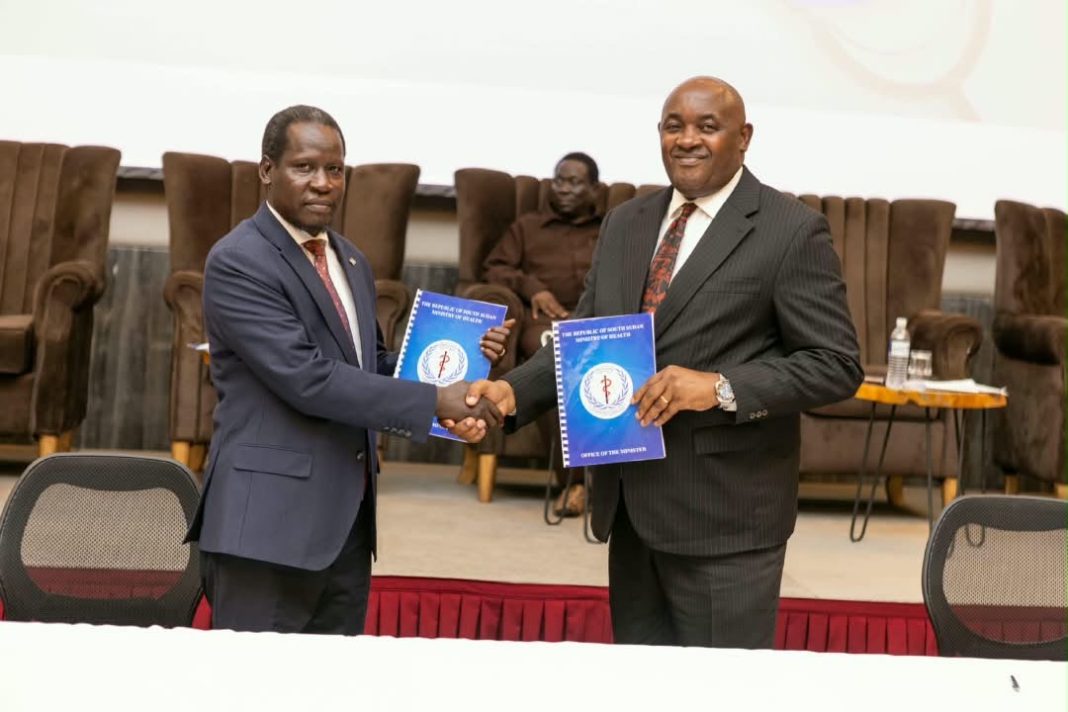

Uganda and South Sudan have signed a three-year agreement aimed at strengthening cross-border preparedness and response to public health emergencies, as the two neighbouring countries seek to contain diseases and other health threats that can spread across their shared border.
The Memorandum of Understanding was signed in Juba on Sept. 7 by South Sudan’s Minister of Health Luke Thompson Thoan Teny and Uganda’s Minister of Health Chris Baryomunsi.
The signing was witnessed by South Sudan Vice President Hussein Abdelbagi Akol, underscoring the political commitment to improving health security in communities living along the border.
Under the agreement, the two countries will strengthen disease surveillance, laboratory preparedness, risk communication and community engagement, as well as coordination during public health emergencies.
The partnership will be implemented through a costed and time-bound joint roadmap designed to turn the agreement into practical activities, including skills exchanges, mentorship programmes, simulation exercises and coordinated response operations along the border.
The Africa Centres for Disease Control and Prevention (Africa CDC) welcomed the agreement, saying closer cooperation between neighbouring countries was important in preparing for and responding to cross-border health threats.
The initiative was facilitated by Africa CDC, the United Kingdom Health Security Agency and the World Health Organization through the Continental Incident Management Support Team.
The collaboration will focus on strengthening preparedness against threats including cholera and other infectious diseases that can move across national borders.
For communities in the border areas, where movement between Uganda and South Sudan is common, coordinated surveillance and rapid information-sharing can help health authorities identify outbreaks earlier and mount a joint response.
The agreement comes as African countries continue to strengthen regional mechanisms for detecting and responding to public health emergencies, with cross-border cooperation regarded as a key component of continental health security.