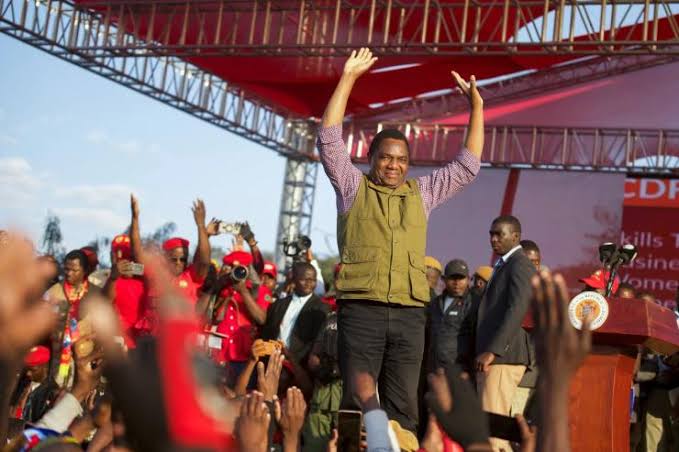

Hakainde Hichilema returns to State House with an economy stabilised but a political system facing questions over the credibility of the election that gave him another five years.
Zambia’s President Hakainde Hichilema has begun a second five-year term with two sharply contrasting legacies competing for attention: an economy that has moved back from the brink and an election whose aftermath has deepened concerns about democratic accountability.
Hichilema, 64, was sworn in on Tuesday before thousands of cheering supporters at the National Heroes Stadium in Lusaka, with presidents and senior officials from across Africa attending the ceremony.
Official results gave him 60% of the vote in the 13 August election, against 38% for his main challenger, Brian Mundubile. But the decisive victory has been accompanied by allegations that the vote tally was manipulated — claims the authorities reject.
The contradiction is striking. A president who came to power promising to repair a country weakened by debt and economic decline is beginning another term at a moment when questions are being raised about the institutional safeguards meant to protect the political system.
Mundubile was unable to mount a legal challenge to the election result after courts were sealed off on the final day for filing a petition. He and his running mate, Makebi Zulu, later went into hiding before being detained and charged with treason.
Authorities accused opposition figures of plotting an armed insurrection, allegations they denied.
The political tensions intensified a day after polling when security forces raided a property in Lusaka linked to Mundubile. A former cabinet minister was killed during the operation, while several opposition politicians were arrested.
The developments have complicated what might otherwise have been a straightforward story of electoral victory.
International observers said polling day itself was largely peaceful, but the European Union election observation mission raised concerns about the administration of the results.
In several tallying centres, observers said officials did not immediately record announced results on tally sheets. They also cited weak verification between digital entries and paper records, while returning officers repeatedly paused proceedings while waiting for instructions from headquarters.
Those concerns have left Zambia facing an uncomfortable paradox: an election that produced a commanding majority, yet one whose counting and verification processes have attracted scrutiny.
Hichilema’s political achievement cannot, however, be separated from the economic circumstances in which he first took office.
When he won in 2021, Zambia had recently defaulted on its international debt and inflation was above 24%.
“We inherited a broken-down country… the economy was declining,” Hichilema told the BBC before the latest election.
His government subsequently negotiated a restructuring of Zambia’s debt and worked to rebuild relations with international creditors. Inflation has fallen substantially from the levels inherited by his administration, providing the president with a significant economic achievement to defend.
But the recovery has not necessarily translated into relief for every household.
Prices continue to rise and many Zambians remain under pressure from the cost of living, meaning the headline story of economic stabilisation sits uneasily alongside the everyday experience of citizens struggling to make ends meet.
That tension is likely to define Hichilema’s second term.
He now has five more years to turn macroeconomic stability into broader prosperity — while simultaneously confronting questions about the strength of Zambia’s democratic institutions.
The celebrations at the National Heroes Stadium therefore carried two messages.
For Hichilema’s supporters, they marked the return of a leader who inherited a heavily indebted economy and claims to have put it on a more stable footing.
For his critics, the inauguration is the beginning of a second term whose electoral mandate remains contested.
Zambia’s paradox is consequently no longer simply about whether an economy can recover from crisis.
It is whether economic recovery can coexist with political confidence — and whether a government can strengthen the foundations of a country while facing questions about the institutions that underpin its democracy.
The answer may ultimately determine how Hichilema’s second term is remembered.