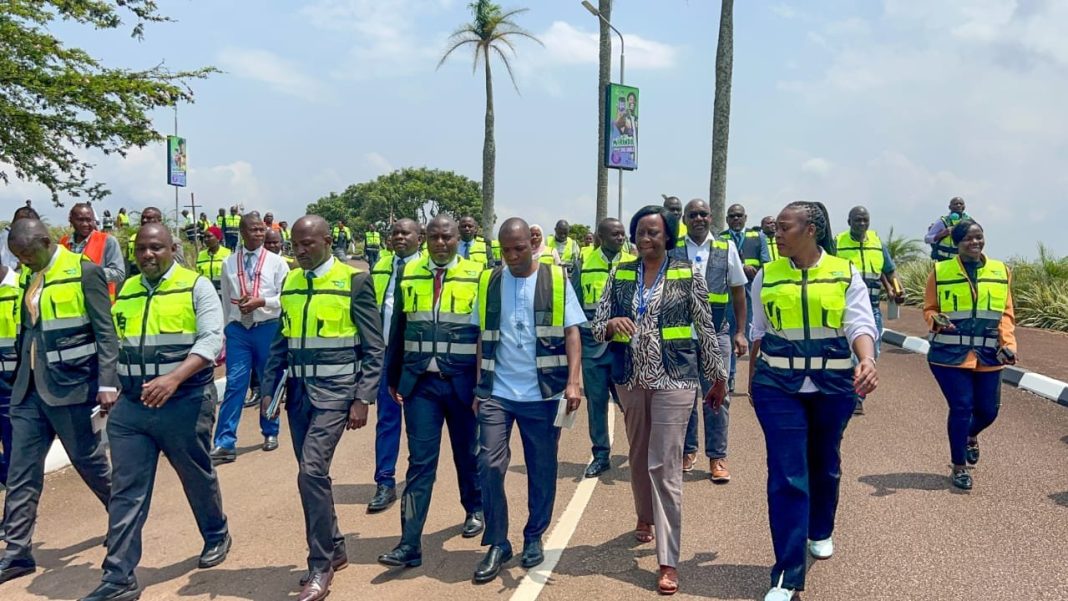

Members of Parliament on the Public Accounts Committee–Committee of Statutory Authorities and State Enterprises (PAC-COSASE) have inspected facilities at Entebbe International Airport as part of their oversight of Uganda’s aviation sector, with the committee seeking to establish how public resources invested in the country’s main gateway are translating into improved services.
The MPs, led by Hon. Muwada Nkunyingi, were hosted by the management of the Uganda Civil Aviation Authority (UCAA) on Thursday, August 20, 2026, and taken through key airport facilities, including the main terminal’s departure and arrival areas, the new terminal extension, cargo centre, electrical centre, fire station and business-class lounge.
The visit gave the accountability committee an opportunity to assess developments at the airport while receiving an update on the performance and resilience of Uganda’s aviation industry.
UCAA Acting Director General Olive Birungi Lumonya told the legislators that the sector had continued to expand despite external disruptions, including interruptions to flight operations linked to Middle East airspace.
“The aviation subsector has demonstrated considerable resilience in the face of a number of external shocks, including Middle East Airspace flight disruptions,” Lumonya said.
Passenger numbers at Entebbe have also continued to rise. According to UCAA, the airport handled 2.48 million international passengers in 2025, up from 2.24 million in 2024 — an increase of about 11 per cent.
The authority attributed the growth to increased airline connectivity, tourism and the introduction of new routes and operators.
Uganda has also concluded 64 Bilateral Air Service Agreements with other countries, agreements that provide the framework for international air connectivity and market access.
For PAC-COSASE, however, the airport tour was more than a showcase of new infrastructure. The committee’s mandate places emphasis on accountability and oversight of public entities, and the MPs indicated that they would seek further engagement with UCAA to obtain additional clarification on issues arising from their assessment.
The authority also highlighted Uganda’s performance in international aviation safety and security audits.
Uganda achieved an effective implementation score of 72.64 per cent under the International Civil Aviation Organization’s Universal Safety Oversight Audit Programme–Continuous Monitoring Approach (USAP-CMA) in September 2023.
The score was above both the regional average of 55 per cent and the global average of 69.4 per cent.
On aviation security, Uganda scored 81.6 per cent in the ICAO security audit conducted in January and February 2024. This was above the regional average of 64.5 per cent and the global average of 72.36 per cent.
UCAA said no significant safety or security concern was raised in either audit.
The authority has also acquired three new fire trucks to maintain Category 9 fire cover at Entebbe International Airport, strengthening the airport’s emergency-response capacity.
Infrastructure upgrades have extended to passenger facilities. Lumonya said the Karibuni Lounge had been refurbished and relocated to the second floor of the passenger terminal building, creating space for additional passenger lounges on the first floor.
The project has been completed.
Beyond airport infrastructure, Lumonya pointed to the development of Uganda’s 15-year Air Navigation Plan for 2025–2040 as another major milestone, alongside Uganda’s election to the ICAO Council for the 2025–2028 period.
She described the ICAO Council seat as a significant achievement and recognition of Uganda’s contribution to international civil aviation.
The inspection comes as Entebbe International Airport assumes an increasingly important role in Uganda’s tourism, trade and broader economic ambitions.
For the MPs, the next stage will be to scrutinise the information gathered during the visit and engage UCAA further where additional explanations are required.
The committee members said they appreciated the developments they observed on the ground, while stressing their accountability role in ensuring that public investments and operations deliver value to Ugandans.