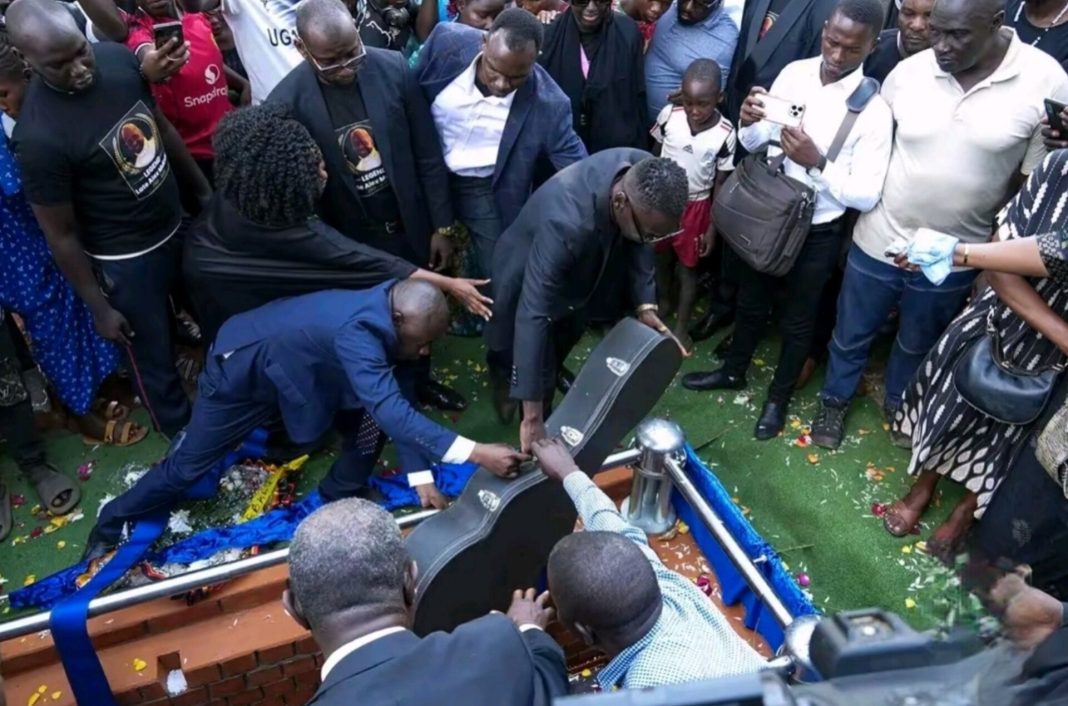

Uganda’s theatre community on Thursday bid farewell to veteran playwright, actor, director and cultural figure Alex Mukulu, who was laid to rest at Kijabijo along Gayaza Road in Wakiso District.
Mukulu, who died on August 15 aged 72, was given a solemn final send-off attended by family members, friends, fellow artists, cultural leaders, government officials and members of the public. His burial followed days of tributes that brought Uganda’s arts fraternity together to honour a man whose career spanned more than four decades.
The funeral reached a ceremonial climax with an eight-gun salute, marking the state-supported recognition of Mukulu’s contribution to Uganda’s cultural and creative sector.
His final journey took him back to Kijabijo after his body had been presented to the arts community at the National Theatre, the institution with which much of his professional life was associated. A requiem service and vigils preceded Thursday’s burial.
Mukulu’s death had prompted an unusual level of national attention for an artist, with the government joining discussions on his funeral arrangements after his contribution was described as that of a national asset.
A career built on the stage
Born in 1954 in Misebe, Ssingo County, Mukulu studied Film and Drama at Makerere University after attending Kololo Secondary School. He entered the theatre world in the 1970s, producing his first play, Muzukulu wa Kabangala, in 1977. His career subsequently produced a body of work that included theatre, writing, acting, directing and cultural mentorship.
Among his best-known works was 30 Years of Bananas, a politically charged production that examined Uganda’s post-independence history through satire and caricature. The work became one of the defining productions of his career and was later published as a book in 1993.
He also created Wounds of Africa, The Guest of Honour and The People’s President, while his Journey to Self-Realization was performed at the opening ceremony of the 2007 Commonwealth Heads of Government Meeting in Kampala.
Beyond the stage, Mukulu was remembered as a mentor who helped shape generations of performers and theatre practitioners. Buganda’s Katikiro Charles Peter Mayiga described him as a trainer, actor, songwriter and musician who had a strong connection to Buganda’s culture and served Kabaka Ronald Muwenda Mutebi II.
A curtain call for a theatre giant
Mukulu’s death has been widely described within Uganda’s creative sector as the loss of one of the country’s most influential theatre personalities.
His final burial in Kijabijo therefore marked more than the end of a funeral programme. It was a closing chapter for an artist who spent decades using the stage to entertain, provoke debate and hold a mirror to Ugandan society.
For a generation that encountered Uganda’s political and social questions through his plays, the eight-gun salute at Kijabijo offered a formal national farewell to a man whose most enduring instrument was not the gun, but the stage.