
Lionel Messi has announced his retirement from international football, bringing an extraordinary 21-year career with Argentina to an emotional close.
The 39-year-old captain confirmed the decision on Monday, saying it was one that “hurt” but that he understood the time had come to step away from the national team.
Messi leaves Argentina as its most-capped player and all-time leading scorer, with 207 appearances and 125 goals. His final appearance came in the 2026 World Cup final, where Argentina lost 1-0 to Spain after extra time in New York-New Jersey.
“I’ve given it my all; I have nothing left to give,” Messi said, while also pointing to the emergence of a new generation of Argentine players who deserve their opportunity.
The announcement marks the end of one of the most remarkable international careers in football history.
For years, Messi’s relationship with Argentina was defined as much by heartbreak as brilliance. He reached the 2014 World Cup final and suffered defeats in the 2015 and 2016 Copa América finals before finally breaking through.
His first international retirement came in 2016, after Argentina lost the Copa América final to Chile on penalties. Messi missed Argentina’s penalty during the shootout and, overwhelmed by another major final defeat, briefly walked away.
He returned, however, and the years that followed transformed the story.
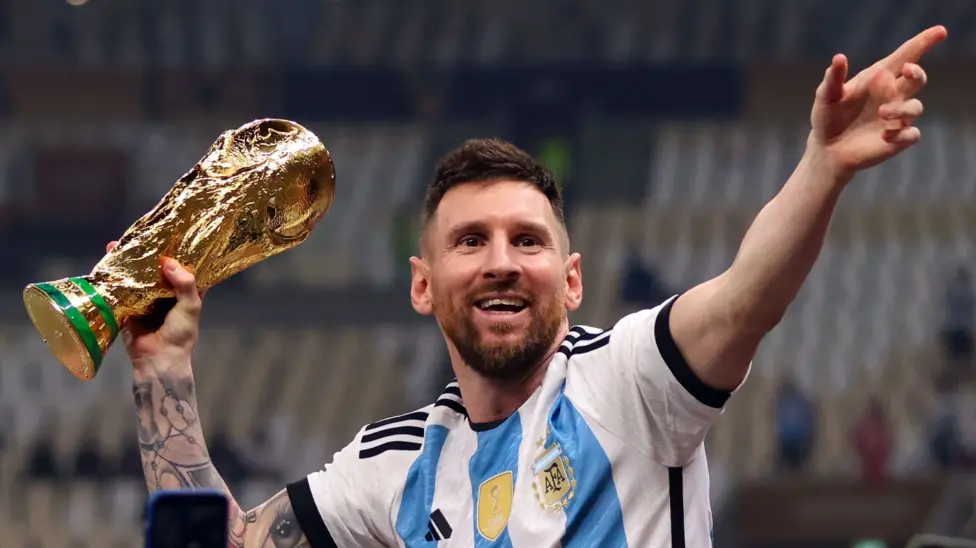
Argentina won the 2021 Copa América, giving Messi his first major international trophy. A year later came the defining achievement: the 2022 World Cup in Qatar, where Messi captained Argentina to victory over France in a dramatic final.
A second Copa América title followed in 2024, establishing a golden era for Argentine football. Messi then led the country to another World Cup final in 2026, only for Spain to claim the trophy with a 1-0 extra-time victory.
Messi said he had actually written his retirement message on 21 July, two days after Argentina’s defeat to Spain.
The decision became even clearer following the death of his father, Jorge Messi, earlier in August. Reports said the loss prompted Messi to reconsider how much longer he wanted to continue with the national team.
His final World Cup campaign further cemented his statistical legacy. FIFA records show Messi extended his record for World Cup appearances to 34, while his career World Cup tally reached 21 goals.
Yet numbers only tell part of the story.
Messi arrived on the international stage in 2005 as a teenager, making his debut against Hungary. His first appearance lasted barely a minute before he was sent off, an unusually chaotic beginning to what would become one of the greatest international careers in football.
Twenty-one years later, he leaves having achieved what once seemed impossible.
He became Argentina’s record goalscorer, record appearance-maker, World Cup champion and a two-time Copa América winner. More importantly, he helped transform a generation of disappointment into one of the most successful periods in the country’s football history.
“I love, have loved, and will always love being part of the national team,” Messi said in his farewell.
He thanked Argentine supporters for two decades of loyalty and said he would now watch the national team “from the sidelines” as a supporter.
The international stage may have lost its No. 10, but Messi’s football career is not over.
He will continue playing at club level with Inter Miami in Major League Soccer, leaving the door open for another chapter away from the blue and white of Argentina.
But for the national team, the era is over.
Messi’s first Argentina appearance came with a red card. His last ended with a World Cup final defeat.
Between those two moments came the trophies, the failures, the tears, the redemption and, finally, the World Cup he spent much of his career chasing.
Argentina now has to imagine football without Lionel Messi.
That may be the hardest part of all.