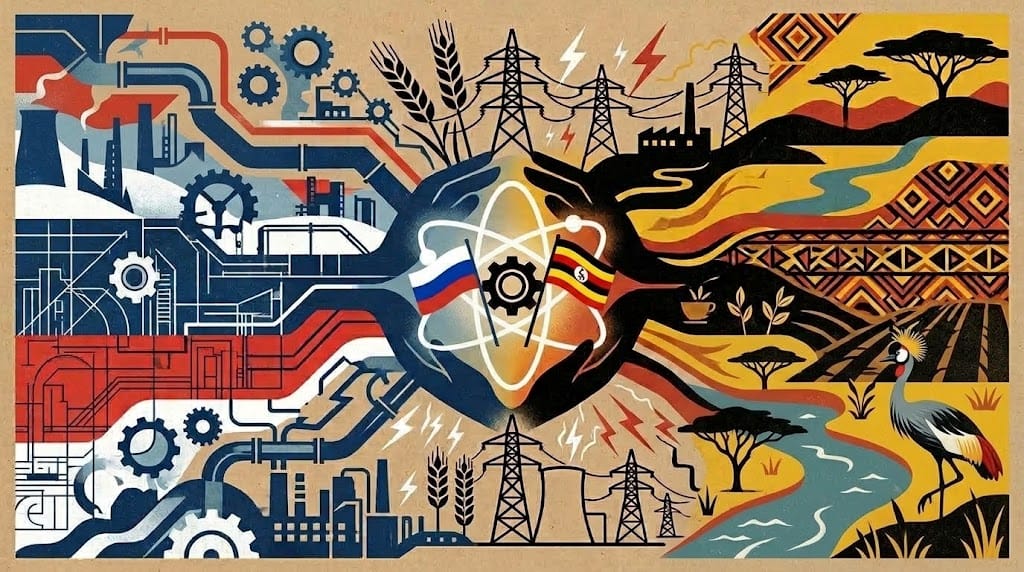

Uganda and Russia have renewed discussions on nuclear energy cooperation, with officials and experts calling for stronger technology transfer, local skills development and industrial partnerships between the two countries.
The discussions were held on October 7 during a round-table meeting on Uganda-Russia cooperation at the New Vision offices in Kampala.
The meeting brought together Russia’s Chargé d’Affaires ad interim to Uganda, Sergey Lobanov; Damalia Noel Abbo Ofumbe, a senior energy specialist in the Nuclear Energy Department of the Ministry of Energy and Mineral Development; Denis Degteev, a political and economic scientist and chief research fellow at the Institute of Africa of the Russian Academy of Sciences; Elsie Pule, chief coordinator of the BRICS nuclear platform and director of special projects for Rosatom in Central and Southern Africa; and Herbert Kafiro, deputy executive director of the Southern and Eastern Africa Trade Information and Negotiations Institute (SEATINI).
The discussions covered nuclear energy, energy security, oil and gas, electrification, trade and human-resource development.
Participants said Uganda-Russia relations should move beyond commodity trade towards long-term production partnerships, technology transfer and development of Ugandan expertise
Opening the meeting, Lobanov said diplomatic relations between the Soviet Union and Uganda were established on October 13, 1962, and the two countries would soon mark 64 years of diplomatic relations.
“We were one of the first powers to recognise the sovereignty and independence of Uganda,” he said.
Lobanov highlighted cooperation between Russia’s state nuclear corporation Rosatom and Uganda’s Ministry of Energy and Mineral Development, expressing hope that projects involving the peaceful use of nuclear energy would move forward.
“At the end of this month, the third Russia-Africa summit will be held in Russia. We hope that its results will make it possible to raise bilateral relations to new heights in the sphere of energy, trade, the economy, science and technology,” he said.
Uganda’s nuclear programme is part of its long-term plan to diversify electricity generation. The Ministry of Energy and Mineral Development says the 2023 Energy Policy targets more than 52,000 megawatts of total electricity generation capacity by 2040, including 24,000MW from nuclear power.
Nuclear power plans
Ofumbe said Uganda’s move towards nuclear energy had been driven partly by the need to diversify its electricity sources, given challenges affecting hydropower.
“Since 2007 we have faced a number of problems, such as drought on the Nile River, so we had to revise our energy balance. We are developing hydro and solar energy, but we also need other sources. That is how the need arose for nuclear energy,” she said.
She said several locations had been identified for possible nuclear power development, including Buyende and Nakasongola, while other sites have also been considered under Uganda’s nuclear power programme.
The Ministry of Energy and Mineral Development says Buyende District has been selected as the preferred location for Uganda’s first nuclear power plant following site evaluations.
Nakasongola is also being considered for a major nuclear power project. Daily Monitor reported in October 2025 that Government had proposed a 7,200MW plant at Kisenyi Village in Kalungi Sub-count, comprising six 1,200MW reactors.
Ofumbe said negotiations were ongoing with Rosatom and that a site assessment in Nakasongola was planned.
“We recently signed a roadmap for this project,” she said.
Uganda and Russia signed a memorandum of understanding on cooperation in the peaceful use of nuclear energy in 2017. Rosatom’s 2017 report also records the signing of the memorandum with Uganda and says such agreements were intended to support the development of nuclear power infrastructure.
Ofumbe said the two countries subsequently signed an intergovernmental agreement in Vienna in 2019.
She said the feasibility study for the proposed project is expected to be completed by 2030, while the first unit could be commissioned between 2035 and 2038.
However, the Government’s wider nuclear programme has its own implementation targets, with the Ministry currently indicating 2031 as the target for Uganda’s first nuclear power plant. The differing dates reflect different stages and proposals within Uganda’s broader nuclear programme and should not be treated as a confirmed commissioning date.
Ofumbe stressed that nuclear technology would have applications beyond electricity generation.
“We are already implementing projects for the diagnosis and treatment of cancer at the Uganda Cancer Institute, and we are working on food safety and the diagnosis of animal diseases, such as foot-and-mouth disease,” she said
She said skills transfer would be critical to the success of Uganda’s nuclear programme.
“The station will operate for 100 years, and Ugandans must be able to independently manage and maintain it,” Ofumbe said.
Trade and industrialisation
Degteev said the Russia-Africa summit would provide an opportunity to deepen economic relations between Russia and African countries beyond conventional commodity trade.
He cited the El-Dabaa nuclear power plant in Egypt as an important development in Africa’s nuclear energy sector.
“Atomic energy gives an enormous impetus to electricity generation, which is vital for the industrialisation of Africa,” he said.
Degteev also highlighted opportunities for regional cooperation in the oil and gas sector, noting that East African countries have petroleum resources but continue to import refined petroleum products.
“We hope that the oil extracted in Uganda will be processed locally and exported to neighbouring countries. Russia is ready to participate in the development of regional energy projects,” he said.
Kafiro described energy as a matter of national economic security and industrial policy, saying Uganda’s economic ambitions would require a reliable supply of electricity.
“Uganda dreams of a $500 billion economy, and this is impossible without industrialisation, which, in turn, is impossible without energy,” he said.
He urged Uganda to integrate nuclear energy into sectors beyond electricity generation, including agriculture and healthcare.
Kafiro also called for Uganda to address its trade imbalance with Russia by increasing exports of value-added products.
He said Uganda imports machinery and wheat from Russia while its exports are largely dominated by raw commodities such as coffee and tea.
“We need to negotiate the export of value-added goods. By exporting raw materials, we export jobs,” he said.
He called for broader negotiations involving government agencies, farmers and the Ministries of Trade and Agriculture to identify opportunities for value addition and exports.
Lobanov, in his closing remarks, thanked the participants and called for more such discussions to identify areas for stronger bilateral cooperation.
“We should hold such events more often in order to reveal the development potential of our relations, make them mutually beneficial and begin a new era of cooperation between Russia and Uganda,” he said.
The meeting came ahead of the third Russia-Africa Summit, scheduled for October 28-29, 2026, in Moscow. Uganda’s Ministry of Foreign Affairs confirmed in May that Russia had formally invited Uganda to participate in the summit, which is expected to address trade, investment, technology transfer, education and other areas of cooperation.