
Rwandan President Paul Kagame has called for greater accountability among African leaders, warning that national sovereignty should not shield governments from scrutiny when they fail to deliver for their citizens.
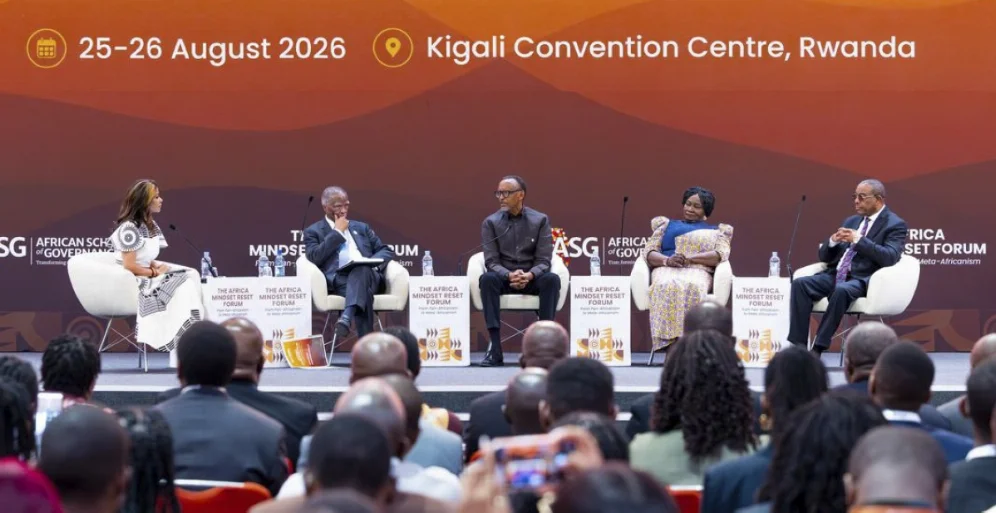
Kagame made the remarks on Tuesday, August 25, during a presidential panel at the Africa Mindset Reset Forum in Kigali, where he argued that Africa’s central development challenge is no longer a lack of resources or ideas, but the failure to translate them into measurable results.
“Africa seems to have everything in place to succeed. It has people, it has resources,” Kagame said. “But the question is how do we change from a position where we have everything we need and are clear about what we have to be, to actually having the Africa we want?”
The Rwandan leader said African governments and institutions have spent decades diagnosing the continent’s challenges through platforms such as the African Union and other regional and international forums. But he questioned whether repeated discussions have produced enough action.
“We cannot stay in one place where we are discussing our problems, evidently convincing ourselves that we have more or less what we need to be where we want to be, but we are not getting there,” he said.
Kagame said the persistent gap between Africa’s ambitions and its outcomes should compel leaders and institutions to identify the structural and governance failures that repeatedly prevent progress.
“If we have everything in place, it means there is something we have to identify that keeps failing us, and therefore take the bull by its horns and deal with what we have to deal with,” he said.
Sovereignty must not become a shield
Kagame placed accountability at the centre of the continent’s leadership debate, arguing that sovereignty carries responsibilities as well as rights.
“If there are leaders who are not doing the right things, people should point it out. You cannot just mess up a country that has sovereignty and then we keep quiet,” he said.
“Sovereignty and legitimacy should indicate that people are doing the right things for the people.”
His remarks underscore a broader question facing African democracies: how to reconcile the principle of national sovereignty with the need for citizens, regional institutions and other stakeholders to demand accountability from governments.
For Kagame, political legitimacy should ultimately be measured not only by the existence of institutions or mandates, but by whether leaders deliver tangible improvements in people’s lives.
Governance determines whether development delivers
Kagame also linked governance directly to Africa’s ability to turn investments in infrastructure, food security and other sectors into sustainable development.
“The governance aspect of it is vital. Infrastructure and food security are key, but depending on the governance structure, these are going to happen and give the results you expect or not,” he said.
The argument places institutional effectiveness at the heart of Africa’s development debate. Roads, energy projects, agricultural programmes and other investments, Kagame suggested, cannot deliver their full potential where institutions are weak or implementation is consistently delayed.
He criticised what he described as a culture in which governments formulate policies and make commitments but fail to follow through, often because of bureaucracy, delays or excuses.
“African countries must instead develop a culture in which what leaders say, plan and want is matched by what they actually do,” Kagame said.
“We can’t continue saying things about what we have to do and then start doing different things. We have to match what we say, want and do for us to match the results.”
From promises to execution
Kagame further warned that excessive caution can become an obstacle to progress, particularly when leaders hesitate to act despite knowing what needs to be done.
“Even if you are afraid to do something, you are already making a mistake,” he said.
The comments reflect a recurring concern in African governance debates: the distance between policy formulation and implementation. Across the continent, governments routinely adopt ambitious development plans, regional agreements and reform programmes, yet their impact can be weakened by poor execution and institutional bottlenecks.
Kagame warned that Africa could remain trapped in this cycle unless leaders begin measuring success by results rather than declarations.
“We can’t keep running in the circle, sometimes congratulating each other, hugging each other, but after a year, three or five, we look back and we are in the same place where we were or even moved backwards,” he said.
A debate over Africa’s leadership future
The Africa Mindset Reset Forum, hosted by the African School of Governance, brought together political leaders, former heads of state, business leaders, academics and emerging leaders to examine governance, institutions and the culture of execution needed to accelerate Africa’s development.
Kagame’s intervention placed leadership accountability at the centre of that conversation, arguing that Africa’s future will depend not simply on the resources it possesses or the policies it adopts, but on whether its institutions and leaders can convert those advantages into results for citizens.
The challenge, in his formulation, is no longer simply to define the Africa the continent wants. It is to build the political and institutional discipline capable of delivering it.