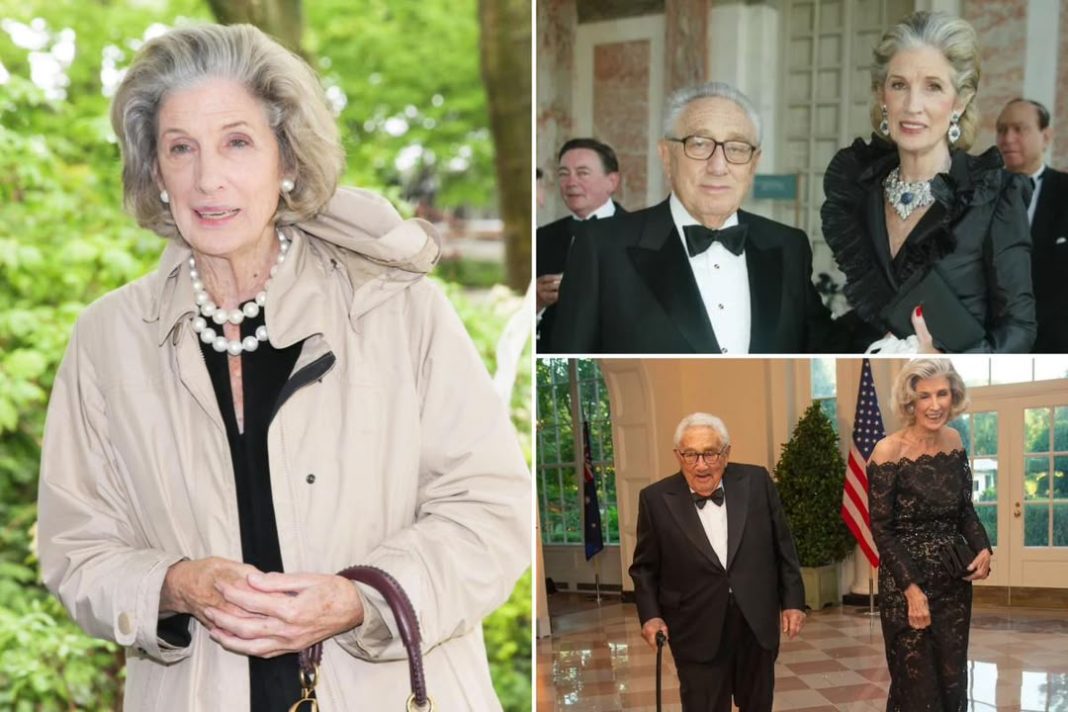

Nancy Kissinger, the widow of one of the most consequential and controversial figures in 20th-century American foreign policy, died on Thursday, according to her family. The New York Times was first to report her death.
Kissinger was more than a political spouse. Before marrying Henry Kissinger in 1974, she had built a career in American politics, working for New York governor Nelson Rockefeller and later directing international studies for Rockefeller’s Commission on Critical Choices for Americans. (Wikipedia)
Her long proximity to the centres of political power gave her an unusual perspective on the foreign-policy establishment of the Cold War era.
Former New York mayor Mike Bloomberg remembered her as a formidable intellectual presence, describing her as a “powerhouse of ideas and insights” who put those qualities to work in government and philanthropy. He also called her Henry Kissinger’s “most valued and trusted advisor”.
A career before the Kissinger name
Born Nancy Sharon Maginnes in New York in 1934, she studied history at Mount Holyoke College, graduating in 1955. She later pursued graduate studies and developed a career focused on politics and international affairs.
Her association with Rockefeller began in the 1960s. She initially worked as a researcher on a Rockefeller task force and subsequently continued at the Rockefeller Brothers Fund. She later became director of international studies for Rockefeller’s Commission on Critical Choices for Americans. (Wikipedia)
It was through this political world that her relationship with Henry Kissinger developed.
The couple married in Arlington, Virginia, on 30 March 1974. (Wikipedia)
Beside Henry Kissinger through an era of upheaval
Nancy Kissinger accompanied her husband through decades of American political and diplomatic life, as Henry Kissinger moved from the Nixon administration into the State Department and later became an influential voice in international affairs.
Henry Kissinger served as national security adviser and secretary of state under presidents Richard Nixon and Gerald Ford. His diplomacy helped shape US relations with China and the Soviet Union and the negotiations surrounding the Vietnam war. His career also attracted enduring criticism over US foreign policy in Vietnam, Cambodia, Chile and elsewhere.
Nancy’s own political experience meant she was not simply an observer of that world. She had worked on international affairs before their marriage and remained part of the political and social networks surrounding her husband.
Her presence was sometimes captured in the photographs and accounts of the period: alongside Henry Kissinger at official receptions, diplomatic gatherings and meetings with political leaders. The Gerald R Ford Presidential Library, for example, records her attendance at the 1977 ceremony at which Henry Kissinger received the Presidential Medal of Freedom. (Ford Library Museum)
A partnership that lasted nearly half a century
The Kissingers remained married until Henry Kissinger died in November 2023, aged 100.
Nancy’s role in his life became increasingly visible in later years, when she was frequently described as a close adviser and companion. Bloomberg’s tribute reflected that perception, portraying her as someone whose judgment Henry Kissinger valued deeply.
Her own public life also extended into philanthropy and institutional work. She served on the boards and governing bodies of several organisations, including the Rockefeller Institute of Government and The Masters School. (SourceWatch)
Nancy Kissinger’s death comes less than three years after her husband’s, closing a long partnership that had stretched from the political turbulence of the 1970s into the 21st century.
She leaves behind a legacy that sits partly in the shadow of Henry Kissinger’s towering and disputed reputation, but her career before and alongside him offers a different story: that of a woman who entered American political life on her own terms and remained an informed participant in its upper reaches for decades.