
Uganda and the European Union are seeking to deepen their economic partnership, with investment, trade, energy, climate finance and private-sector development taking centre stage as the two sides mark 50 years of diplomatic and development cooperation.
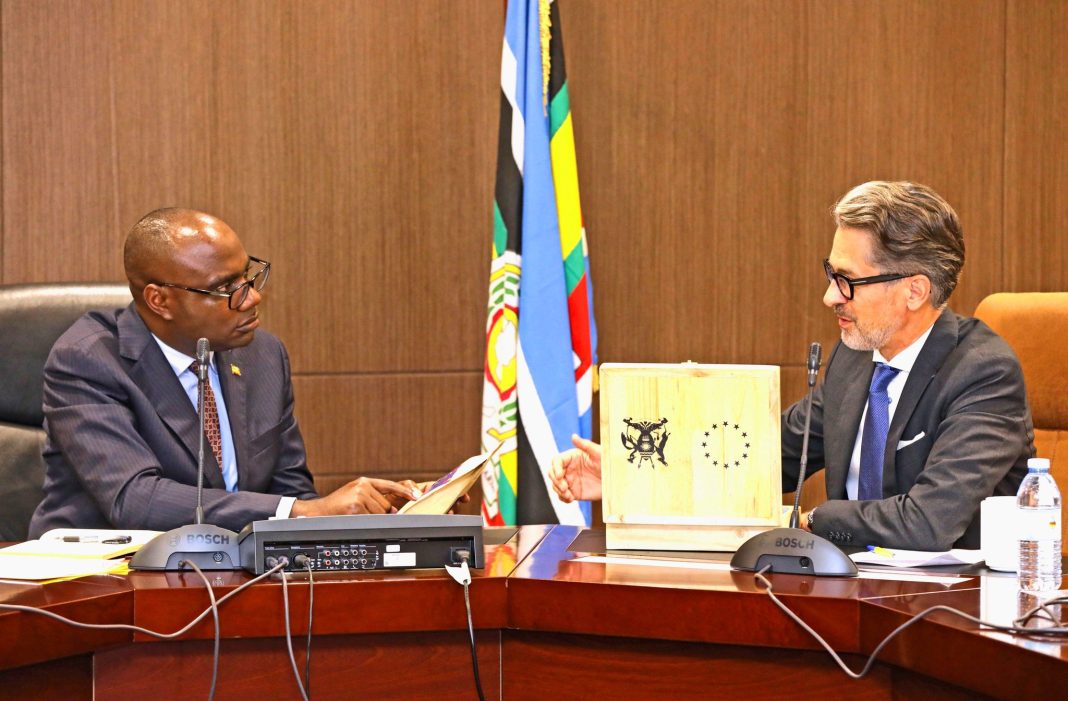
The renewed commitment was reaffirmed on Friday by Finance Minister Henry Musasizi during a meeting with a European Union delegation led by the EU Ambassador to Uganda, Jan Sadek.
The discussions highlighted a shift towards a broader economic relationship designed to mobilise private investment, expand Uganda’s exports, create jobs and support long-term economic transformation.
“We value the European Union’s longstanding partnership with Uganda and look forward to strengthening cooperation that translates into investment, jobs, exports and sustainable economic growth,” Musasizi said.
The meeting comes as Uganda and the EU seek to build on five decades of cooperation, moving beyond traditional development assistance towards investment-led partnerships in infrastructure, energy, trade, climate finance and productive sectors.
Sadek reaffirmed the EU’s commitment to working with Uganda’s Ministry of Finance, describing it as the bloc’s primary government counterpart for development cooperation.
He said the EU’s bilateral development cooperation allocation for Uganda under the 2021–2027 framework stands at €539 million, while Team Europe provides more than €750 million annually in development assistance to the country.
€1.4 billion targeting private-sector growth
A significant component of the partnership is the EU’s Global Gateway strategy, through which Team Europe is investing approximately €1.4 billion in Uganda’s private-sector development.
The investment package includes about €300 million in grants targeting access to finance, skills development, improvements in the business environment and productive infrastructure.
The initiative is intended to help address some of the constraints facing businesses while supporting investment in sectors capable of generating employment, expanding production and increasing export earnings.
Sadek said EU–Uganda cooperation is organised around three broad priorities: sustainable and inclusive growth and jobs, governance and social inclusion, and connectivity.
He added that the partnership was evolving towards a broader financing model combining grants, concessional lending, guarantees and blended finance to attract additional private capital.
“Our portfolio is broad and designed to deliver practical results while supporting Uganda’s own priorities,” Sadek said.
The EU’s support also covers productive sectors and value chains, including coffee, forestry, tourism and critical raw materials, alongside investments in energy, transport and digital connectivity.
Energy investment targets 30 more years
Energy infrastructure featured prominently in the discussions, particularly the rehabilitation of the Nalubaale and Kiira hydropower plants, which Sadek described as one of Team Europe’s flagship initiatives in Uganda.
The project has a €170 million financing package, comprising €30 million in EU grants and concessional loans from the European Investment Bank and the French Development Agency.
The rehabilitation is intended to extend the operational life of the two strategic hydropower facilities by at least another 30 years, helping preserve existing renewable electricity generation infrastructure.
“The rehabilitation of the Nalubaale and Kiira hydropower plants is one of our flagship Team Europe initiatives in Uganda,” Sadek said.
The investment comes as Uganda continues to pursue improvements in its energy infrastructure to support industrial expansion, business growth and rising electricity demand.
EU signals support for Uganda’s green bond plans
Climate finance was another major issue discussed, with the two sides exploring Uganda’s preparedness to issue its first sovereign green bond.
The EU expressed interest in supporting the country’s preparations and examining how the planned issuance could attract international private capital into sustainable investments.
A sovereign green bond would provide Uganda with another potential financing instrument for projects with environmental benefits, although its effectiveness would depend on credible project selection, transparent reporting and investor confidence.
Uganda’s exports to EU rise to €1.8 billion
Trade figures provided by Sadek point to a significant expansion in commercial relations between the two sides.
Uganda’s exports to the European Union increased from €377 million in 2015 to €1.8 billion in 2025, while the country recorded a trade surplus of approximately €950 million with the bloc last year.
The figures underline the EU’s importance as an export market for Uganda and provide a basis for further discussions on expanding market access, strengthening productive capacity and increasing the competitiveness of Ugandan businesses.
The focus on coffee, tourism, forestry and other productive value chains reflects efforts to connect European investment and market opportunities with Uganda’s export ambitions.
As the partnership enters its sixth decade, the discussions between Musasizi and Sadek point to a growing emphasis on using development finance to unlock private investment, strengthen infrastructure and expand trade.
The central challenge will be translating the commitments and financing envelopes into actual investments, productive jobs and stronger export capacity for Uganda.