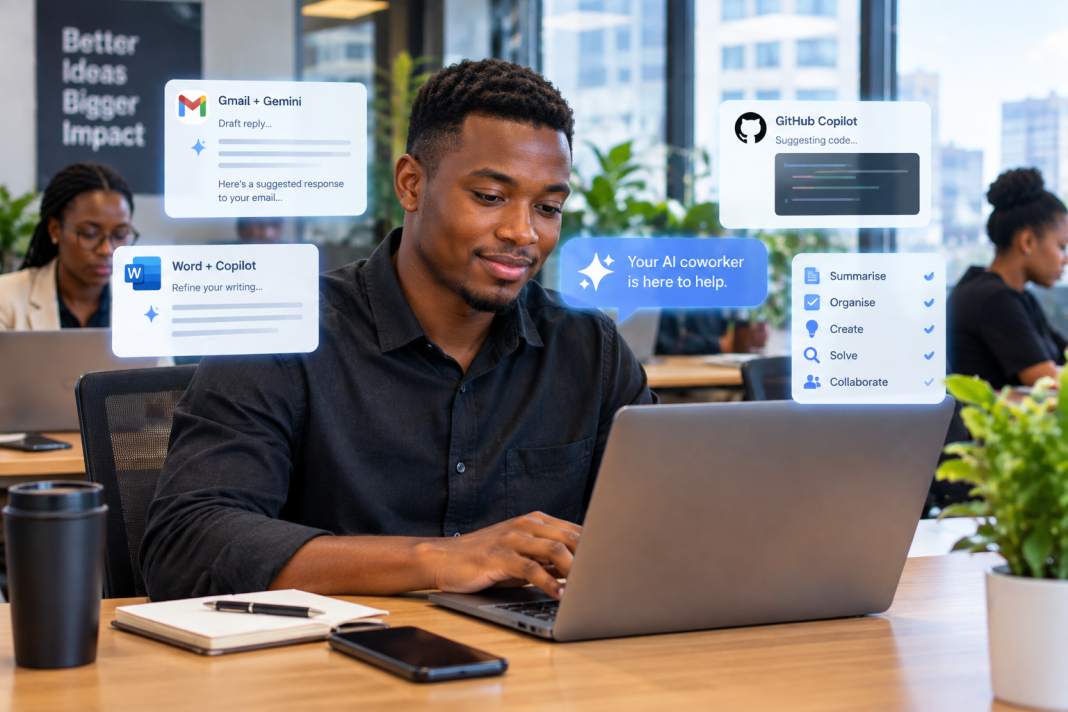

It doesn’t drink coffee. It doesn’t ask for leave. But it’s sitting beside you, helping you write, analyze, design, and decide.
By Robinah Alice Namuwaya
You probably didn’t notice your first day with an AI coworker. There was no welcome email. No office desk. No staff introduction.
One morning, Gmail quietly began helping you write emails through Gemini. WhatsApp introduced Meta AI. Microsoft Word started suggesting better ways to phrase your thoughts. GitHub Copilot began completing lines of code before developers finished typing.
Nothing announced its arrival. Yet something about work had quietly changed.
You begin writing an email. Before you’ve finished the second sentence, Gmail suggests the next one.
You upload a meeting recording. NotebookLM offers a summary before you’ve even pressed play.
You paste a paragraph into Word. It recommends a clearer version.
For years, software waited for instructions. Now it makes the first contribution. That may be the biggest difference between yesterday’s software and today’s artificial intelligence.
A calculator waits.
A spreadsheet waits.
Spellcheck waits.
AI doesn’t.
It drafts.
Suggests.
Summarizes.
Questions.
Improves.
The conversation has changed.
The software no longer waits for work. It joins the work.
Think about your best coworker. They don’t do your job for you. They make your job better. They notice what you’ve missed. They suggest a better idea. They help when you’re stuck.
AI is beginning to play a remarkably similar role.
A tool waits for you. A coworker contributes with you.
That is why the biggest workplace question may no longer be whether AI will replace people.
For many workers, it already hasn’t. Instead, it has quietly become the first contributor.
A journalist uploads an interview. Within minutes there’s a transcript, suggested headlines and recurring themes.
The story still belongs to the journalist. It simply no longer begins with a blank page.
The same pattern is appearing almost everywhere.
Teachers begin with AI-generated lesson outlines.
Programmers review AI-generated code.
Designers refine AI-generated concepts.
Doctors use AI to organize consultation notes.
The final decisions are still human. But the first contribution increasingly isn’t.
Tomorrow morning, you’ll probably open your laptop, check your email and begin work as you always do.
Only this time, pay attention. Notice who suggests the first sentence. Who summarizes the meeting? Who offers another way to write the report? Who quietly contributes before you’ve even finished thinking? Because your newest coworker may never introduce itself.
There won’t be a handshake.
No employee number.
No desk beside yours.
It will simply start helping.
Years from now, we may look back and realize that work did not change the day robots walked into our offices.
It changed the day software quietly started working with us.
And perhaps the most remarkable part is that most of us never noticed the day our newest coworker arrived.