
Ugandan President Yoweri Museveni has backed the construction of a $16 billion oil refinery in Kenya, arguing that East Africa needs more refining capacity to process its natural resources, create employment and reduce dependence on imported petroleum products.
Speaking at the groundbreaking ceremony in Mokowe, Lamu County, Museveni said Uganda would proceed with its planned refinery in Hoima despite the scale of the proposed Dangote East Africa Petroleum Refinery.
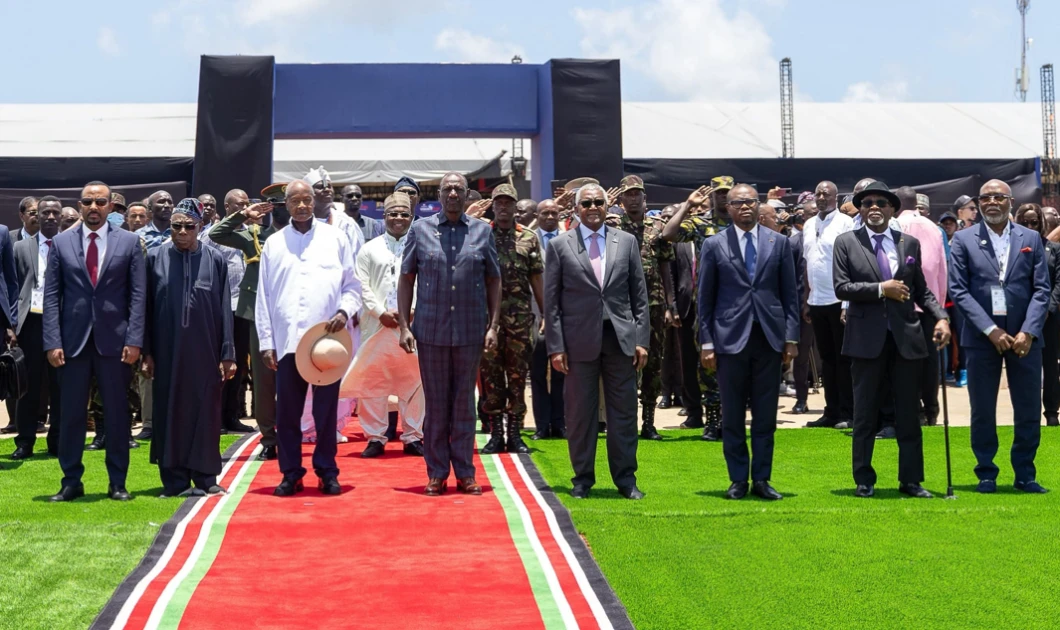
The ceremony brought together Kenyan President William Ruto, Ethiopian Prime Minister Abiy Ahmed, Nigerian industrialist Aliko Dangote and other African leaders.
The Lamu refinery is designed to process 700,000 barrels of crude oil per day, positioning it among the largest proposed refining projects in Africa.
Museveni said the region could accommodate several refineries, including projects in Kenya, Uganda, Tanzania and Nigeria, arguing that each could serve different markets while supporting broader regional industrialisation.
“We are going to build a small refinery in Uganda. We had planned this long ago. We can’t change that. The refinery will produce for Uganda and for the interior parts of Africa,” Museveni said.
Uganda’s proposed 60,000-barrel-per-day refinery is planned for Kabale in Hoima District. The Ministry of Energy has announced implementation agreements with UAE-based Alpha MBM Investments for the approximately $4 billion project.
Museveni open to regional investment
The Ugandan leader also indicated that Kampala could consider taking an equity stake in the Lamu project, but said he first wanted to understand the status of a previously proposed refinery in Tanga, Tanzania.
Museveni said he intended to consult Tanzanian President Samia Suluhu Hassan and Ruto before making a decision.
“I want to discuss with Samia and His Excellency Ruto to find out what happened to that refinery in Tanga. What was the problem?” he said.
Dangote has reserved up to 30 per cent of the Lamu refinery for East African countries interested in investing in the project, potentially giving regional governments an opportunity to participate in its ownership and share in its financial returns.
“This project is for all of East Africa. We have earmarked a 30 per cent stake for countries in the region,” Dangote said.
He traced the origins of the project to an earlier meeting with Museveni and Ruto during a conference in Kenya, where the three discussed the possibility of establishing a major refinery to serve the region.
Ruto credited Museveni with helping advance the proposal, describing the Ugandan leader’s vision as instrumental in bringing the project to its current stage.
Africa must process its own resources
The refinery project has been presented as part of a broader African industrialisation agenda centred on processing natural resources locally rather than exporting raw materials and importing finished products.
Ruto said African countries should use their natural resources as the foundation for industrial development.
At the ceremony, he argued that the continent should move beyond supplying raw materials to global industries and instead build manufacturing capacity that creates jobs and retains more economic value within Africa.
Dangote echoed the argument, saying Africa could not achieve lasting prosperity while continuing to export unprocessed resources and import finished goods.
“For too long, our continent has been rich in resources but poor in value addition. I firmly believe Africa cannot build lasting prosperity by exporting what it has and importing what it needs,” he said.
Museveni illustrated the economic difference between exporting raw agricultural commodities and processing them locally, using coffee as an example.
He said a kilogramme of coffee could fetch about $2 after husking, while roasting, grinding and packaging could raise its value to approximately $40.
He also cited Dangote’s transition from importing cement into Africa to establishing manufacturing operations on the continent as an example of the industrial transformation he wants African economies to pursue.
Museveni renews East African federation call
Beyond the refinery, Museveni used the occasion to renew his call for political federation among East African countries, arguing that deeper integration would help regional economies benefit more fully from major investments.
He said countries could earn returns from owning shares in the refinery, but that financial participation alone would not guarantee that their citizens benefit from employment opportunities generated by the project.
“Although the refinery is here, they will also get profit. But it does not answer the issue of jobs,” Museveni said.
He argued that a politically integrated East Africa would make it easier for citizens to access employment opportunities across national borders, drawing comparisons with the movement of petroleum products within Nigeria.
Ethiopian Prime Minister Abiy Ahmed also called for greater participation of African young people in major industrial projects.
He said young Africans should be trained and involved as engineers, contractors and technical professionals rather than remaining spectators as large investments take shape.
“East Africa is not only a market; it is a place to build and create value. Young Africans should not remain observers of projects like this. They should become the engineers and contractors. That is how we build a lasting legacy,” Abiy said.
60,000 jobs and a 40-month completion target
Dangote said the Lamu refinery could generate approximately 60,000 jobs during construction, while plans include establishing a technical training school capable of training 1,000 people in engineering and related skills.
He pledged to commission the facility within 40 months.
The project is planned for Lamu Port along the Lamu Port-South Sudan-Ethiopia Transport (LAPSSET) Corridor and is intended to supply petroleum products to markets across East Africa and beyond.
Its proposed capacity of 700,000 barrels per day would make it comparable in scale to Dangote’s refinery in Nigeria, which has a similar nameplate processing capacity.
However, the Lamu development also faces legal challenges. A Kenyan court has ordered the status quo to be maintained in a land dispute involving residents who have raised concerns about land ownership and compensation. The dispute introduces potential legal and implementation uncertainties even as the groundbreaking ceremony proceeds.
For Uganda, the development presents both an opportunity for regional cooperation and a reminder of the scale of investment taking shape in East Africa’s petroleum industry.
Museveni says the Lamu refinery should not replace Uganda’s Hoima project. Instead, he sees multiple refineries operating across the region, processing African crude, supplying regional markets and supporting the continent’s ambition to retain more value from its natural resources.