
By Robinah Alice Namuwaya
Last week, a friend excitedly shared an email announcing that she had secured a new job with a manufacturing company in Kampala.
The message was polished, confident and free of grammatical errors. As I read through it, I could not help but smile. We had studied together, and I knew writing had never been her strongest skill.
Curious, I asked how she had managed to write such a professional email.
“I used ChatGPT,” she replied.
Her answer was short, but it reflected something much bigger than a successful job application.
Across Uganda, thousands of people are quietly turning to artificial intelligence (AI) to write emails, prepare reports, generate business ideas, summarize documents, create social media content and even assist with academic research.
What once sounded like science fiction has gradually become part of everyday life.
Yet despite its growing popularity, many Ugandans still ask one simple question:
What exactly is Artificial Intelligence?
Artificial Intelligence, commonly known as AI, refers to computer systems designed to perform tasks that normally require human intelligence.
These include understanding language, recognizing images, solving problems, making predictions, learning from information and generating content.
Although AI has become one of the world’s biggest technology conversations in recent years, the idea itself is not new.
The field formally took shape in 1956 during the Dartmouth Summer Research Project on Artificial Intelligence in the United States. The conference was organized by American computer scientist John McCarthy, who later became known as the “Father of Artificial Intelligence.”
Together with other researchers, he imagined a future where computers could imitate aspects of human thinking, solve problems and learn from experience.
Seventy years later, that vision is slowly becoming reality, not just in Silicon Valley or Europe, but also in Uganda.
AI is Already Part of Everyday Life
Today, artificial intelligence quietly powers many digital services people use every day, often without them realizing it.
When your smartphone predicts the next word while typing a message…
When Google Maps suggests a faster route through Kampala traffic…
When YouTube recommends another video you might enjoy…
Or when your email automatically filters spam messages…
Artificial intelligence is often working behind the scenes.
The arrival of generative AI tools such as ChatGPT has simply made the technology more visible to ordinary people.
Unlike traditional software that only follows fixed instructions programmed by humans, generative AI analyses enormous amounts of information, including books, websites, articles and other publicly available material, to recognize patterns.
When someone asks it a question, it predicts the most suitable response based on those patterns.
That is why it can draft emails, summarize reports, explain difficult concepts, write speeches, brainstorm business ideas and even generate computer code within seconds.
It is not “thinking” like a human being.
It is predicting.
And that prediction is becoming increasingly useful to millions of people around the world.
For many Ugandans, AI has quickly become a productivity tool.
University students are using it to revise for examinations and simplify difficult concepts. Entrepreneurs use it to prepare marketing content and business proposals.
Office workers rely on it to polish reports, while content creators use it to brainstorm ideas and edit scripts.
Yet behind all these impressive capabilities lies another important lesson.
Artificial intelligence is not always right.
That is a lesson Ruth Nanjego learned firsthand.
A first-year Journalism and Media Studies student at Kampala University, Nanjego admits she had never heard about artificial intelligence before joining university.
“I didn’t know anything about AI until I came to campus,” she recalls. “When we started receiving coursework, I honestly didn’t know where to begin. My older sister, who had already graduated from university, introduced me to ChatGPT. She taught me how to write better prompts and how to edit the responses instead of copying everything.”
Like many students, Ruth quickly embraced the technology.
“It became my study partner,” she says with a laugh. “I mainly use it for coursework and revision.”
But one classroom experience completely changed the way she viewed AI.
“There was a Communication Skills question where ChatGPT gave me an explanation that was different from what our lecturer had taught us. I typed in my lecturer’s explanation, and ChatGPT immediately admitted it was better and corrected its answer.”
She pauses before laughing again.
“I honestly didn’t know AI could make mistakes. I trusted everything it told me. It was only later that I noticed the disclaimer saying ChatGPT can make mistakes. I laughed because it’s funny how easily we trust technology.”
Her experience highlights one of the biggest conversations surrounding artificial intelligence today.
While AI can dramatically improve productivity and learning, experts continue to encourage users to verify important information rather than accepting every response at face value.
The technology can assist human thinking.
It should not replace it.
From The Classroom to Owino Market
Beyond classrooms and offices, AI is quietly becoming part of everyday life for people who may not even realize they are interacting with it.
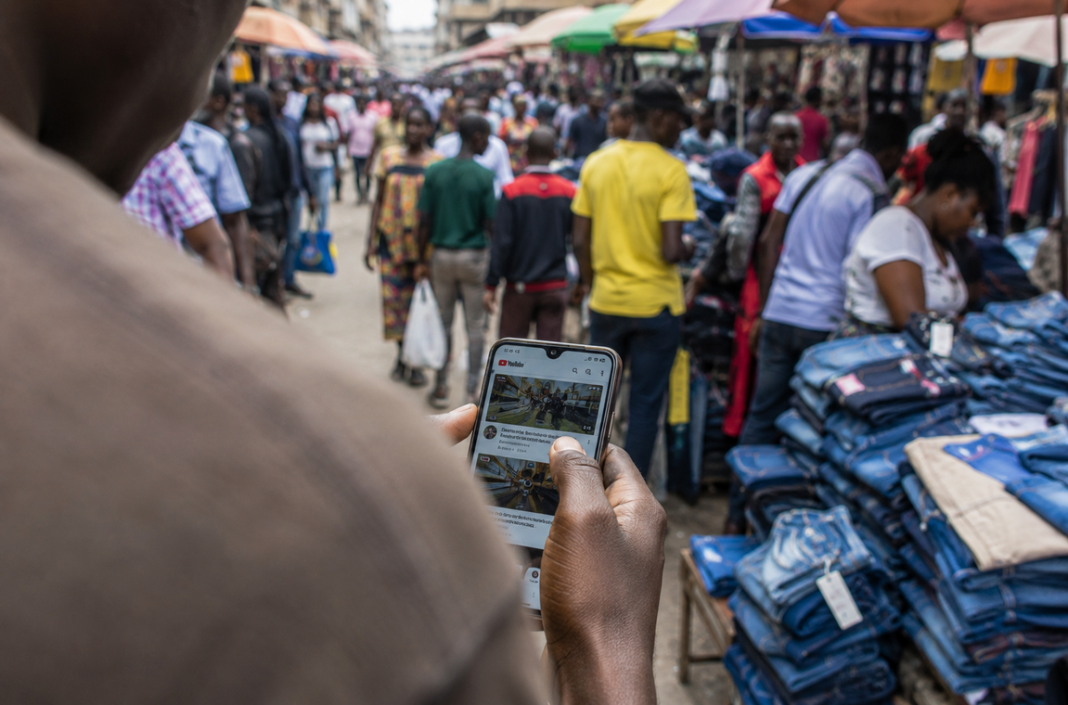
Deep inside the bustling corridors of Owino Market in downtown Kampala, 26-year-old Mawada Henry spends his days selling second-hand jeans.
Having left school after Senior Four, Henry says artificial intelligence is something he has heard people mention but never really understood.
“I thought AI was for white people,” he says with a smile. “I use WhatsApp, TikTok, YouTube and Google every day, but I didn’t know those things had anything to do with AI.”
One incident particularly stayed with him.
“I remember one of my customers talking on the phone and telling someone to use ChatGPT. I had never heard about it before.”
Although he may not recognize AI by name, Henry unknowingly interacts with it every day.
The videos YouTube recommends, the search results Google displays and even some of the content appearing on social media platforms are powered by recommendation systems driven by artificial intelligence.
Yet Henry remains unconvinced that AI has anything meaningful to offer his business.
“How can AI help me sell my second-hand jeans?” he asks. “It doesn’t make sense to me. I don’t like using things I don’t understand.”
His question reflects the thoughts of many ordinary Ugandans.
For someone trying to earn a living in a busy marketplace, artificial intelligence can feel distant and abstract.
But as smartphones become more common and digital services continue expanding across Uganda, the technology is gradually becoming part of everyday life—even for people who may never consciously decide to use it.
The challenge, perhaps, is no longer introducing AI to society.
It is helping people understand where it already exists, how it works and how it can improve their lives without replacing the human judgment that remains essential.
HEALTHCARE’S AI QUESTION: ASSISTANT, NOT REPLACEMENT
The healthcare sector is another area where artificial intelligence is slowly beginning to influence how people work.
At Ibulanku Health Centre III, Dr. Musamba Erisa has watched digital technology become increasingly important in healthcare over the years.
Although he admits he is not an AI specialist, he believes artificial intelligence is already helping health workers perform their duties more efficiently.
“To me, AI is something that helps us access information quickly,” he says. “In government health facilities, we use digital systems to keep patient records and prepare daily, weekly, monthly and annual reports. These systems help us retrieve information much faster than before.”
Dr. Musamba says his first encounter with AI dates back to 2013 when he acquired his first smartphone during his studies at Medical Laboratory Technology (MLT) in Jinja.
Through computer training and interactions with international consultants, he gradually became aware of how digital technologies were changing healthcare.
Even so, he believes AI should be viewed as an assistant rather than a replacement for medical professionals.
“ChatGPT can provide useful information,” he explains, “but when it comes to healthcare, it is still incomplete. Medical decisions should never depend entirely on AI.”
Instead, he sees the technology as having greater potential in supporting healthcare professionals.
“In areas such as analyzing laboratory results, interpreting X-rays and reducing human error, AI can become a very useful tool. It helps improve efficiency, but qualified health workers must still make the final decisions.”
Like many professionals, however, Dr. Musamba also worries about the future if people begin depending too heavily on machines.
“If AI starts replacing professional judgment, mistakes could happen. A patient could receive the wrong medication or incorrect advice. Technology should support healthcare workers—not replace them.”
His concerns reflect a debate taking place far beyond Uganda.
Around the world, governments, educators, employers and technology experts continue to ask the same questions.
How much should people rely on artificial intelligence?
Who should be responsible when AI makes mistakes?
How can innovation continue without compromising privacy, ethics or public trust?
While there are no simple answers, one thing is becoming increasingly clear.
Artificial intelligence is no longer a technology reserved for computer scientists.
It is becoming part of everyday life.
Students are using it to revise for examinations.
Business owners are experimenting with it to improve productivity.
Health workers are exploring how it can support patient care.
Market traders unknowingly interact with AI every time recommendation systems suggest videos, products or search results tailored to their interests.
And the technology itself continues to evolve.
THE FUTURE: LEARNING TO WORK WITH MACHINES
The next phase is already emerging through what experts call AI agents—systems capable of performing tasks, making decisions and completing entire workflows with minimal human supervision.
Although these developments may still sound futuristic to many Ugandans, they are steadily moving closer to everyday reality.
For Dr. Musamba, the future is not about choosing between humans and machines.
“AI is here to stay,” he says. “Whether we like it or not, it is becoming part of our lives. It helps reduce human errors, reminds us of important things and improves organization. The important thing is that people should learn how to use it properly.”
At the same time, he cautions that technological progress will also demand new skills.
“As machines become more capable, fewer people may be needed to perform certain tasks. Those who fail to adapt to new technologies could find themselves left behind.”
His words echo a concern shared by economists and technology experts worldwide: the future of work will belong not only to those who understand their professions, but also to those who understand how to work alongside technology.
As I thought back to my friend’s excitement after landing her new job, I realized her email represented far more than good writing.
It represented a quiet transformation already taking place across Uganda.
From university lecture rooms to busy hospital wards…
From downtown Owino Market to corporate offices in Kampala…
Artificial intelligence is gradually finding its way into people’s daily lives.
Some embrace it with confidence.
Others approach it with caution.
Many, like Henry, use it without even realizing it.
Whether drafting an email, searching for information, recommending the next video to watch or helping health workers analyze medical data, AI is steadily changing how people learn, work, communicate and solve problems.
The question is no longer whether artificial intelligence will shape Uganda’s future.
It already is.
The real challenge is ensuring that every Ugandan, from the university student and the doctor to the trader in Owino Market, understands not only what AI can do, but also how to use it responsibly.
Because in the end, artificial intelligence is not replacing humanity.
It is simply becoming another tool in human hands.
And like every powerful tool before it, its impact will depend on how wisely we choose to use it.