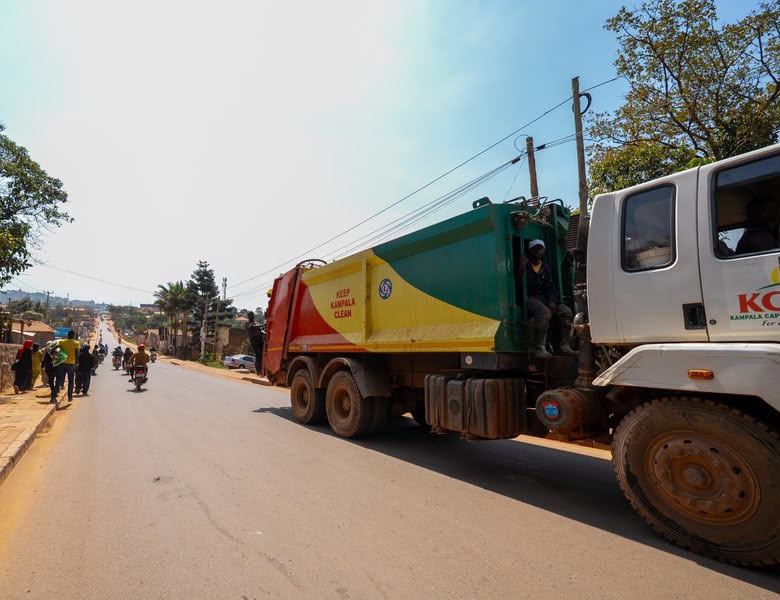

Kampala Capital City Authority (KCCA) is set to expand its garbage collection fleet by 10 trucks as the city prepares for the national cleaning day, amid efforts to tackle the estimated 2,000 to 2,500 tonnes of waste generated in Kampala every day.
KCCA Executive Director Sharifa Veki said government has provided funding to procure the additional trucks, bringing KCCA’s total garbage collection fleet to 116 vehicles with a combined capacity of more than 2,600 tonnes.
The additional trucks are expected to strengthen waste collection across Kampala’s five divisions, with each division expected to receive two additional trucks by the end of the 2026/27 financial year.
Veki said the investment is intended to improve the city’s ability to collect waste as KCCA prepares for the national cleaning day.
The authority has also contracted nine private waste collection companies, with each company assigned to one of Kampala’s nine constituencies. Together, the companies have a collection capacity of 1,669.5 tonnes per day.
When the private operators’ capacity is combined with the 500 tonnes KCCA expects to collect from common-user spaces, the city’s daily collection capacity is projected to reach 2,169.5 tonnes.
The expansion comes as KCCA prepares to mobilise residents for the national cleaning day, which will require households and businesses to actively participate in separating and presenting waste for collection.
Waste separation to drive cleaning exercise
Veki said the national cleaning day will use a “bring-to-track” model, under which residents will be required to separate waste into organic and inorganic categories before collection.
The system is intended to allow garbage trucks to collect waste directly, rather than having rubbish dumped on the ground before being loaded.
“This will ensure that waste is loaded directly onto the trucks and not dumped on the ground,” Veki said.
She warned residents against placing garbage along roads and verandas, stressing that such practices are illegal.
KCCA officials and leaders in the different city divisions will identify and agree on collection points where residents will take their waste during the exercise.
Inspection checklists will be used to monitor households and ensure that residents do not continue holding waste after collection points and schedules have been established.
KCCA warns against illegal garbage collectors
The authority has also warned residents against using unlicensed garbage collectors during the cleaning exercise.
Veki said bicycles, boda bodas and other vehicles that are not licensed by KCCA will not be permitted to collect garbage.
The measure is intended to ensure that waste collected during the national cleaning exercise is handled through authorised channels and does not end up being illegally dumped.
Routine waste collection charges will continue to apply to privately collected waste during the exercise.
Households in slum areas will pay Shs1,000 per 50-kilogramme bag, while other domestic households and commercial premises will pay Shs3,000 per 50-kilogramme bag. Schools, churches and hospitals will pay Shs40,000 per loading.
KCCA will remain responsible for waste generated from government common-user facilities, including public markets, taxi parks and health centres.
The additional garbage trucks are part of a broader government push to strengthen Kampala’s waste management system. Government has also allocated funds for phase one of a waste management and material recovery facility at Buyala in the 2026/27 financial year.
For KCCA, the national cleaning day will provide an early test of whether the expanded fleet and new collection arrangements can match Kampala’s growing waste volumes and improve the cleanliness of the capital.