
Mr President, your legacy is no longer going to be judged only by the roads built, the power generated, the schools constructed or the security that your Government has maintained over the decades. It will also be judged by the condition in which Uganda’s forests, wetlands, rivers, lakes and other natural resources are handed to the next generation.
That is why I believe it is time to have an uncomfortable but necessary conversation about Uganda’s environment.
In the nearly four decades in power, there are achievements that supporters can point to with pride, just as there are decisions and failures that critics will continue to question. But environmental degradation is different. It is a legacy that cuts across political parties, generations and governments.
Once a forest disappears, a wetland is filled, a river is polluted or
a natural drainage system is destroyed, restoring it can take decades — and in some cases may be impossible.
Mr. President, Uganda needs an Environment Recovery Fund (ERF), not necessarily another Government institution, but a properly capitalized and independently accountable mechanism capable of financing the restoration of eco-systems and resolving some of the land and property problems created by environmental enforcement.
The warning signs are already visible.
I grew up in Matale, near Kalisizo, in what is now Kyotera District. When I was young, there was a Government forest near Kalisizo town that local people knew as Namagoma. Today, that forest is largely gone. That is just one small example of a much bigger national story.
According to the National Forestry Authority’s current strategic plan, Uganda’s total forest cover fell from about 4.9 million hectares in 1990 to 2.6 million hectares in 2023, reducing forest cover from 24.1% to 12.6% of the country’s total land area. Forest cover on private land suffered an even sharper decline, falling from 16.25% in 1990 to 5.54% in 2023.
These are not merely environmental statistics. Forests regulate water, protect soils, support agriculture, absorb carbon, provide livelihoods and moderate local climates. Their destruction therefore eventually becomes an economic and social problem.
Wetlands tell a more complicated story. The National Environment Management Authority (NEMA), now reports that Uganda’s wetland coverage has recovered from about 8.9% in the early 2020s to 13.9% by 2025, following restoration and enforcement efforts. NEMA says thousands of wetlands have been gazetted and that restoration, boundary demarcation and enforcement are continuing. This is progress that should be acknowledged.
But recovery at the national level should not make us complacent about what is happening in individual communities, towns and wetlands. The National State of the Environment Report identifies wetland degradation, deforestation, land degradation, pollution, biodiversity loss, floods and droughts among Uganda’s continuing environmental challenges. Where are the guardians before destruction happens?
This is where I want to put difficult questions to the President.
At the local level, the Government has a chain of officials and institutions responsible for administration, security, planning and environmental management. District environment officers, local governments, Resident District Commissioners, security agencies, physical planners and other officials operate across the country.
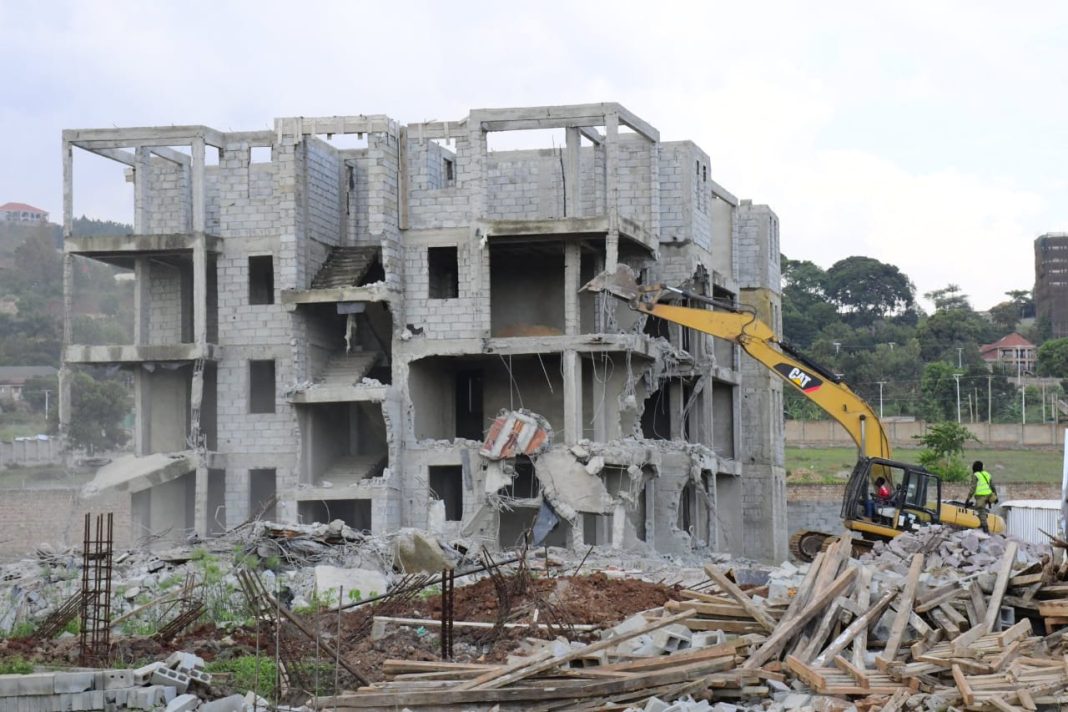
Yet how do illegal developments sometimes reach the point where millions of shillings have been invested before enforcement action begins? Why do authorities sometimes appear most visible after a wetland has been filled, a drainage channel blocked or a large structure constructed? Why is prevention not receiving the same attention as demolition?
NEMA says its mandate includes coordinating, monitoring, regulating and supervising activities relating to the environment, while local authorities and other lead agencies also have responsibilities under Uganda’s environmental laws. This raises an important governance question: if an illegal development can take months or, years to reach completion, where were the responsible authorities during its construction?
Punishment after destruction is necessary. Prevention is better. Demolition cannot become Uganda’s environmental policy. There is a legitimate argument for removing structures that have been illegally built in protected eco-systems. But demolition alone cannot constitute environmental management.
Consider the ordinary Ugandan who sells land, borrows money from a bank or relatives, obtains construction materials and spends years building a house or business premises, only to discover that the land falls within an environmentally protected area.
There are cases where the developer knowingly ignored the law. Such cases should be treated differently. But there can also be situations involving historical titles, conflicting Government maps, inadequate information, questionable land transactions, or failures by public institutions. NEMA makes an important clarification: it does not issue land titles; title issuance is the responsibility of the Ministry of Lands and related agencies.
That distinction matters. If one arm of Government allows, or fails to prevent a questionable transaction, while another later demolishes the resulting development, the citizen is left wondering where Government responsibility begins and ends.
This is precisely why Uganda needs a systematic recovery mechanism. The law already provides the foundation. The proposal for ERF is not completely new. Uganda’s National Environment Act already provides for a National Environment Fund (NEF). The law allows the fund to receive Government allocations, environmental levies, fees, administrative fines and other approved contributions. More importantly, the law expressly provides that the fund can support the management of sensitive and fragile eco-systems and critical environmental restoration activities.
The problem, therefore, is not necessarily the absence of a legal concept. The question is whether Uganda is giving that mechanism enough money, independence, visibility and operational focus to match the scale of the environmental crisis.
NEMA’s own 2025/26–2029/30 Strategic Plan estimates that implementation will require about Shs.295 billion, against Government appropriations of about Shs.270 billion, leaving a funding gap of approximately Shs.24 billion. If environmental restoration is a national priority, this gap deserves serious political attention.
Mr. President, turn NEF into a genuine recovery mechanism. I suggest that Government consider re-structuring and strengthening the existing NEF into an environment recovery fund, or create a dedicated recovery window within it.
The ERF would have several clear functions. First; ecosystem restoration.
Money should be available to restore degraded wetlands, forests, riverbanks, lake shores and other fragile ecosystems.
Second; prevention. Districts and municipalities should have access to funding for mapping, boundary demarcation, environmental monitoring and early intervention before illegal developments become permanent.
Third; environmental information. Every district should have accurate, publicly accessible maps showing protected wetlands, forest reserves, river buffers and other environmentally sensitive areas.