
By Robinah Alice Namuwaya
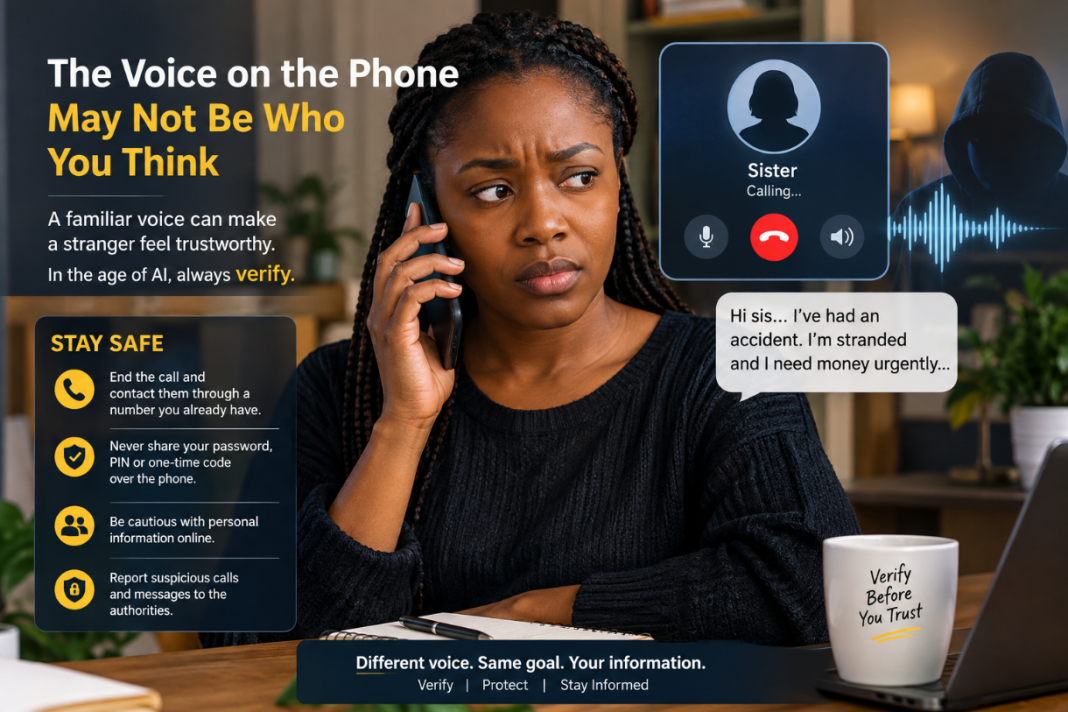
A familiar voice can make a stranger feel trustworthy.
That is exactly what artificial intelligence is beginning to exploit.
Imagine receiving a call from someone who sounds exactly like your sister. They know your name. They know where you work. They know something about your family. Then comes the emergency: there has been an accident, they are stranded somewhere, or they urgently need money.
The voice sounds right. The story sounds plausible.
But the person speaking may not be your sister at all.
Artificial intelligence (AI) can now generate synthetic speech that imitates a real person’s voice from recordings. The technology has legitimate uses, including accessibility and entertainment. In the hands of cybercriminals, however, it can become another weapon for impersonation.
Cybercriminals are people who use computers, phones, networks or digital services to steal money, information or access, or to deceive and harm others. They do not always need to break into a computer. Sometimes, they attack something much more human: our judgement.
That is what makes AI-assisted voice scams different.
The danger is not simply that someone can create a fake voice. It is that the voice can be combined with information gathered from social media, messaging platforms and other public sources to make a deception feel personal.
This is an old crime with a more convincing disguise.
Uganda is already familiar with phone-based deception. The Uganda Communications Commission (UCC) has warned consumers about vishing, in which criminals use phone calls to deceive victims, and smishing, which uses fraudulent text messages to obtain information or trigger unsafe actions. It also advises people to limit personal information shared online and strengthen authentication on sensitive accounts.
AI does not replace these scams.
It makes them harder to doubt.
For years, people have been told to watch for unfamiliar numbers, suspicious links, poor spelling, strange messages and unusual requests. Those precautions still matter.
But what happens when the caller has the right voice, knows your name and speaks with the confidence of someone you already trust?
That is where the cybersecurity conversation needs to change.
The safest response may no longer be learning how to identify whether a voice sounds artificial. For an ordinary person, that can be extremely difficult. Instead, the important skill is verification.
If someone who sounds like a relative calls asking for money, end the call and contact them through a number already saved on your phone.
If a colleague makes an urgent payment request, confirm it through an established workplace channel.
If anyone asks for a password, PIN or one-time code over the phone, stop and verify.
A familiar voice should no longer be treated as proof of identity.
This matters beyond individual phone calls. Africa’s digital economy increasingly depends on mobile phones for money, banking, business, employment, social media and public services. INTERPOL’s 2026 African Cyberthreat Assessment says AI is linked to 55 per cent of reported cybercrime across the surveyed African countries, making attacks faster, more scalable and harder to detect. The assessment also identifies AI-enabled social engineering among the continent’s evolving threats.
In other words, the technology is changing faster than the warning signs people have traditionally relied on.
Uganda is already strengthening its wider cybersecurity systems. In July 2026, the National Information Technology Authority-Uganda (NITA-U) launched the updated National Information Security Framework (NISF) 2026, which strengthens cybersecurity governance, security assessments, baseline controls and institutional resilience. The framework reflects a broader recognition that information security is no longer simply an ICT concern but also a matter of public trust and national development.
But synthetic-media fraud introduces another challenge.
If a victim receives an AI-assisted impersonation call, where should the incident be reported? How quickly can evidence be preserved? Can investigators establish whether an audio recording is genuine or synthetic? Do investigators and service providers have the tools and skills needed to trace such activity?
INTERPOL’s 2026 assessment points to the same capacity problem across Africa, calling for stronger digital-forensic capabilities, AI literacy for law-enforcement officers, cross-border cooperation and public-private partnerships.
The issue, therefore, is bigger than teaching Ugandans that criminals can clone voices.
It is about what we use as proof of identity in a digital society.
A voice can tell us who we believe is speaking. It should not, by itself, authorise a financial transaction, reveal a password or prove that an urgent request is genuine.
That may sound like a small behavioural change. But when a phone call can trigger a mobile-money transfer, expose personal information or provide access to an account, verification becomes a cybersecurity control.
The deeper lesson is uncomfortable: artificial intelligence is changing digital trust.
Yesterday, people worried about forged messages and edited photographs. Today, text, images, audio and video can all be manipulated. Tomorrow, proving that something is genuine may become as important as recognising that it is fake.
For Uganda, the challenge is therefore not simply to warn people about cloned voices.
It is to build a system in which citizens can verify high-risk requests, report suspected synthetic-media fraud and receive help quickly when deception occurs.
The question is no longer whether the voice on the phone sounds familiar.
It is whether we have a reliable way to prove who is really speaking.