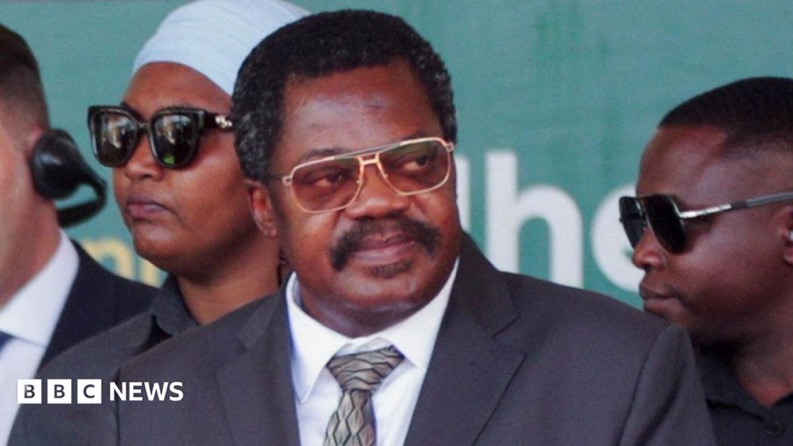

Tanzania’s Vice-President Emmanuel John Nchimbi has resigned from office and announced his retirement from politics and public service, ending a tenure of less than a year and opening an unexpected new chapter in President Samia Suluhu Hassan’s administration.
Nchimbi announced his decision on Tuesday, August 25, 2026, in a letter addressed to President Hassan and shared publicly on his Instagram account. His resignation will take effect on September 4.
The 54-year-old vice-president said he had decided to step down after becoming convinced that President Hassan wanted a change in the country’s second-highest office.
“I am fully satisfied, without any doubt, that Her Excellency the President desires change, and thus I have decided to fulfil my promise,” Nchimbi said in his resignation notice.
Nchimbi said he had promised Hassan in August 2025 that he would serve faithfully and voluntarily give way if she decided she needed another vice-president.
He thanked Hassan, the ruling Chama Cha Mapinduzi (CCM) party and Tanzanians for the confidence and support extended to him during his public-service career.
“I will continue to be a good citizen of Tanzania,” he said, signalling his withdrawal from active politics rather than a move to another government position.
A historic departure
Nchimbi’s resignation is highly unusual in Tanzania’s political history. The EastAfrican reported that he is the first Tanzanian vice-president to voluntarily relinquish the office while still serving.
He was sworn in as vice-president on November 3, 2025, alongside Hassan after she began her second term. Tanzania’s constitutional framework provides for the vice-president to serve for five years unless the office becomes vacant earlier through circumstances including resignation. It also requires the president to appoint a replacement within 14 days after the office becomes vacant, subject to confirmation by the National Assembly.
That means Hassan is now expected to nominate a successor, with Parliament required to confirm the appointment.
The timing of Nchimbi’s departure is likely to intensify questions about the relationship between the president and her deputy. For months, media reports and political speculation had suggested that Nchimbi had been increasingly sidelined from some high-profile government activities. Those reports had not been officially confirmed, but his resignation has brought renewed attention to the speculation.
Nchimbi himself did not accuse Hassan of wrongdoing or disclose a specific disagreement. Instead, his explanation was framed around his previous commitment to leave whenever the president wanted a different deputy.
Resignation follows turbulent political period
The departure also comes less than a year after Tanzania’s disputed 2025 presidential election, which returned Hassan to power with nearly 98% of the vote.
The election was followed by deadly unrest and intense criticism from opposition groups and rights organisations over the government’s handling of demonstrations. A government-appointed commission later reported that at least 518 people were killed during violence surrounding the October 2025 elections.
The commission’s findings have remained controversial, with opposition groups challenging its credibility and disputing the government’s account of responsibility for the violence.
Hassan’s government has faced continuing scrutiny over political freedoms and the treatment of opposition figures since the election, making any major change within the top leadership politically significant.
From CCM leadership to State House
Nchimbi’s rise to the vice-presidency followed a long career inside CCM and the Tanzanian government.
Before becoming vice-president, he served as CCM secretary-general and held several ministerial positions, including minister of home affairs and minister of information, culture and sports. He also served as Tanzania’s ambassador to Egypt.
His elevation to the vice-presidency came after he was selected as Hassan’s running mate for the 2025 presidential election.
His resignation therefore removes from government one of CCM’s experienced political figures at a time when the administration is still dealing with the political consequences of the 2025 election.
For Hassan, the immediate task will be to select a new deputy capable of helping consolidate the administration after a politically turbulent first year of her second term.
For Nchimbi, however, the message is clear: he says he is leaving both the vice-presidency and active politics, choosing instead to remain, in his own words, a citizen of Tanzania.