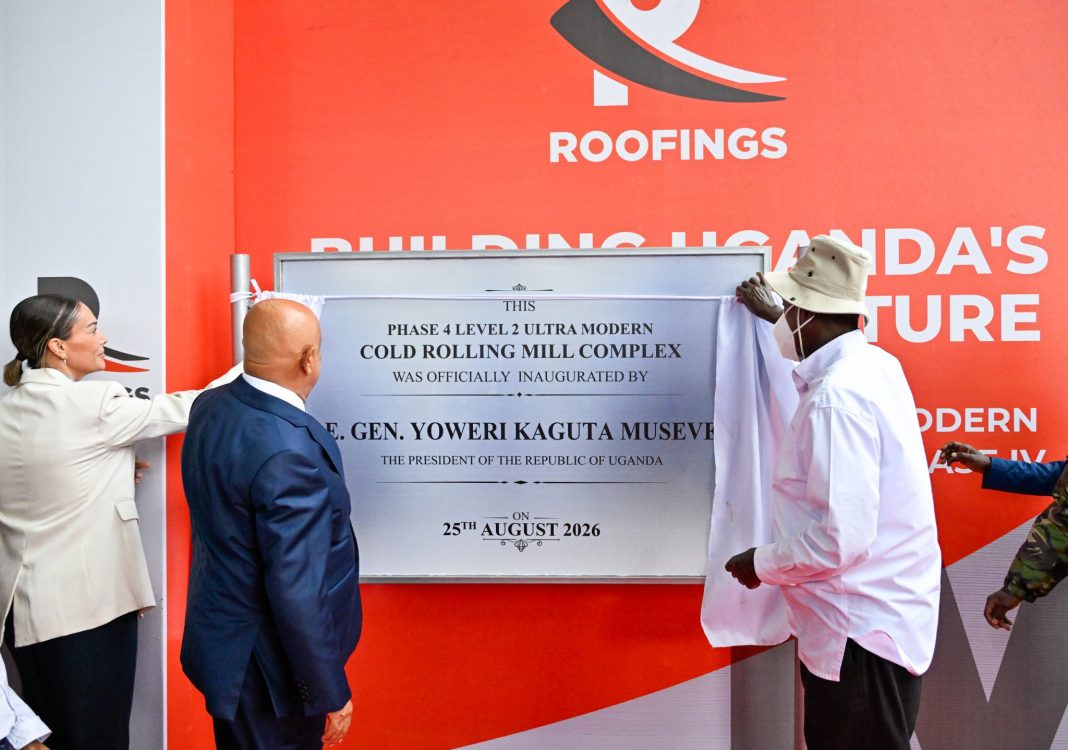

President Yoweri Kaguta Museveni has inaugurated Roofings Group’s new $125 million Ultra-Modern Cold Rolling Mill Complex in Namanve, describing the investment as an important contribution to Uganda’s industrialisation and import-substitution drive.
The Phase IV facility, which represents the largest expansion in Roofings Group’s more than 30-year history, has an annual production capacity of 300,000 metric tonnes of steel.
The plant features Level Two automation and advanced equipment for cold rolling, galvanising and colour coating, enabling Roofings to manufacture a wider range of higher-value steel products for Uganda and regional markets.
Museveni, who commissioned the facility at the company’s Namanve factory, commended Roofings Group Chairman Dr. Sikander Lalani and the company for investing in domestic manufacturing.
The President said Roofings has become a significant contributor to Uganda’s economy, with an annual turnover of approximately Shs1.2 trillion and more than 2,000 Ugandans employed.
Museveni targets East African trade barriers
Museveni also used the occasion to renew his commitment to removing barriers that restrict trade within the East African Community.
He said he would continue engaging his counterparts in the region to address obstacles preventing East Africans from freely trading and doing business across borders.
The issue is particularly important for manufacturers making large capital investments in production capacity.
A bigger regional market allows companies to spread production costs across several countries while increasing opportunities for exports, employment and industrial investment.
Uganda has repeatedly called for the removal of non-tariff barriers that restrict the movement of goods within the EAC, including delays at borders and restrictions affecting regional trade.
New steel capacity
Roofings says the new facility will manufacture high-quality steel products designed to last for up to 30 years, targeting construction and other industrial applications across East Africa.
The plant’s production chain includes cold rolling, galvanising and colour coating, allowing the company to undertake more value addition locally.
Cold rolling improves the strength, surface finish and dimensional accuracy of steel, while galvanising protects steel against corrosion. Colour coating provides an additional protective and decorative layer for products used in construction and other applications.
The investment consequently gives Roofings greater capacity to manufacture finished and semi-finished steel products within Uganda instead of relying heavily on imported products.
Building Uganda’s industrial base
The expansion comes as Uganda seeks to transform its economy from dependence on raw commodity exports towards manufacturing and value addition.
The steel industry is particularly important because steel is an essential input in construction, infrastructure, manufacturing, energy and other sectors.
Government has increasingly promoted domestic production as a way of reducing import dependence, retaining more value within the economy and creating industrial jobs.
Roofings has been one of the country’s major private-sector investors in the steel industry, with its manufacturing operations expanding over several decades.
The company’s Namanve complex has progressively added production capabilities, including hot rolling, cold rolling and galvanising.
The latest investment takes that expansion further by increasing production capacity and introducing more advanced manufacturing technology.
Regional export ambitions
Roofings says the new plant will serve markets across East Africa, positioning Uganda as a potential manufacturing and distribution hub for steel products.
The ambition aligns with the government’s push to increase Ugandan exports and take advantage of the EAC’s regional market.
However, manufacturers continue to face challenges including high production costs, access to raw materials, infrastructure constraints and non-tariff barriers.
For Uganda’s industrialisation strategy to deliver its full potential, the expansion of production capacity will therefore need to be matched by stronger regional market access.
The commissioning of Roofings’ $125 million plant marks a significant addition to Uganda’s industrial capacity, but its long-term impact will ultimately depend on how effectively the country connects new manufacturing capacity with domestic demand, regional markets and local raw-material supply chains.