
Uganda and Tanzania have taken another major step towards advancing East African Community (EAC) integration after signing a landmark agreement to jointly develop the Tanga Regional Energy Hub, a project expected to strengthen cross-border trade, regional energy security and industrial development across East and Central Africa.
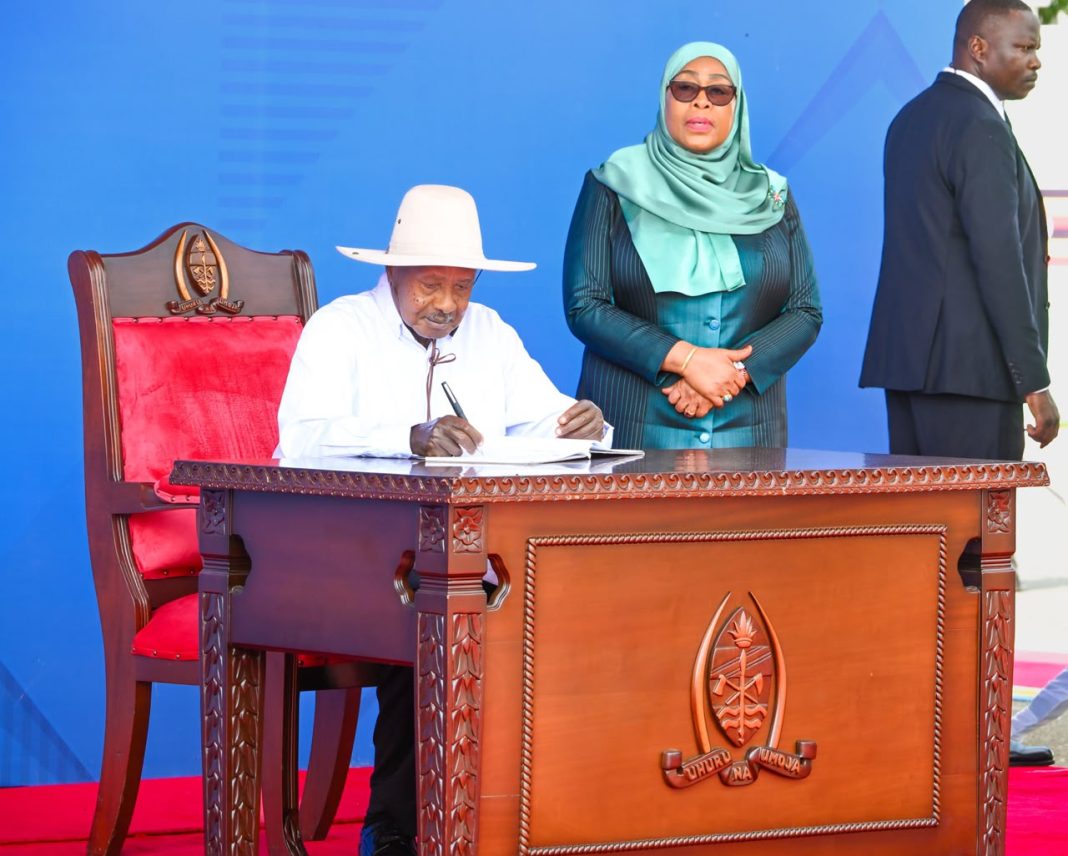
The agreement, witnessed by President Yoweri Kaguta Museveni and Tanzanian President Dr. Samia Suluhu Hassan during Museveni’s two-day working visit to Tanzania, brings together the Uganda National Oil Company (UNOC), Tanzania Petroleum Development Corporation (TPDC) and Vitol Bahrain E.C. to accelerate regional petroleum infrastructure and unlock new trade opportunities.
The new partnership builds on the East African Crude Oil Pipeline (EACOP), shifting regional cooperation beyond crude oil transportation towards petroleum storage, refining, logistics, trading and distribution. The project will complement Uganda’s Hoima refinery while positioning Tanzania’s Port of Tanga as a strategic gateway for petroleum products destined for markets across East and Central Africa.
The development is widely seen as another milestone in the EAC’s long-standing ambition of promoting regional integration through shared infrastructure that reduces the cost of doing business, facilitates trade and improves the movement of strategic commodities across member states.
Speaking during the signing ceremony, Uganda’s Minister of Energy and Mineral Development, Dr. Monica Musenero, described the partnership as a practical demonstration of regional cooperation, saying the agreement reflects the shared vision of Uganda and Tanzania to build prosperity through stronger economic ties.
She said the projects are designed not only to improve infrastructure but also to stimulate industrialisation, create employment opportunities and strengthen logistics networks that support regional commerce.
Dr. Musenero also revealed that feasibility studies for a refined petroleum products pipeline and storage terminal are progressing well, while studies for a proposed natural gas pipeline between Uganda and Tanzania are expected to conclude by October 2026. In addition, she confirmed progress on the Uganda–Tanzania 400kV electricity interconnector, supported by US$250 million in financing for Uganda’s section, which is expected to increase electricity trade within the Eastern Africa Power Pool and improve regional power connectivity.
Tanzania’s Minister of Energy, Hon. Deo Ndejembi, described the agreement as the next chapter in Uganda and Tanzania’s energy cooperation, saying the countries are now moving from transporting crude oil to building an integrated regional energy economy.
He said the proposed Tanga Regional Energy Hub could attract investments exceeding US$20 billion while creating a competitive petroleum market capable of serving multiple countries across the region. He added that the planned bidirectional petroleum products pipeline will allow refined fuels to move efficiently between Uganda and Tanzania based on market demand, expanding export opportunities and strengthening energy security.
Regional Integration Through Infrastructure
The latest agreement illustrates how infrastructure is increasingly becoming the backbone of East African integration. Rather than developing isolated national projects, Uganda and Tanzania are investing in interconnected energy systems that support regional value chains, lower transport costs and improve the competitiveness of East African products.
The partnership also signals growing confidence in regional cooperation following the successful implementation of EACOP. By linking oil infrastructure, electricity transmission and future natural gas networks, the two countries are laying the foundation for a more integrated regional market capable of attracting large-scale investment and supporting industrial growth beyond national borders.
As the East African Community continues pursuing deeper economic integration, the Uganda-Tanzania partnership demonstrates how cross-border infrastructure can translate regional commitments into practical investments that boost trade, create jobs and strengthen economic resilience across the bloc.