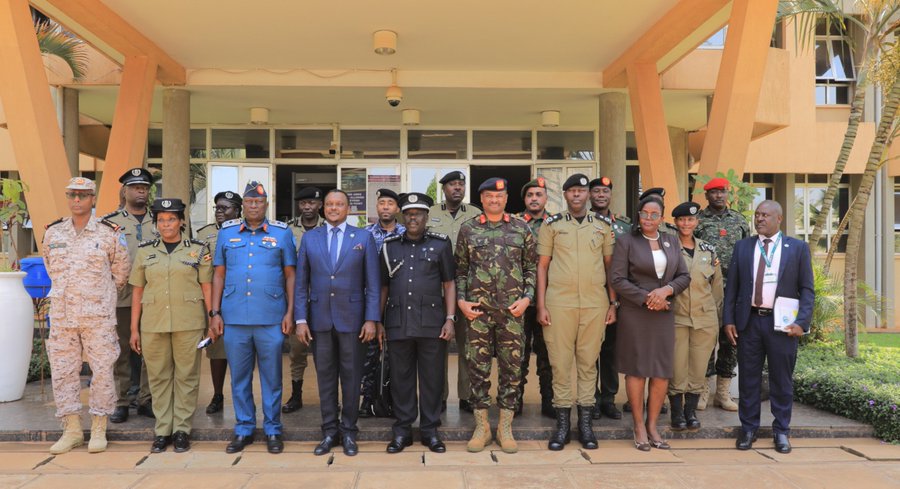

Uganda’s police force is positioning itself for a larger role in regional peace operations as the Eastern Africa Standby Force assesses the capabilities the country has pledged for possible future deployments.
The visit by a delegation from the Eastern Africa Standby Force (EASF) to Uganda is more than a routine verification exercise. It offers a window into how countries in the region are preparing their security institutions to respond to crises that increasingly cross national borders.
The delegation, led by Brig. Gen. Ronald Rwivanga, was received by Uganda’s Deputy Inspector General of Police, James Ocaya, who reaffirmed the Uganda Police Force’s readiness to contribute personnel to regional peace support operations.
Ocaya’s emphasis on preparedness is significant. Peacekeeping missions depend not only on the availability of personnel, but also on whether those personnel are adequately trained, equipped and able to operate within international legal and humanitarian standards.

According to the police, all personnel earmarked for deployment have completed mandatory pre-deployment training, including instruction in International Humanitarian Law and International Human Rights Law.
That emphasis reflects one of the central challenges facing regional peace operations: maintaining public confidence while security forces operate in politically and militarily complex environments. Training in humanitarian and human rights law is therefore not simply a procedural requirement. It is part of the credibility that regional peacekeeping institutions must establish among the populations they are expected to protect.
For Uganda, the EASF assessment also reinforces its long-standing ambition to remain an important security actor in East Africa. The country has contributed security personnel to regional and international operations, giving its forces experience in operating beyond Uganda’s borders.
But regional influence brings scrutiny. A pledge of troops or police officers to a standby force is ultimately meaningful only if the personnel can be deployed rapidly and perform effectively when a crisis emerges. Verification exercises such as the one now taking place in Uganda are intended to establish whether those commitments exist beyond official declarations.
The broader significance lies in the changing security landscape of eastern Africa. Conflicts, political instability, terrorism and humanitarian emergencies have repeatedly tested the capacity of regional organisations to respond collectively. The effectiveness of mechanisms such as the EASF depends heavily on whether member states can translate political commitments into deployable capabilities.
Uganda’s message to the EASF is therefore straightforward: its police personnel are trained, prepared and available to support regional peace operations when required.
The more difficult test, however, will come when that readiness is put into practice. For regional peacekeeping to command legitimacy, preparedness must be matched by professionalism, respect for civilian populations, accountability and clear mandates.
The EASF verification process provides an opportunity to test precisely those commitments. For Uganda, it is also a chance to demonstrate that its contribution to regional security is not measured only by the number of personnel it can provide, but by the quality and credibility of the force it sends.