
Minister says National Enterprise Corporation only held discussions with Russian firm Global Security, as Parliament probes the digital number plate project
Uganda’s Defence Minister, Kiryowa Kiwanuka, has told Parliament that the National Enterprise Corporation (NEC) has never been involved in implementing or operating the Intelligent Transport Monitoring System (ITMS), amid an ongoing inquiry into the country’s controversial digital number plate project.
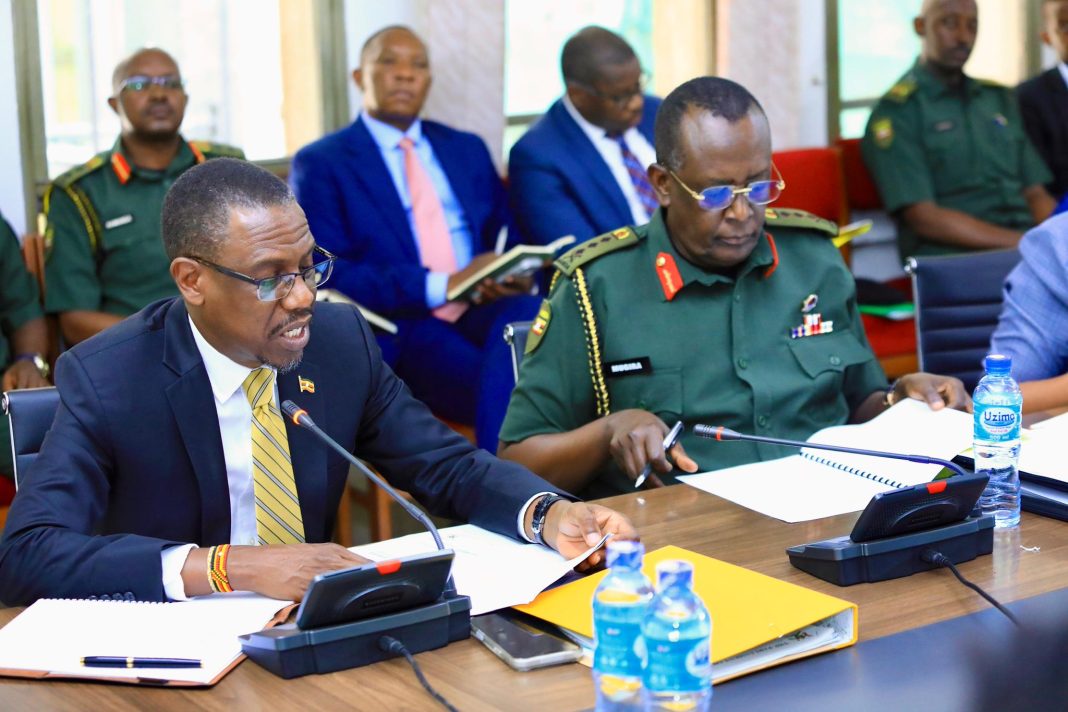
Kiwanuka made the clarification before Parliament’s Committee on Physical Infrastructure while appearing alongside NEC officials led by Managing Director Gen. James Mugira.
The committee is examining the contractual arrangements, financing, implementation and security aspects of Uganda’s digital number plate project, including the role played by NEC and its dealings with Russia-based Joint Stock Company Global Security.
The minister told MPs that NEC had not implemented or operated the ITMS, drawing a distinction between discussions and the actual execution of the system.
The clarification comes as lawmakers scrutinise how the digital number plate project was structured, financed and implemented, as well as the responsibilities assigned to the various government agencies and private partners.
NEC relies on joint ventures
Kiwanuka separately told Parliament’s Committee on Defence and Internal Affairs that NEC has increasingly turned to joint ventures to finance its commercial operations because of limited government funding.
He said the UPDF’s commercial arm has received only about Shs2 billion annually from government over the past 15 years, largely to meet salaries and operational expenses.
As a result, NEC has relied on private-sector and other joint-venture partners to provide capital for factories, equipment, technology and day-to-day operations.
Under the arrangements, NEC contributes assets such as land, infrastructure and other institutional support, while its partners provide much of the financing and technical capacity.
According to Kiwanuka, the model has enabled NEC to generate more than Shs27.6 billion in dividends, which have subsequently been reinvested in productive projects.
Dividends reinvested in projects
Among the projects cited by the minister are an oil-waste management project in Kyangwali, a new production line at NEC Uzima and a masks manufacturing factory.
The minister said the commercial strategy was intended to enable NEC to remain productive despite limited direct government financing.
The disclosures come as Parliament continues to examine the operations of NEC and its commercial partnerships, alongside the separate inquiry into the digital number plate project.
The ITMS project has attracted particular parliamentary scrutiny because of its links to road traffic monitoring, vehicle identification and national security.
Kiwanuka and the NEC team later appeared before the Committee on Defence and Internal Affairs to brief MPs on the corporation’s broader operations and financial model.
The minister said NEC’s reliance on joint ventures should be understood against the backdrop of its limited annual government allocation and the need to mobilise additional capital to sustain its commercial activities.