
How Invisible Algorithms Quietly Shape Everyday Life
By Robinah Alice Namuwaya
Suzana Kateregga, popularly known as Suzie on TikTok, has learned that success on social media can be strangely unpredictable.
Sometimes she carefully plans a video, records it several times, edits every detail, adds the right music and uploads what she believes is her best work.
Then almost nobody sees it.
Another day, she casually records an ordinary moment, uploads it without much thought and wakes up to hundreds of views.
The difference leaves her puzzled.
“Sometimes I post what I think is my best video and it reaches only about 50 people,” she says. “Then another simple video suddenly reaches over 500 views and more. That’s when you realize you’re not the only one deciding who sees your content, and what content should go high and be pushed.”
She pauses before laughing.
“Sometimes these social media platforms even ask me to choose the categories of things I want to watch like sports, comedy or food. But honestly, I don’t know how all that works. My concern is why I think this is my best video, but it doesn’t perform as well as the simple one. I really wonder what people like sometimes.”
Suzie’s experience raises a question millions of people rarely stop to ask.
Who actually decides what appears on our phones?
Every day, Ugandans unlock their smartphones expecting to catch up with the latest news, watch videos, search for information or chat with friends. Yet long before anyone taps the first video or types the first search, invisible computer systems have already begun making decisions about what is likely to appear on the screen.
Those systems are called algorithms.
Although the word often sounds technical, an algorithm is simply a set of step-by-step instructions that tells a computer how to perform a task or solve a problem.
Think about preparing a favourite meal.
A recipe tells someone what ingredients to use, what should happen first, what comes next and when the food is ready. If the steps are followed correctly, the result is predictable.
An algorithm works in much the same way.
Instead of preparing food, however, it processes information.
Algorithms have existed for decades and quietly power many of the digital services people depend on every day.
When someone enters a PIN at an ATM, an algorithm checks whether the numbers match the account before allowing access.
When Google Maps suggests avoiding traffic along Jinja Road and recommends another route, another algorithm has compared thousands of possible roads to identify the quickest journey.
Banks use algorithms to detect suspicious transactions.
Email services use them to separate genuine messages from spam.
Mobile money platforms rely on them to verify transactions within seconds.
Most people never notice these systems because they simply complete their tasks and move on.
But there is one type of algorithm that has become far more personal than the rest.
The recommendation algorithm.
Unlike an ATM algorithm, which only answers the question “Is this PIN correct?“, recommendation algorithms ask something entirely different.
“What is this person most likely to want next?”
Imagine walking into a neighbourhood supermarket where the shopkeeper already knows the soda you usually buy, the bread you prefer and even your favourite brand of soap.
Without asking, the shopkeeper places those products in front of you.
Not because you requested them.
Because years of serving you have revealed your habits.
Recommendation algorithms behave in a remarkably similar way.
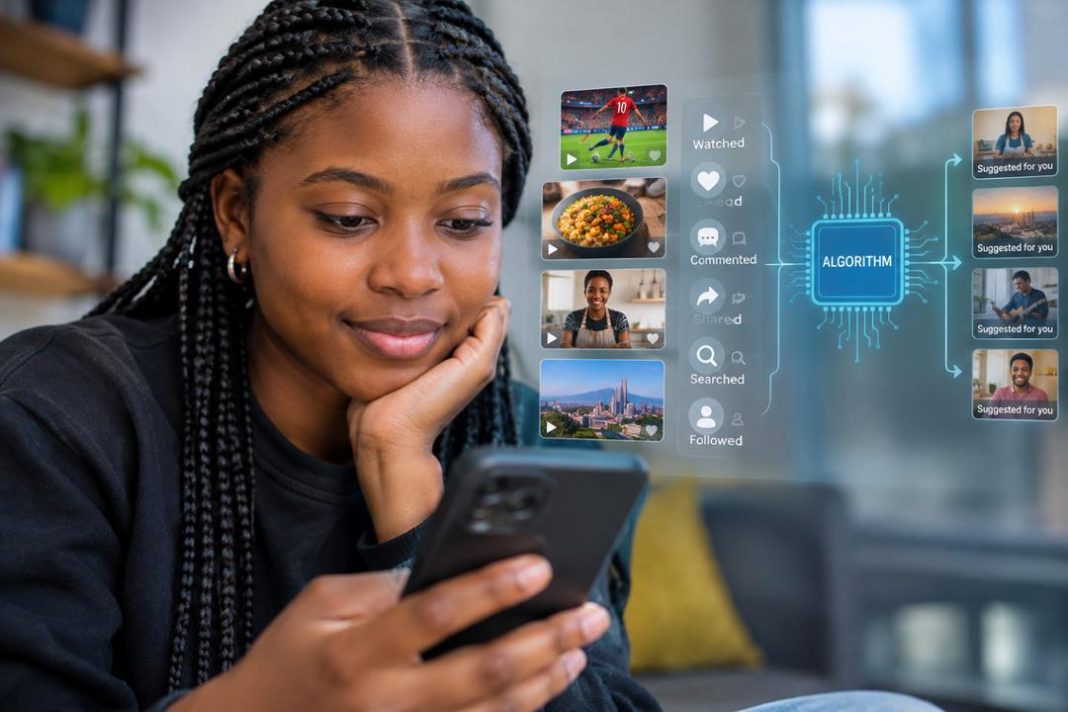
Every video watched.
Every story opened.
Every song skipped.
Every product searched.
Every post liked.
Every comment shared.
Each action leaves behind a tiny digital clue.
Over time, computers begin recognising patterns in those clues and predicting what is most likely to keep someone’s attention.
The phone does not actually know its owner.
It knows the owner’s habits.
That is why two friends sitting side by side can open TikTok at exactly the same moment and see completely different videos.
One may immediately find football highlights.
Another sees cooking tutorials.
Someone else receives business advice, while another is welcomed by comedy skits from Kampala creators.
They are using the same application.
But they are not experiencing the same internet.
Each person is seeing a version quietly personalised by recommendation algorithms.
The influence of these invisible systems stretches far beyond entertainment.
A university student searching for revision materials soon begins receiving more educational content.
A market vendor interested in business ideas notices entrepreneurial videos appearing more frequently.
A musician hopes streaming platforms recommend a newly released song to listeners who have never heard it before.
A journalist publishing an investigative story waits to see whether social media platforms decide to place it before thousands of readers—or quietly leave it unseen.
For businesses, creators and media organisations alike, visibility is no longer determined only by the quality of content.
Increasingly, it also depends on whether algorithms believe that content deserves a wider audience.
This is why many content creators now speak about “working with the algorithm.”
Not because they fully understand it.
But because they know it exists.
Suzie is one of them.
Like thousands of creators, she has learned that producing excellent content alone does not guarantee people will see it.
Some videos flourish unexpectedly.
Others disappear almost unnoticed.
The mystery is not always whether people liked the content.
Sometimes the bigger question is whether enough people were shown the opportunity to like it in the first place.
Technology experts often explain that recommendation algorithms are designed to maximise engagement rather than manipulate opinions. Their purpose is to predict what users are most likely to find interesting based on previous behaviour.
In many ways, they improve daily life.
They help people discover educational resources, connect with communities, find local businesses, enjoy music they may never have searched for and explore ideas matching their interests.
Yet they also remind us that convenience comes with responsibility.
If people only consume information similar to what they have previously watched or agreed with, they may unknowingly encounter fewer alternative perspectives.
That is why digital literacy today is no longer only about knowing how to use a smartphone.
It is also about understanding how smartphones quietly use information about us.
As Uganda continues embracing digital technologies, conversations about the future should not focus only on faster internet, better smartphones or the latest artificial intelligence tools.
They should also include the invisible systems already shaping everyday experiences.
Most people may never see an algorithm.
They will never touch one.
They will probably never write one.
Yet every day they interact with dozens of them without even noticing.
Long before someone watches the next video…
Reads the next headline…
Searches for the next answer…
Or buys the next product…
An invisible algorithm has already begun making predictions.
Perhaps the real question is no longer whether algorithms influence our digital lives.
They already do.
The more important question is whether we understand enough about them to make informed choices in the world they are quietly helping shape.
Because long before people learn how algorithms work…
Algorithms have already begun learning about them.