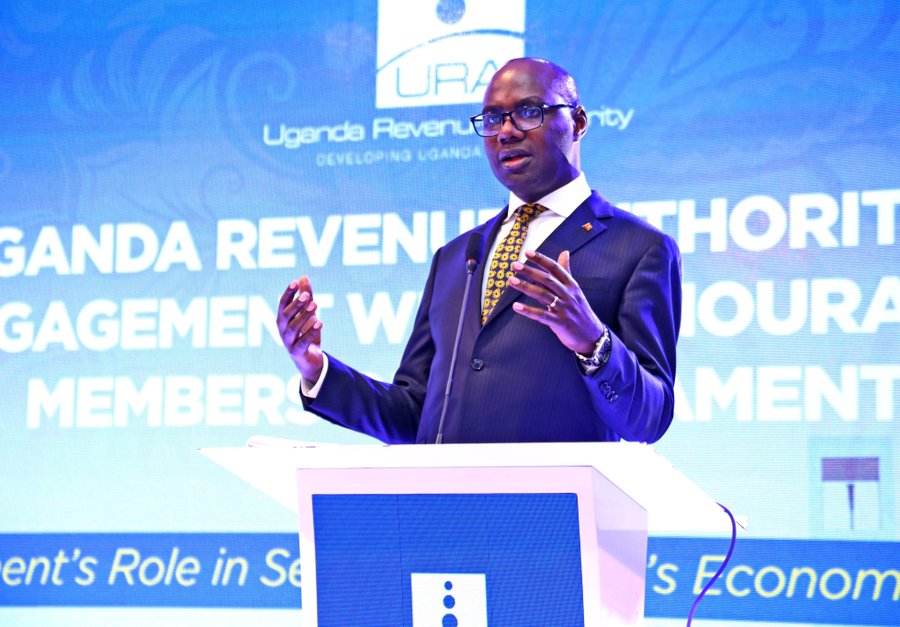

Uganda aims to raise its revenue-to-GDP ratio to 20% by the 2029/30 financial year by bringing more economic activity into the tax system rather than relying on higher tax rates, Finance Minister Henry Musasizi said on Wednesday.
Musasizi urged lawmakers to support measures to broaden the tax base as the government seeks to increase domestic revenue, reduce reliance on borrowing and strengthen fiscal self-reliance.
“The answer cannot simply be higher tax rates. We cannot achieve 20% by continuously taxing the same people more,” Musasizi said during a Uganda Revenue Authority (URA) engagement with parliamentary committees in Kampala.
He said the government would focus on economic growth, formalisation, improved tax compliance, better administration of existing taxes, taxation of emerging economic activities and reducing revenue leakages.
Uganda’s revenue-to-GDP ratio is currently about 14.7%, according to the government.
Musasizi linked the revenue drive to President Yoweri Museveni’s ambition of building a $500 billion economy under the government’s Tenfold Growth Strategy, saying the country could not continue financing development through borrowing.
URA Commissioner General John Rujoki Musinguzi said changes in Uganda’s economy were creating new challenges for tax collection, including widespread informality, the growth of the digital economy, cross-border businesses, offshore income, fragmented government data and illicit trade.
He said the extractive sector would also require specialised tax capabilities as activity in the sector expands.
URA plans to map and register priority sectors, strengthen taxpayer education and compliance and use risk-based enforcement, Musinguzi said.
He also called for greater information sharing between government institutions to help identify taxable economic activity.
Parliament’s Finance Committee Chairperson Maximus Ochai said lawmakers needed more time to scrutinise proposed tax measures before the start of each financial year.
Ochai said the process for developing tax policy should be reviewed so that MPs, particularly members of the Finance Committee, could begin examining proposed measures by the end of December.
“With those proposals, we would wish to have the standard reports that inform the greatest tax measures,” Ochai said.
The government is seeking to increase domestic revenue as it finances public services and development while trying to contain its dependence on borrowing.