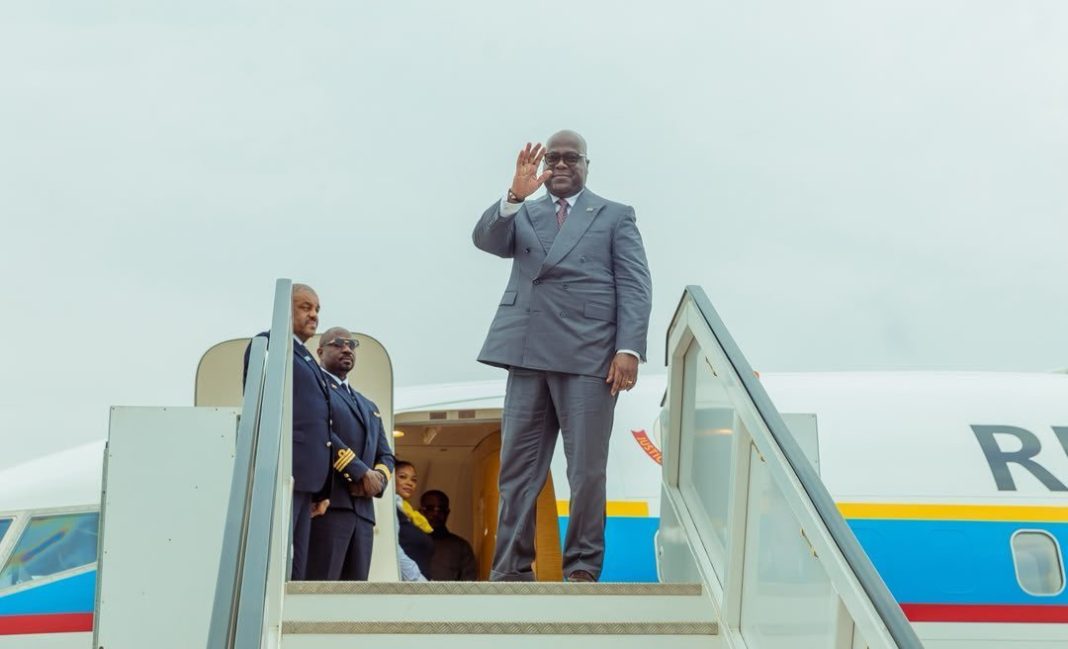

Democratic Republic of Congo President Félix Tshisekedi will not travel to New York for this week’s United Nations General Assembly, with Prime Minister Judith Suminwa appointed to represent the country, amid reports that the United States has denied the president a visa because of Ebola-related travel restrictions.
The Congolese presidency has not publicly confirmed that the U.S. denied Tshisekedi a visa. But local reports say the president will stay out of the United States while Suminwa leads the Congolese delegation to the high-level UN meetings, which run from Sept. 22 to 28.
The United States has imposed Ebola-related travel measures affecting people coming from the DRC. In May, the State Department said it had temporarily suspended visa services at its embassy in Kinshasa, citing the ongoing Ebola outbreak.
Washington has also introduced restrictions preventing travellers who have been in the DRC within the previous 21 days from boarding commercial flights to the United States, as part of measures aimed at reducing the risk of importing Ebola.
The measures come as the DRC faces a significant outbreak of Bundibugyo virus disease, a form of Ebola. The World Health Organisation reported 6,757 confirmed cases and 3,267 deaths in the DRC as of Sept. 7, with transmission recorded across 61 health zones in six provinces.
Suminwa to represent Congo
Suminwa is scheduled to attend the high-level segment from Sept. 22 to 26 and will represent the DRC in discussions on peace and security, sustainable development, international cooperation and multilateralism, according to the Congolese prime minister’s office.
Her participation means Tshisekedi will break with his previous practice of personally attending the UN’s annual high-level gathering since becoming president.
Reports circulating in Congolese media attribute the president’s absence to the U.S. restrictions, while critics have questioned whether Ebola alone explains the decision, particularly because a Congolese government delegation is still travelling to New York.
There is, however, no public U.S. statement identified in the reporting reviewed that specifically says Washington rejected Tshisekedi’s visa application.
US-Congo ties under scrutiny
The episode comes at a sensitive point in relations between Washington and Kinshasa. Tshisekedi met U.S. Assistant Secretary of State for African Affairs Frank W. Garcia Jr. in Houston in June, where they discussed the strategic partnership between the two countries, critical minerals, regional security, economic cooperation and the Ebola response.
The United States has also taken broader measures because of the outbreak. Its latest travel advisory for the DRC warns of the Ebola situation and says people who have been in the country within 21 days are subject to boarding restrictions for U.S.-bound commercial flights.
The WHO, meanwhile, says it does not recommend general restrictions on travel or trade with countries affected by the outbreak, while urging stronger surveillance and cross-border coordination.
The difference between the WHO guidance and Washington’s domestic travel measures underscores the public-health context surrounding Tshisekedi’s reported visa problem.
For now, the precise circumstances surrounding the president’s absence remain unclear. What is confirmed is that Tshisekedi will not attend the UN gathering in person and that Suminwa will represent the DRC in New York as the country continues to battle the Ebola outbreak.