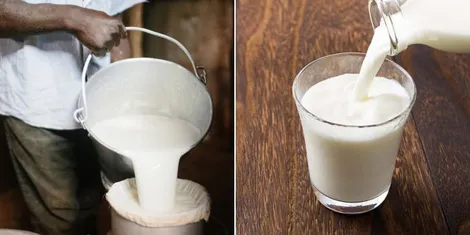

Kenya’s decision to turn to Uganda for milk is revealing something bigger than a temporary shortage on supermarket shelves. It is exposing Uganda’s emergence as one of East Africa’s most important dairy suppliers at a time when climate pressures are beginning to test the region’s food systems.
Kenya’s Trade Cabinet Secretary Lee Kinyanjui confirmed on September 5 that his country was importing milk from neighbouring countries, including Uganda, because domestic production was no longer sufficient to meet demand.
“Locally we are not able to meet our demand, so we are actually importing from our neighbouring countries like Uganda,” Kinyanjui said, while urging Kenyan farmers to increase production.
The significance of that statement goes beyond Kenya’s current supply problem.
It puts Uganda at the centre of an increasingly important question for East Africa: Can Uganda become the region’s dependable dairy supplier as climate shocks make milk production increasingly unpredictable elsewhere?
Uganda has built the production base
Uganda now produces an estimated 5.4 billion litres of milk annually, placing it among the region’s leading dairy producers. Government figures and industry reports show that production has expanded substantially over the past decade, while the sector has increasingly moved towards processing and exports.
The importance of Uganda is not simply the amount of milk produced.
The country has developed a broad dairy-producing belt stretching through areas such as Ankole, Mbarara, Ntungamo and greater Masaka. These regions provide the raw milk base for processors supplying Uganda’s domestic market while also supporting exports.
That production gives Uganda something its neighbours increasingly need: a potential surplus that can move across borders when regional markets come under pressure.
Kenya’s current shortage is perhaps the clearest demonstration of that role.
Formal milk deliveries to Kenyan processors fell by 3.7% between June and July 2026, from 84.4 million litres to 81.3 million litres, with preliminary indications pointing to another decline in August. The Kenya Dairy Board attributed the pressure largely to seasonal conditions affecting key producing areas.
Rwanda is also experiencing milk-supply pressures, while reports indicate that Tanzania and Uganda have maintained relatively stronger output.
That creates an opportunity for Uganda to become more than a national dairy producer.
It can become a regional dairy buffer.
Kenya’s shortage could strengthen Uganda’s position
East Africa’s dairy market is increasingly interconnected.
When production falls in Kenya or Rwanda, the natural question becomes where additional supplies can be obtained. Uganda’s geographic position, established dairy industry and growing processing capacity make it an obvious candidate.
For Uganda, this presents an economic opportunity.
More regional demand can mean larger markets for farmers, better incentives for investment and greater utilisation of processing facilities. It can also support Uganda’s broader ambition of shifting agricultural exports away from raw commodities towards higher-value processed products.
Milk powder, UHT milk, butter oil and other dairy products are particularly important because they allow Uganda to participate in regional trade without relying entirely on the immediate movement of highly perishable raw milk.
That could make Uganda’s dairy industry more competitive across East Africa.
But there is a catch.
Uganda is becoming a supplier at the same time its own supply is under pressure
The country’s dairy advantage is not guaranteed.
JESA Farm Dairy has announced a temporary shortage of its products in Uganda, blaming the prolonged dry season for reduced milk production among farmers. The company said shortages of pasture and water had affected milk yields from its Busunju farm and its network of out-grower farmers in central Uganda.
That development creates an important contradiction.
Uganda is being called upon to supply a milk shortage in Kenya while some Ugandan processors are themselves struggling to secure enough milk.
This is the point at which the story stops being simply about exports and becomes a question of national and regional resilience.
Uganda may have a 5.4-billion-litre annual production capacity, but that does not mean 5.4 billion litres are permanently available for export.
Milk production fluctuates with weather, pasture, water availability, feed prices and animal productivity. A prolonged dry spell can reduce farm-level output quickly.
That is exactly what is happening now.
Climate change is Uganda’s biggest threat to becoming East Africa’s dairy hub
The biggest challenge to Uganda’s dairy ambitions may therefore not come from Kenya, Tanzania or Rwanda.
It may come from the climate.
Uganda’s Ministry of Water and Environment says several parts of the country are currently experiencing dry conditions, with stable rains expected to become established in many areas from mid-to-late September and peak rainfall expected between late October and November.
For dairy farmers, those forecasts matter enormously.
Pasture and water determine how much milk cattle can produce. When both become scarce, farmers either buy expensive feed and water or watch production fall.
That means Uganda cannot sustainably position itself as East Africa’s dairy supplier simply by increasing the number of cattle.
It needs to make dairy production less dependent on unpredictable weather.
That means greater investment in water harvesting, irrigation, pasture development, silage, hay, improved animal breeds, veterinary services, cooling infrastructure and affordable livestock feed.
Without those investments, Uganda’s dairy surplus could remain vulnerable to the same climate shocks that are currently forcing Kenya to look across the border.
The opportunity is bigger than Kenya
Kenya is only the most visible example.
East Africa’s growing population and expanding urban centres are creating a larger market for milk and processed dairy products. As incomes rise and urbanisation accelerates, demand for reliable, safe and convenient dairy products is likely to increase.
Uganda therefore has an opportunity to build a regional dairy industry that serves not only Kenya but also Rwanda, South Sudan, Tanzania, eastern Democratic Republic of Congo and other neighbouring markets.
The strategic advantage is already there.
Uganda has land, a large livestock population, established dairy-producing regions and an expanding processing industry.
What is missing is the scale of investment required to turn those advantages into a consistently reliable regional supply system.
Uganda must avoid exporting its advantage away
There is, however, another issue Kampala will have to manage carefully.
If Uganda becomes the preferred supplier whenever neighbouring countries experience shortages, increased exports could eventually compete with domestic demand.
That could benefit farmers through better prices but put pressure on Ugandan processors and consumers.
The objective, therefore, should not be simply to export more milk.
It should be to produce substantially more milk than Uganda currently needs while maintaining affordable domestic supplies.
That requires productivity gains rather than merely selling more of the existing production.
A farmer producing twice as much milk from the same land and herd is ultimately more valuable to Uganda’s dairy ambitions than simply sending more of today’s production across the border.
East Africa’s dairy future may run through Uganda
Kenya’s current milk shortage has inadvertently given Uganda a powerful demonstration of its growing importance in East Africa’s food economy.
Uganda is no longer simply producing milk for Kampala and other domestic markets. Its dairy industry is increasingly becoming part of a regional supply chain.
But the current dry spell also delivers a warning.
JESA’s shortage shows that Uganda is not insulated from the same climate pressures affecting its neighbours. If the country wants to become East Africa’s dairy safety net, it must first make its own dairy system resilient enough to withstand prolonged periods of drought.
That is the strategic opportunity before Uganda.
The country can either remain a major milk producer or build itself into East Africa’s dairy hub.
The difference will depend on what happens next: whether investment follows production growth, whether farmers receive the infrastructure needed to withstand dry seasons, and whether Uganda develops enough processing and storage capacity to supply regional markets without compromising its own.
Kenya’s milk shortage has opened the door.
Uganda now has to decide how far it wants to walk through it.