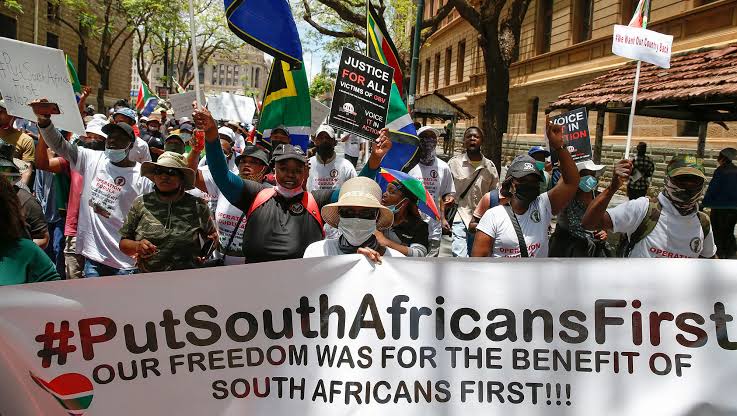

President Bola Tinubu’s decision to raise South Africa’s recurring xenophobic and Afrophobic attacks before the African Union is more than a diplomatic complaint.
It exposes a difficult contradiction at the heart of the African integration project: how can the continent build unity, free movement and shared prosperity while Africans themselves continue to face hostility in other African countries?
Nigeria’s intervention comes at a particularly sensitive moment. More Nigerians are being repatriated from South Africa following tensions affecting African migrants and other foreign nationals. On August 26, 67 returnees—30 adults, 36 children and an infant—arrived in Lagos, barely a week after another 83 Nigerians returned on August 18.
The numbers alone may not define the scale of the problem, but politically they carry considerable weight. They turn xenophobia from an abstract human-rights concern into a question of continental solidarity and the credibility of African integration.
African unity cannot stop at national borders
The African Union was created around an ambitious idea: that Africa’s political and economic future should increasingly be pursued collectively rather than through isolated national interests.
That vision becomes difficult to defend when Africans are treated as outsiders on African soil.
South Africa has every sovereign right to regulate immigration, as Nigeria itself acknowledged. Governments have legitimate responsibilities to enforce immigration laws, protect employment opportunities, control borders and maintain public order.
But sovereignty cannot provide a blanket justification for violence or collective hostility against foreigners.
That distinction is crucial.
Illegal immigration is a policy issue. Xenophobia is a social and political problem. Violence against migrants is a security and human-rights issue. Conflating the three risks turning legitimate immigration enforcement into hostility against entire nationalities.
The Nigeria-South Africa relationship makes the issue bigger
Nigeria and South Africa are two of Africa’s most influential states, economically and diplomatically. Their relationship therefore has implications beyond their bilateral ties.
Nigeria has historically played a major role in continental diplomacy, including the struggle against apartheid. South Africa, meanwhile, emerged from apartheid with a strong commitment to African solidarity and continental leadership.
That history makes attacks against Africans in South Africa particularly uncomfortable.
The question increasingly becomes: What does African solidarity mean if Africans cannot safely live, work or do business elsewhere on the continent?
For Nigeria, the issue is also deeply personal. Nigerians are among the largest African communities outside their country, and South Africa remains an important destination for business, education, employment and investment.
Repeated episodes of hostility therefore risk damaging not only diplomatic relations but also the people-to-people connections that African integration is supposed to strengthen.
Xenophobia threatens AfCFTA’s promise
There is an economic dimension that should not be ignored.
The African Continental Free Trade Area was built on the expectation that African economies can become more integrated by allowing goods, services, capital and businesses to move more easily across borders.
But economic integration becomes harder when people are viewed as competitors rather than fellow Africans.
A trader from Nigeria, Ghana, Ethiopia, Zimbabwe or another African country operating in South Africa is not merely a migrant statistic. Such traders form part of the continent’s emerging cross-border economy.
If hostility toward foreigners becomes normalised, it can discourage entrepreneurship, investment and movement of skills across African borders.
In that sense, xenophobia is not simply a social problem. It can become an obstacle to Africa’s economic integration.
But African unity also requires honest discussion of migration
There is a danger, however, in treating the issue entirely through the language of victimhood.
South Africa has genuine challenges involving unemployment, poverty, pressure on public services, undocumented migration and competition for economic opportunities. Those concerns cannot simply be dismissed as xenophobia.
African unity requires South Africa’s neighbours and continental institutions to listen to those concerns as well.
The harder task is separating legitimate grievances from scapegoating.
When migrants are blamed collectively for structural economic problems, the conversation moves from policy to prejudice. That is where African governments need to draw a clear line.
South Africa can enforce its immigration laws. It can deport people who violate those laws. It can strengthen border controls.
But enforcement should be based on law, evidence and individual responsibility—not nationality or ethnicity.
The AU now has an opportunity
Tinubu’s call for the issue to be placed on the agenda of the AU’s 40th Ordinary Session in January 2027 could provide an opportunity for the continent to move beyond condemning individual outbreaks of violence.
The AU needs a continental framework for dealing with xenophobia and Afrophobia.
That could include stronger early-warning mechanisms, preventive diplomacy, protection of migrant communities, cross-border investigations of attacks and clearer commitments from member states to protect African nationals living within their territories.
The same preventive philosophy contained in the Luanda Action Plan is relevant here. Tinubu’s argument that preventing conflicts is cheaper and more sustainable than managing them after they erupt applies not only to wars between states but also to tensions within communities.
Waiting until violence occurs and then organising evacuations and repatriations is the most expensive form of crisis management.
The better approach is prevention.
Repatriation should not become the solution
The return of Nigerian migrants from South Africa provides an immediate humanitarian response, but it should not become the continent’s default answer to xenophobia.
If African citizens must repeatedly be evacuated from one African country because of hostility toward foreigners, the problem is not solved when the aircraft lands in Lagos.
It merely moves the victims away from the immediate danger.
The deeper problem remains: why are Africans being made to feel foreign in Africa?
That is the question the AU must confront.
African unity cannot mean only joint summits, common declarations and diplomatic handshakes. It must eventually translate into how an ordinary African trader, student, worker or businessperson is treated when they cross another African border.
Tinubu’s intervention therefore deserves to be viewed within that wider context.
The real test of African unity is not whether African governments can agree in conference rooms. It is whether African people can live, work, trade and move across the continent without being targeted simply because they come from another African country.
Until that becomes reality, the dream of one Africa remains unfinished.