
Uganda has moved a step closer to issuing its first sovereign green bond after the Ministry of Finance, Planning and Economic Development, in partnership with the Bank of Uganda (BoU) and key financial-sector stakeholders, validated a draft framework designed to guide sustainable investment and thematic bond issuance.
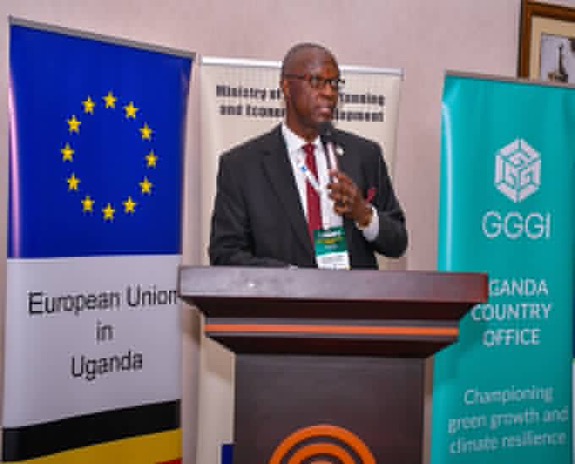
The technical workshop, held last week at Serena Hotel Kigo, brought together the Ministry of Finance, BoU, Uganda Bankers’ Association (UBA), European Union (EU) and the Global Green Growth Institute (GGGI), alongside representatives from commercial banks, development finance institutions, pension funds, insurers, capital-market intermediaries, regulators, line ministries and civil society.
The Sovereign Sustainable Finance Framework is intended to establish the rules through which Uganda can raise capital for projects with measurable environmental and broader sustainability benefits.
The framework is particularly significant as the government and BoU undertake preparatory work towards Uganda’s first sovereign green bond, with technical assistance from GGGI.
For Uganda’s financial sector, the move could open another channel for mobilising long-term domestic and international capital for climate-related infrastructure and other sustainable investments.
Wilbrod Owor, Executive Director of the Uganda Bankers’ Association, described the validation workshop as a milestone for the banking industry, saying financial institutions already have an appetite to finance green investments but need the systems and expertise to translate that appetite into actual lending and investment.
“Capital is not just money. It is skills, knowledge, practice and information and it looks for cash flow, markets and the supporting infrastructure,” Owor said.
The framework is aligned with the International Capital Market Association’s Green Bond Principles, providing a recognised structure for determining what can qualify for green financing and how investors can assess the use and impact of proceeds.
Under the proposed framework, eligible investments will be identified and subjected to defined evaluation and selection procedures. It will also establish mechanisms for managing and tracking bond proceeds, as well as reporting on how funds are allocated and the environmental or sustainability impact achieved.
The framework builds on several policy and regulatory foundations Uganda has developed in recent years, including the National Green Taxonomy, the National Climate Finance Strategy 2025–2030 and BoU’s guidelines on managing climate-related financial risks.
These instruments are intended to help financial institutions identify sustainable economic activities, assess climate-related risks and direct capital towards investments capable of supporting Uganda’s transition to a greener and more resilient economy.
The involvement of banks, pension funds, insurers and other institutional investors in the validation process also points to an effort to ensure that the framework is not merely a government borrowing instrument but part of a broader architecture for developing Uganda’s sustainable finance market.
A successful sovereign green bond would give the government an additional financing instrument while potentially creating a benchmark for future corporate and financial-sector green bonds.
It could also help deepen Uganda’s capital markets by giving institutional investors access to securities linked to nationally defined environmental and sustainability priorities.
However, the credibility of such a market will ultimately depend on transparency. Clear eligibility criteria, independent assessment, rigorous tracking of proceeds and credible impact reporting will be essential if Uganda is to convince investors that green bond proceeds are financing projects that genuinely deliver the promised environmental and social outcomes.
The validation workshop therefore represents more than a technical step towards issuing a new government security. It is part of Uganda’s broader attempt to build the institutional infrastructure needed to turn climate and sustainability ambitions into investable projects—and attract capital to finance them.