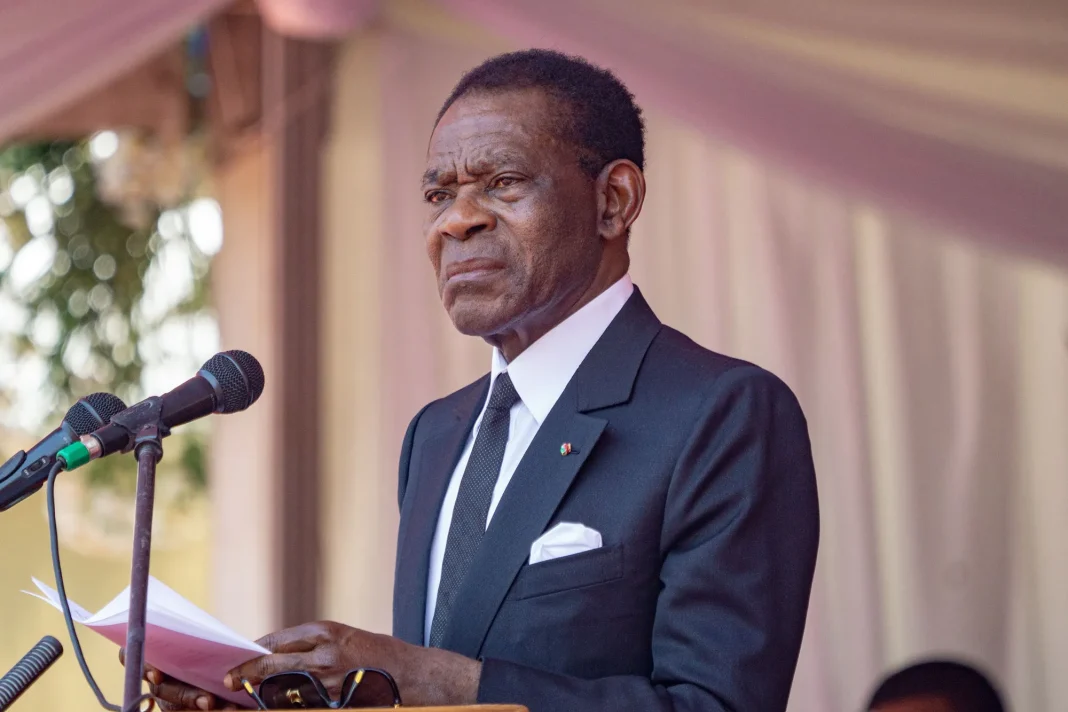

For half a century, petroleum has promised Equatorial Guinea prosperity, bought the Obiang regime time and turned a tiny African state into an object of competition between foreign powers. Now the oil is running down. The dynasty is preparing its succession. And gas may be the family’s last great bet.
There are countries where oil changed the government.
And then there is Equatorial Guinea, where oil helped create the modern political order itself.
When the Spanish flag came down on 12 October 1968, Equatorial Guinea inherited an economy that was small but comparatively prosperous. Cocoa plantations flourished. Timber was valuable. The country possessed one of the higher standards of living in Africa at independence.
What followed was one of the continent’s most brutal political and economic reversals.
Francisco Macías Nguema’s presidency became synonymous with repression, isolation and economic collapse. The institutions inherited at independence were hollowed out, agricultural production deteriorated and thousands of Equatorial Guineans fled.
In August 1979, Macías was overthrown by his nephew, Teodoro Obiang Nguema Mbasogo.
Obiang did not merely inherit a damaged country.
He inherited a country whose most important natural-resource promise had not yet been realised.
For the next four decades, he would preside over its transformation from an impoverished former Spanish colony into one of Africa’s most extraordinary petro-states.
He would also become the world’s longest-serving current president. Guinness World Records lists him as having held the presidency since 1982, after taking power in the 1979 coup.
The oil would make his government rich.
It would not make the country politically free.
And now, as the hydrocarbons begin to decline, Equatorial Guinea faces the question that every petro-state eventually encounters:
What happens to a political system when the resource that sustained it begins to disappear?
The oil arrived late — but it arrived spectacularly
The transformation accelerated in the 1990s.
Commercial petroleum production turned Equatorial Guinea into a different kind of African state almost overnight. The development of the Zafiro field in the mid-1990s was particularly consequential, sending production soaring and attracting some of the world’s largest energy companies.
For a country of barely a million people, the numbers became astonishing.
Oil exports transformed public finances. Infrastructure appeared at extraordinary speed. Malabo and Bata acquired the visual language of a wealthy state: monumental government buildings, new roads, airports and ambitious construction projects.
The regime embraced a new identity.
Equatorial Guinea was to become the “Kuwait of Africa.”
The slogan contained both ambition and illusion.
For a brief period, the statistics seemed to justify it.
The country’s oil-fuelled expansion was among the most dramatic in the world. Equatorial Guinea moved into the ranks of upper-middle-income countries, and its GDP per person became extraordinarily high by African standards.
But GDP per capita was an awkward measure of reality.
A small population divided into a very large petroleum economy can produce spectacular averages without producing spectacular living standards.
The oil boom therefore created a peculiar political geography: extraordinary wealth at the level of the state, alongside persistent deprivation among much of the population.
The IMF now describes the problem more bluntly. Equatorial Guinea’s non-hydrocarbon economy contracted during much of 2013–23, while weak investment in education, health and social protection constrained the development of human capital.
The country became rich.
It did not become diversified.
That distinction would eventually matter.
The curse was not that oil disappeared
The conventional story of the resource curse is simple.
A country discovers oil, becomes rich, becomes corrupt and eventually collapses when the oil runs out.
Equatorial Guinea is more complicated.
The oil did not simply enrich the government.
It insulated the government.
Petroleum revenue reduced the need to build a broad tax base. It allowed the state to finance grand projects without developing the sort of productive private economy that might have demanded greater accountability.
And because the country’s population is small, enormous sums could be concentrated within a remarkably narrow political system.
This was the architecture of Nguemismo: a political order in which the presidency, the ruling party, the security apparatus and the economic system became deeply intertwined.
The result was a state that could absorb economic shocks without necessarily reforming itself.
That became apparent after 2014.
The global oil-price collapse struck Equatorial Guinea at precisely the moment when its own mature fields were already beginning to decline.
The boom ended.
The recession stayed.
The IMF says the economy contracted in seven of the nine years preceding its 2025 assessment, principally because hydrocarbon production collapsed.
The country experienced a modest recovery in 2024.
Then the numbers deteriorated again.
The IMF estimates that Equatorial Guinea’s economy contracted by 6.4% in 2025, with hydrocarbon output falling by 16.8%. It expects the economy to remain under pressure as production declines, with average annual growth of -0.8% between 2025 and 2030.
That is no longer a temporary oil-price problem.
It is a structural problem.
The wells are ageing.
The next Obiang economy
And yet the dynasty is not behaving as though its economic story is over.
It is changing the commodity.
Oil is giving way to gas.
Equatorial Guinea already possesses the Punta Europa LNG facility, giving it infrastructure that many African gas producers would struggle to build from scratch.
The government’s ambition is larger still: to turn the country into a regional gas hub, drawing on offshore reserves and potentially processing resources from neighbouring countries.
This is not merely an energy strategy.
It is a political strategy.
If oil created the economic foundations of the Obiang era, gas could create the financial bridge into the succession era.
That is why the development of Equatorial Guinea’s gas industry matters far beyond the energy sector.
The question is whether the country can monetise its remaining gas reserves quickly enough to compensate for falling oil production—and whether the resulting revenues will be used to diversify the economy rather than extend the life of the same political model.
The IMF’s warning is severe: declining hydrocarbon production is already putting pressure on the country’s fiscal and external accounts, while diversification remains incomplete.
The clock is ticking.
Enter Teodorín
At the centre of that clock stands the president’s son.
Teodoro Nguema Obiang Mangue—known almost universally as Teodorín—has spent years moving from the margins of the presidential family into the centre of state power.
He is now vice-president.
His rise has been inseparable from controversy.
American prosecutors once portrayed him as the archetype of the corrupt African elite: a government official whose lifestyle could not be reconciled with his official income.
The U.S. Department of Justice said in 2014 that Teodorín had amassed more than $300 million in assets through corruption and money laundering, despite receiving an official government salary of less than $100,000.
The case produced some of the most surreal images of the global fight against kleptocracy.
A Malibu mansion.
A Ferrari.
Michael Jackson memorabilia.
The United States eventually secured a settlement under which Teodorín relinquished more than $30 million in assets, including the Malibu property and Ferrari.
For Washington, he was once a test case.
Could the United States use its financial system to pursue the proceeds of corruption belonging to the son of a sitting African president?
The answer was yes.
But geopolitics has a long memory—and an even longer appetite for strategic interests.
The Atlantic changes the calculation
Equatorial Guinea is small.
Its population is small.
Its territory is fragmented between the mainland and islands.
But its location is not small.
The country sits on the Gulf of Guinea, facing an Atlantic increasingly shaped by competition among the United States, China and other external powers.
Washington has repeatedly expressed concern about China’s expanding strategic footprint in Africa.
In 2022, the commander of U.S. Africa Command said China had made progress towards establishing a potential military facility in Equatorial Guinea. The claim intensified speculation about Malabo’s strategic importance, although subsequent research has stressed that reports of an actual Chinese naval base remained unproven.
The important point is not whether a Chinese base exists.
It is that Washington believes the possibility matters.
That changes the calculation.
An authoritarian government that might once have been viewed principally through the lenses of democracy, corruption and human rights can also become a government viewed through energy security, maritime access and strategic competition.
And Equatorial Guinea has something else Washington wants:
energy.
American companies have been deeply involved in the country’s hydrocarbons sector for decades.
The geopolitical irony is striking.
Washington once pursued the assets of the president’s son.
Washington’s companies are now deeply embedded in the country’s energy future.
The relationship is no longer simply about whether the Obiang government is acceptable.
It is about whether the government is useful.
The mathematics of pragmatism
This is where the story of Equatorial Guinea becomes bigger than Equatorial Guinea.
Across Africa, governments with poor democratic records have learned that strategic geography can provide diplomatic insurance.
A country does not have to be democratic to be useful.
It has to matter.
Equatorial Guinea matters because of oil and gas.
It matters because of its position on the Atlantic.
It matters because of its proximity to Central Africa’s maritime routes.
And it matters because China has made infrastructure, mining, energy and political relationships across the continent a central part of its global strategy.
Malabo therefore sits inside a familiar African paradox.
Foreign governments can criticise its governance while simultaneously seeking cooperation with its government.
The result is a form of diplomatic compartmentalisation.
Corruption can be condemned.
Human-rights concerns can be raised.
But energy contracts continue.
Security discussions continue.
Strategic relationships continue.
The regime survives not because nobody knows what it is.
It survives partly because powerful outsiders have reasons to keep dealing with it.
The succession may be more important than the oil
The coming transition is therefore not simply about who replaces Obiang.
It is about whether the political system he built can survive him.
Obiang is now in his eighties.
His son has been positioned for years as the likely successor.
But dynastic succession is never as simple as inheritance.
A president can transfer an office.
He cannot automatically transfer loyalty.
The elder Obiang’s authority has been built over decades through relationships within the military, ruling party, bureaucracy and security establishment.
His successor will have to reproduce that equilibrium.
And Teodorín carries an additional burden.
His international reputation is already established.
He is not an unknown heir.
He is a figure whose name became globally associated with extravagance and corruption through the American forfeiture cases.
That makes the succession unusually exposed.
The regime’s challenge is therefore to transform Teodorín from controversial heir into credible head of state without allowing the succession itself to fracture the system.
The illusion of permanence
The most interesting feature of the Obiang era is not that it has lasted so long.
It is that every major crisis has appeared to make its end more plausible.
Macías was overthrown.
Oil prices collapsed.
Oil production declined.
The economy entered recession.
Teodorín faced international legal pressure.
The dynasty survived.
Now the oil fields are ageing.
The IMF reports that hydrocarbon production fell 14% year-on-year during the first three quarters of 2025, with especially steep declines in the third quarter as ageing oil and gas wells required longer maintenance.
This is the point at which the old political bargain should become vulnerable.
The resource is shrinking.
The economy is contracting.
The population still needs jobs and services.
The state needs revenue.
The successor needs legitimacy.
And the foreign powers that once competed for oil are increasingly interested in gas, strategic access and geopolitical alignment.
Yet there is no guarantee that scarcity produces reform.
Sometimes it produces the opposite.
When resources become scarcer, the political elite can become more determined to control them.
That is the danger for Equatorial Guinea.
The end of the oil boom may not produce liberalisation.
It may produce a more defensive version of the same system.
A dynasty looking for its third act
The first act was Macías.
It ended in blood and isolation.
The second was Obiang.
It was financed by oil and defined by extraordinary concentration of political power.
The third is being prepared now.
It will belong, if the succession proceeds as expected, to Teodorín.
Its currency may be gas.
Its external partners may include Washington, Beijing and international energy companies.
Its greatest challenge will be economic diversification.
And its greatest political question will be whether the dynasty can reproduce itself without the abundance that made the old order possible.
That is why Equatorial Guinea should not be understood simply as another African dictatorship sitting on oil.
It is a case study in how natural resources can reshape sovereignty itself.
Oil transformed a small former Spanish colony into a strategic state.
The state transformed petroleum revenue into political endurance.
And political endurance now gives the ruling family an opportunity to attempt something even more difficult:
to survive the decline of the resource that made its survival possible.
The irony is almost perfect.
For decades, analysts waited for oil depletion to weaken the Obiang regime.
But the regime has spent years preparing for depletion.
It is building gas infrastructure.
It is cultivating strategic relationships.
It is positioning the president’s son.
It is negotiating with foreign powers whose interests extend far beyond Malabo’s domestic politics.
The oil curse, in other words, may not end the dynasty.
It may simply force the dynasty to evolve.
And that leaves Equatorial Guinea facing a question that no amount of LNG, diplomatic manoeuvring or presidential succession can permanently postpone:
When the barrels finally stop defining the country, what will remain of the state that oil built?