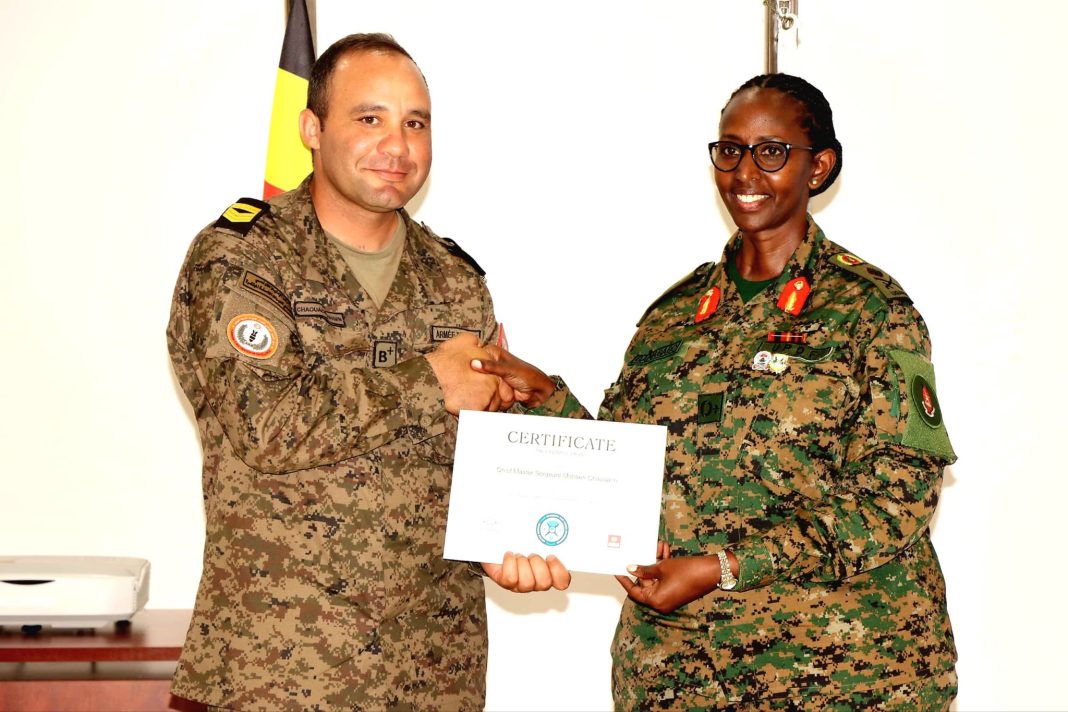

Uganda has reaffirmed its commitment to strengthening international peacekeeping operations through specialised military training, technological innovation and international partnerships, as the country expands its contribution to regional and global security efforts.
The commitment was highlighted by the Director of Women Affairs in the Uganda Peoples’ Defence Forces (UPDF), Brig Gen Charity Bainababo, during the closing ceremony of the 17th Women’s Outreach Course and the 12th United Nations Peacekeeping Micro-UAS Remote Pilot Course held at the UN Regional Service Centre in Entebbe.
Bainababo said Uganda considers peacekeeping an important part of its contribution to international security, emphasising that instability in one country can have consequences beyond its borders.
“Uganda believes in common security because we are alive to the fact that when our brothers and sisters are in trouble, so are we,” she said.
She added that the two training programmes were helping strengthen the preparedness of personnel serving in international peace operations by equipping them with relevant technical, leadership and operational skills.
Uganda to host defence chiefs’ conference
Bainababo also announced that Uganda is set to host the inaugural Conference of Chiefs of Defence Forces, where UPDF Chief of Defence Forces Gen Muhoozi Kainerugaba and his counterparts will discuss Military Operations Other Than War.
The conference is expected to provide a platform for military leaders to discuss cooperation and approaches to security challenges beyond conventional warfare.
She said such initiatives reinforce Uganda’s commitment to collective security and strengthen cooperation among countries participating in peace operations.
Women take on greater roles in peacekeeping
The 17th Women’s Outreach Course brought together officers drawn from seven peacekeeping missions, African Union operations and 14 member states, with a focus on strengthening women’s participation in international peace operations.
Bainababo commended the participants for completing the training, noting that their enhanced technical expertise, leadership abilities and operational readiness would support their contribution to peacekeeping missions.
“These women have worked hard to strengthen their technical expertise, leadership and operational readiness. Their accomplishments are significant as women continue to make essential contributions to peacekeeping,” she said.
She challenged the graduates to apply the knowledge acquired during the course in their respective missions rather than treating their certificates as the end of their learning journey.
“Let the knowledge not remain on paper, on the certificate that you have acquired. Let it be seen from the way you operate, from the way you interact with your colleagues and from the way you interact with technology,” she said.
She further urged them to embrace continuous learning, particularly as technological developments continue to change the demands of modern military operations.
Drone technology gains importance in peacekeeping
The 12th UN Peacekeeping Micro-UAS Remote Pilot Course focused on developing specialised skills in operating micro-unmanned aircraft systems, commonly known as drones, which are increasingly being used to support peacekeeping missions.
Bainababo said the training would improve operational awareness and contribute to safer and more effective peacekeeping through the responsible application of technology.
“In each one of you, a candle has been lit. Go hold it out for all to see. We can only get the value of this course through your actions, through your application of the skills,” she said.
Micro-unmanned aircraft systems can provide peacekeeping personnel with aerial information about operational environments, helping them monitor situations and make better-informed decisions.
France renews support for UN training programmes
The Ambassador of France to Uganda, Virginie Leroy, reaffirmed France’s commitment to supporting UN peacekeeping operations through training, technological development and international cooperation.
Leroy said international partnerships remain central to sustainable peacekeeping, revealing that the partnership supporting the training programmes had recently been renewed until 2029.
She said cooperation was also expanding into areas such as Information and Communication Technology (ICT) and advanced aircraft systems training.
The ambassador highlighted women’s participation and technological innovation as important elements in preparing peacekeeping personnel for emerging operational demands.
She said the Women’s Outreach Course had helped participants build confidence, improve their technical and leadership capabilities and establish professional networks that could support their future roles in peace operations.
On the Micro-UAS programme, Leroy said remotely piloted aircraft were becoming increasingly important in peacekeeping by improving understanding of operational environments, enhancing situational awareness and strengthening mission effectiveness while helping reduce casualties.
She also commended the Government of Uganda for its continued support of United Nations training activities.
The two courses underscore the growing role of specialised training, gender inclusion and emerging technologies in international peacekeeping, as military and civilian personnel adapt to increasingly complex security operations.