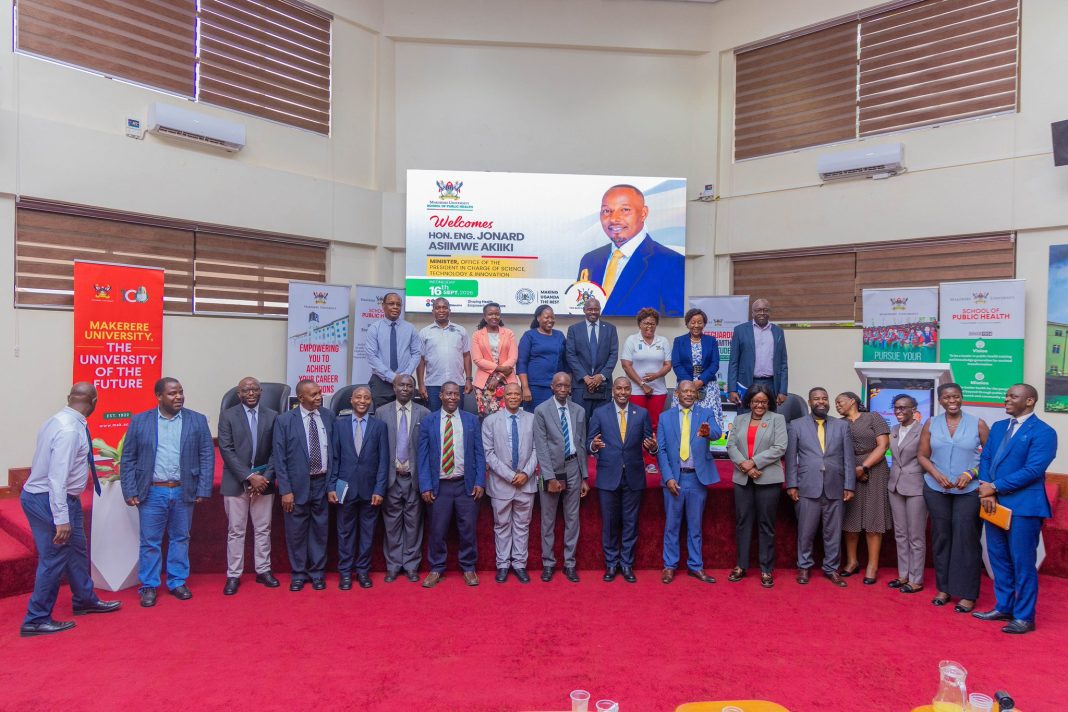

Makerere University and the Science, Technology and Innovation Secretariat in the Office of the President (STI-OP) are exploring ways to move public health research from laboratories and academic publications into government policy, national programmes and scalable solutions.
The discussions took place during a visit to the Makerere University School of Public Health (MakSPH) by Minister of Science, Technology and Innovation Hon. Eng. Jonard Asiimwe, who was accompanied by Makerere University management led by Vice Chancellor Prof. Barnabas Nawangwe.
The visit brought together the minister and researchers working across several public health fields, including health data systems, disease surveillance, climate and environmental health, infectious diseases, maternal and child health, and non-communicable diseases.

Researchers presented work demonstrating how evidence generated at MakSPH has contributed to policy development, strengthened national health programmes and produced interventions with potential for wider adoption.
MakSPH seeks stronger research-to-policy link
MakSPH Dean Prof. Rhoda Wanyenze said the School has the capacity to conduct national surveys, clinical trials and other research capable of generating evidence for public policy and supporting implementation.
She also identified the establishment of an environmental health laboratory as a priority, particularly as Uganda seeks stronger evidence on environmental exposures and their effects on population health.

The proposed laboratory would provide additional capacity for research into factors that influence health and could support evidence-based interventions across communities and national programmes.
STI-OP calls for targeted support to innovations
Minister Asiimwe commended Makerere’s scientific research capacity and called for greater attention to innovations with potential for practical application and wider scale-up.
He proposed targeted support for high-potential innovations, stronger university-industry exchanges and sustainable management of strategic laboratories.
The minister also highlighted opportunities for further collaboration in artificial intelligence for health and the emerging pathogen economy, areas that are increasingly important to health security, disease surveillance and technological innovation.
New MakSPH building nearing completion
During the visit, the minister also toured the new MakSPH building, which is nearing completion.
The facility is expected to strengthen the School’s infrastructure for research, training and public health activities as Makerere expands its contribution to Uganda’s health system.
The engagement also linked MakSPH’s public health research agenda with Makerere University’s broader collaboration with STI-OP, with both sides identifying opportunities to improve the translation of locally generated evidence into policy, programmes and scalable innovations.
The discussions underscore a growing emphasis on ensuring that scientific research does not remain confined to academic institutions, but contributes directly to solving public health challenges and strengthening Uganda’s capacity to develop locally relevant solutions.