
Kenya and Tanzania are pulling far ahead of their East African neighbours in tax collections, helped by the sheer scale of their economies, international trade and strategic ports, while Rwanda is building a smaller but increasingly diversified revenue base around tourism, exports and services.
East Africa’s tax numbers reveal a striking economic hierarchy.
During the 2024/25 financial year, Kenya collected about KSh2.572 trillion in tax revenue, equivalent to roughly $19.9 billion at the exchange rate used in the comparison. The Kenya Revenue Authority said the collection represented an increase over the previous year and exceeded its KSh2.555 trillion target.
Tanzania was also a major revenue collector, with the Tanzania Revenue Authority collecting approximately TZS32.27 trillion during 2024/25, about $11.9 billion. The collection exceeded the authority’s TZS31.5 trillion target by about 3 percent and represented a 16.7 percent increase from the previous financial year.
Uganda, meanwhile, remained behind its two larger neighbours. The Uganda Revenue Authority had set a UGX32 trillion tax-revenue target for 2024/25, with the authority describing the expansion of the tax base, digitalisation and better use of data as key tools for meeting the target.
The comparison puts Uganda’s tax effort at roughly $8.8 billion, depending on the exchange rate and whether the comparison uses the final collection figure or the target. That distinction matters: a target is not the same thing as money actually collected.
Kenya and Tanzania have a powerful advantage: the sea
One of the biggest structural differences between the three larger East African economies is geography.
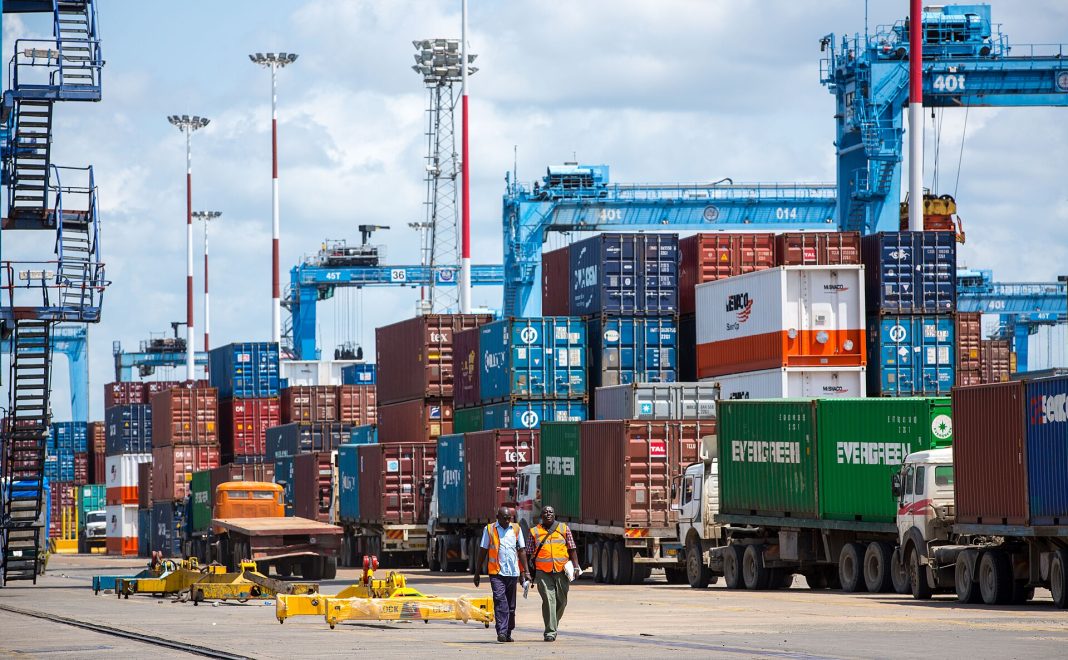
Kenya and Tanzania have direct access to the Indian Ocean and operate major ports that connect the region’s landlocked economies to global trade.
The Port of Mombasa is not simply a Kenyan facility. It is a regional gateway, handling cargo destined for countries including Uganda and other parts of East and Central Africa. Kenya Ports Authority currently describes Mombasa as handling more than 15.8 million metric tonnes of transit traffic.
Tanzania has a similar advantage through Dar es Salaam.
The Tanzania Ports Authority says Dar es Salaam handles about 95 percent of Tanzania’s international trade and serves several landlocked countries, including Rwanda, Uganda, Burundi, Zambia, Malawi, Zimbabwe and the Democratic Republic of Congo.
That geography creates a powerful fiscal ecosystem.
Goods entering Uganda, Rwanda, Burundi, Zambia or the DRC through Mombasa or Dar es Salaam can generate customs duties, VAT, excise taxes and other charges along the supply chain.
In other words, a port does not only move containers; it creates a tax and commercial ecosystem around imports.
Tanzania’s own budget data illustrates the importance of trade taxes. In the first half of 2024/25, the country collected TZS4.33 trillion in import taxes and duties, while taxes on domestic sales and income taxes also generated substantial revenue.
Rwanda chose a different economic model
Rwanda does not have a seaport, and its economy is considerably smaller than those of Kenya, Tanzania and Uganda.
Yet it has built important sources of foreign exchange outside traditional port-driven trade.
Tourism is one of them.
According to the Rwanda Development Board, tourism generated $647 million in revenue in 2024, an increase of 4.3 percent, driven partly by a 27 percent increase in gorilla-tourism revenue.
Exports are another pillar.
Rwanda’s tea and coffee industries, together with horticulture and other agricultural products, contribute to foreign-exchange earnings. The Rwanda Development Board identifies coffee, tea, livestock products, cereals, pyrethrum and horticulture among the country’s important export products.
That does not mean Rwanda “lives on tourism and exports” alone. It also collects domestic taxes, customs revenue and other forms of government revenue.
For 2024/25, Rwanda’s government projected Rwf2.970 trillion in tax revenue, within projected domestic revenues of Rwf3.414 trillion.
So Rwanda’s story is less about the absolute size of taxation and more about how a relatively small, landlocked economy has attempted to broaden its sources of foreign exchange and domestic revenue.
South Sudan sits at the bottom
South Sudan’s reported tax take of about $217 million is dramatically smaller than the other economies in this comparison.
The gap is not surprising.
South Sudan has a much smaller formal economy, limited industrialisation and a narrow domestic tax base. Its economy is also heavily exposed to oil, meaning government finances depend substantially on petroleum revenues rather than a broad-based domestic taxation system.
That makes direct comparisons with Kenya or Tanzania difficult.
The bigger story is not simply who collects the most
The headline figures can easily become misleading if they are interpreted as a league table of which country has the “best” tax system.
Kenya collects more because it has a much larger economy and a huge formal and informal commercial ecosystem.
Tanzania combines a large domestic market with mining, manufacturing, agriculture, tourism and the strategic Dar es Salaam port.
Uganda has a smaller economy and remains heavily dependent on expanding its domestic tax base.
Rwanda is smaller still, but has aggressively developed tourism, exports, services and investment as sources of foreign exchange.
The real question, therefore, is not simply who collected the most tax?
It is how much economic activity each country is able to capture through taxation.
Uganda’s challenge is the size of its tax base
Uganda’s own revenue authority has repeatedly acknowledged the challenge.
URA said its tax-to-GDP ratio remained around 13.5 percent, while arguing that a much higher ratio is necessary if Uganda is to finance development with greater domestic resources.
That makes the Kenyan and Tanzanian figures particularly important for Uganda.
The lesson is not necessarily to impose more taxes.
It is to create more taxable economic activity, bring more businesses into the formal economy, improve compliance, reduce leakages and capture more value from trade, manufacturing, services and natural resources.
Digital systems such as electronic invoicing, data integration and stronger customs systems are therefore becoming increasingly important across the region.
Ports are an advantage — but not the whole story
It would be too simplistic to say Kenya and Tanzania collect more taxes because they have ports.
Ports are certainly a major structural advantage because they concentrate international trade, customs administration, logistics, fuel imports and commercial activity.
But the size of their economies, populations, industrial bases, financial sectors and domestic consumption also matter.
Similarly, Rwanda’s performance cannot be reduced to tourism.
The country’s strategy combines tourism, exports, investment, services and domestic taxation.
The East African tax map therefore tells a bigger story about geography and economic structure.
Kenya and Tanzania benefit from being gateways to the region. Uganda is a major landlocked consumer and producer economy trying to widen its domestic tax base. Rwanda is using tourism, exports and services to overcome the limitations of being landlocked. South Sudan remains constrained by a narrow formal economy and dependence on oil.
The numbers may look like a simple tax ranking.
They are actually a snapshot of how geography, trade and economic structure shape the ability of East African governments to finance themselves.