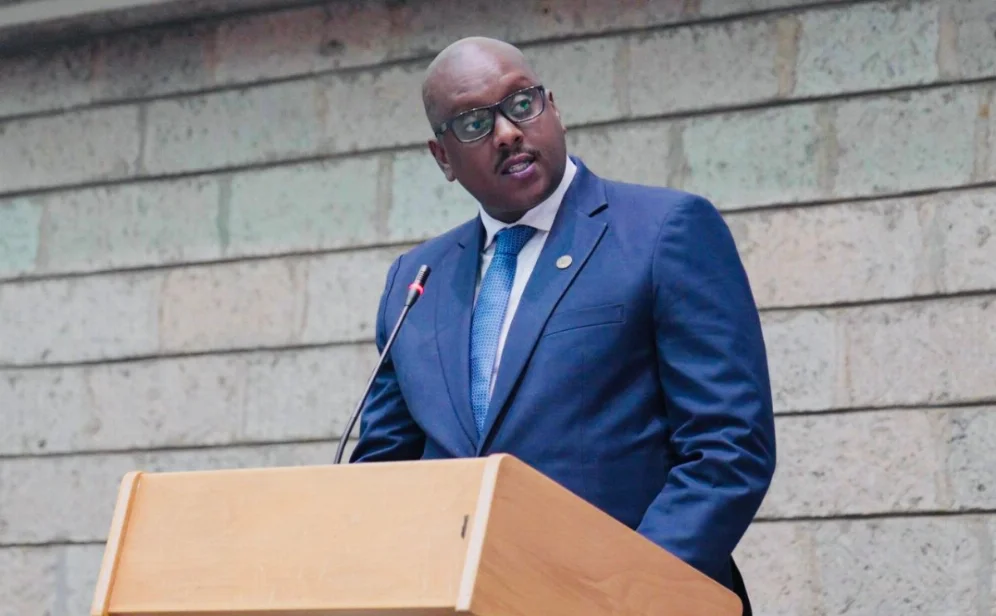

The resignation of senior African Union adviser Fred Gateretse Ngoga after 17 years at the continental body has opened an uncomfortable debate about one of Africa’s oldest political problems:
why do the continent’s institutions so often arrive after a crisis has already become a humanitarian emergency?
Ngoga’s departure from the African Union Commission comes at a politically sensitive moment. Burundi’s President Evariste Ndayishimiye is serving as chairperson of the African Union, while Burundi itself remains burdened by the consequences of years of political instability, displacement and unresolved tensions.
Ngoga has not publicly said that he resigned because of Burundi. But the concerns attributed to him point to something larger than one country or one official.
They expose a fault line within Africa’s peace and security architecture: the distance between early warning and political action.
From refugees to root causes
For years, Africa’s response to political crises has often followed a familiar sequence.
Political tensions rise. Violence follows. Citizens flee. Refugee camps expand. International agencies mobilise. Governments appeal for humanitarian assistance.
The emergency is then managed.
But the political, economic and governance failures that produced the emergency can remain largely intact.
That is the contradiction at the heart of Ngoga’s argument.
His reported message that Burundi cannot be treated through humanitarian management alone challenges a model in which displacement becomes the visible problem while its political causes remain less aggressively confronted.
Burundi’s experience since the 2015 crisis demonstrates the difficulty.
The country has seen large numbers of citizens flee across its borders, particularly into neighbouring Rwanda, Tanzania, Uganda and the Democratic Republic of Congo. Efforts to encourage refugees to return have continued, but questions about security, political freedoms and the conditions awaiting returnees have complicated that process.
The lesson for Africa is significant: a refugee crisis can be a symptom of a political crisis, not its solution.
The uncomfortable politics of African institutions
The timing of Ngoga’s resignation makes the story politically sensitive.
Burundi is currently represented at the highest level of the African Union through its president, who holds the rotating chairmanship of the continental organisation.
That creates an obvious institutional tension.
The African Union is expected to defend principles of peace, democracy, constitutional governance and human rights. At the same time, it operates through member states whose governments can be reluctant to see continental institutions scrutinise their domestic affairs too aggressively.
This is one of the AU’s enduring dilemmas.
The organisation was created partly to move Africa beyond the era when sovereignty was treated as an almost absolute shield against continental intervention. Yet sovereignty remains one of the strongest forces shaping how African states respond to one another.
The result is often cautious diplomacy.
African governments may prefer quiet negotiations, solidarity and non-interference to public confrontation. That approach can sometimes prevent escalation. But it can also create a dangerous gap between knowing that a crisis is developing and being willing to act before it becomes irreversible.
Early warning is useless without early action
Ngoga’s background makes his criticism particularly significant.
He previously headed the AU Commission’s Conflict Prevention and Early Warning Division. His professional experience therefore places him close to the machinery designed to identify threats before they turn into full-scale conflict.
That raises a fundamental question for the AU and other regional institutions:
What is the value of early warning if political systems cannot convert warnings into early action?
Africa does not lack institutions.
The continent has the African Union Peace and Security Council, the Continental Early Warning System, regional economic communities and mechanisms dealing with mediation, governance and conflict prevention.
The problem is often less about architecture than political will, resources, coordination and the willingness of governments to respond when the warning concerns a politically sensitive member state.
A conflict that appears small in its early stages can become extraordinarily expensive once people begin crossing borders.
The burden then shifts from national politics to the entire region.
Burundi cannot be separated from the Great Lakes
This is where Burundi becomes more than a domestic story.
The country sits inside one of Africa’s most politically fragile regions, alongside Rwanda and the Democratic Republic of Congo.
Political instability in one country can rapidly acquire regional consequences through refugees, armed groups, ethnic tensions, border insecurity, trade disruptions and competing political alliances.
The experience of the Great Lakes has repeatedly demonstrated that conflicts rarely respect colonial borders.
The danger is therefore not simply that Burundi might experience another internal crisis.
It is that unresolved instability can become another strand in the wider security crisis stretching across the Great Lakes.
The eastern DRC conflict makes this particularly important. Burundi’s security interests, its relations with neighbouring states and its involvement in regional security calculations mean that developments inside the country cannot easily be isolated from the wider politics of the region.
For the AU, that should make Burundi a test case for preventive diplomacy.
Africa’s sovereignty dilemma
There is also a deeper political question.
How far should African institutions go in confronting governments that are accused of violating democratic or human-rights principles?
The AU has developed stronger continental norms against unconstitutional changes of government. Yet military coups have often received more immediate and visible continental responses than slow-moving democratic deterioration, institutional weakening, political exclusion or rights abuses.
That imbalance matters.
A coup is visible.
A slow erosion of political trust is not.
Displacement is visible.
The political decisions that produce displacement are often much harder to confront.
This is why Ngoga’s argument about root causes matters. Preventing conflict requires institutions to engage with problems before the headlines become refugee statistics.
The bigger question for Africa
Ngoga says leaving the AU does not mean abandoning the mission.
That may ultimately be the most important part of his departure.
His resignation should not be reduced to speculation about whether he was dismissed or whether his concerns were directed at particular individuals.
The larger issue is institutional.
Can Africa build peace systems that do more than respond to humanitarian emergencies?
Can early-warning mechanisms influence political decisions?
Can regional organisations act before displacement reaches hundreds of thousands?
Can the AU discuss human rights consistently even when the government involved is politically powerful?
And can African states accept that preventing a crisis sometimes requires uncomfortable conversations with fellow governments?
These are questions that extend far beyond Burundi.
From the Sahel to Sudan, eastern Congo to the Horn of Africa, the continent has repeatedly paid a higher price for delayed political action.
Africa’s peace architecture will ultimately be judged not only by how efficiently it responds when people are already fleeing their homes, but by whether it can stop people from having to flee in the first place.
Burundi, therefore, is not simply a story about one AU official leaving his institution. It is a warning about the limits of an African system that can become very good at managing the consequences of conflict while remaining politically cautious about confronting its causes.
And that is perhaps the hardest question Ngoga’s departure leaves behind:
When Africa’s early-warning systems sound the alarm, who has the courage—and the political authority—to act?