
Uganda must shift the way it measures the success of its national budget—from how much money government allocates and spends to the tangible improvements that spending delivers to citizens, Permanent Secretary at the Ministry of Finance, Planning and Economic Development Ramathan Ggoobi has said.
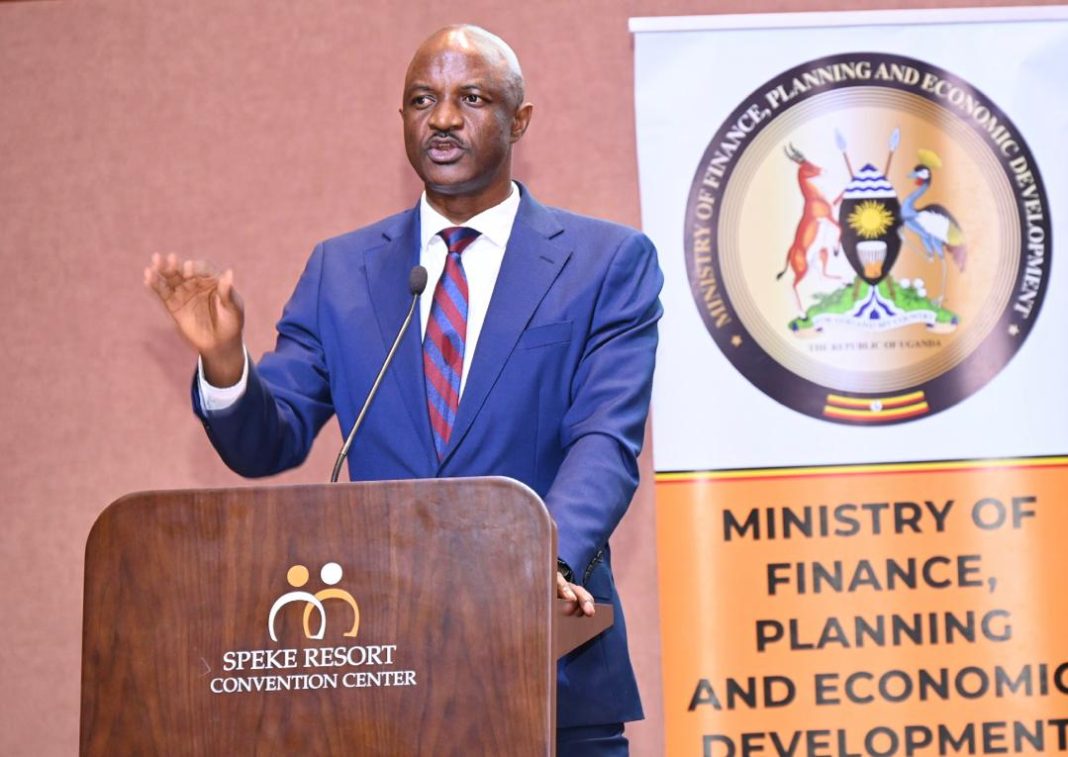
Ggoobi made the remarks while delivering a keynote address titled “The Political Economy of the National Budget: From Allocations to Results,” in which he challenged Parliament and the Executive to rethink how public resources are planned, allocated, implemented and monitored.
“The national budget is more than a statement of Government revenue and expenditure,” Ggoobi said. “It contains our national priorities and choices determining who pays, who benefits, what is funded and what must wait.”
His message was blunt: budget absorption should no longer be treated as evidence of success.
According to Ggoobi, Uganda has made significant progress in strengthening its public financial management systems, but the country now faces a more difficult challenge—ensuring that money released and spent by government translates into development impact.
“Spending money is not the same as creating value,” he said.
Three tests for a good budget
Ggoobi said a credible national budget must pass three fundamental tests: fiscal discipline, allocative efficiency and operational efficiency.
Fiscal discipline requires government to operate within a sustainable resource envelope. Allocative efficiency means directing scarce public resources towards the country’s most important priorities, while operational efficiency requires government agencies to convert those resources into effective services, infrastructure and measurable results
The PS warned that failure on any of the three fronts can undermine the effectiveness of public spending, even when government departments technically meet their budget absorption targets.
He identified fragmented priorities, institutional and constituency pressures, misuse of supplementary budgets and continued financing of poorly performing programmes among the challenges undermining the quality of Uganda’s budget decisions.
Ggoobi calls for a new ‘Budget Compact’
To address these challenges, Ggoobi called for what he described as a stronger “Budget Compact” between the Executive and Parliament.
Under the proposed approach, affordability and national priorities should come before demands for additional spending.
Government, he said, should prioritise completing viable projects before launching new ones, ensure projects are ready for implementation before allocating funds, and make future financing increasingly dependent on performance.
“Resources must follow priorities, funding must follow readiness, future allocations must follow performance, and accountability must follow results,” Ggoobi said.
The approach would represent a significant shift from a system in which budget allocations can sometimes become an end in themselves, towards one where continued government financing is justified by demonstrated performance.
Parliament must scrutinise, not rubber-stamp
Ggoobi also placed Parliament at the centre of the proposed reforms, arguing that lawmakers have a critical responsibility to scrutinise government spending without undermining the broader national fiscal framework
“Parliament must neither be sidelined nor become a rubber stamp,” he said.
He said Parliament’s responsibility should include effective scrutiny, appropriation and oversight, while working constructively with the Executive.
Stronger parliamentary capacity and better coordination among committees, he added, will be necessary to improve the quality of budget decisions and strengthen accountability.
The argument comes as Uganda continues to grapple with competing demands for limited public resources, with pressure for funding coming from national development priorities as well as institutional and constituency interests.
The question Ggoobi wants changed
For Ggoobi, the fundamental question surrounding Uganda’s national budget should change.
Instead of asking “How much money has been allocated?”, he said policymakers should be asking: “What transformation has been delivered out of every shilling we spent?”
That means examining whether public spending has improved services, created jobs, raised household incomes, increased productivity and strengthened infrastructure.
He proposed a clear chain of accountability:
Affordability → National priorities → Project readiness → Effective implementation → Measurable results → Future funding.
Under this model, a project would not simply qualify for funding because money has been provided for it in the budget. Its readiness, implementation record and measurable results would increasingly determine whether it receives additional resources.
From budget absorption to public value
Ggoobi said Uganda already has the institutions and systems needed to manage public finances, but the next stage of reform must focus on improving the quality of decisions made within those systems.
“The next phase is to improve the quality of decisions within those systems and ensure that every shilling delivers maximum public value,” he said.
His warning goes to the heart of Uganda’s development challenge: a budget can be fully spent and still fail to deliver meaningful transformation.
The test of government spending, therefore, should ultimately be what citizens can see and experience—not simply what government financial reports show as having been disbursed.
For Ggoobi, that is the essence of the new budget compact Uganda needs: scarce resources must be directed towards the country’s highest priorities, projects must be ready before they receive funding, performance must determine future allocations, and accountability must be measured through results.
“The key question should no longer be ‘How much money has been allocated?’ but ‘What transformation has been delivered out of every shilling we spent?’”