
Uganda has stepped up its diplomatic campaign for the leadership of the United Nations after President Yoweri Museveni endorsed veteran diplomat Olara Otunnu as the country’s candidate for Secretary-General, arguing that his experience and international standing make him suited to steer the global organisation.
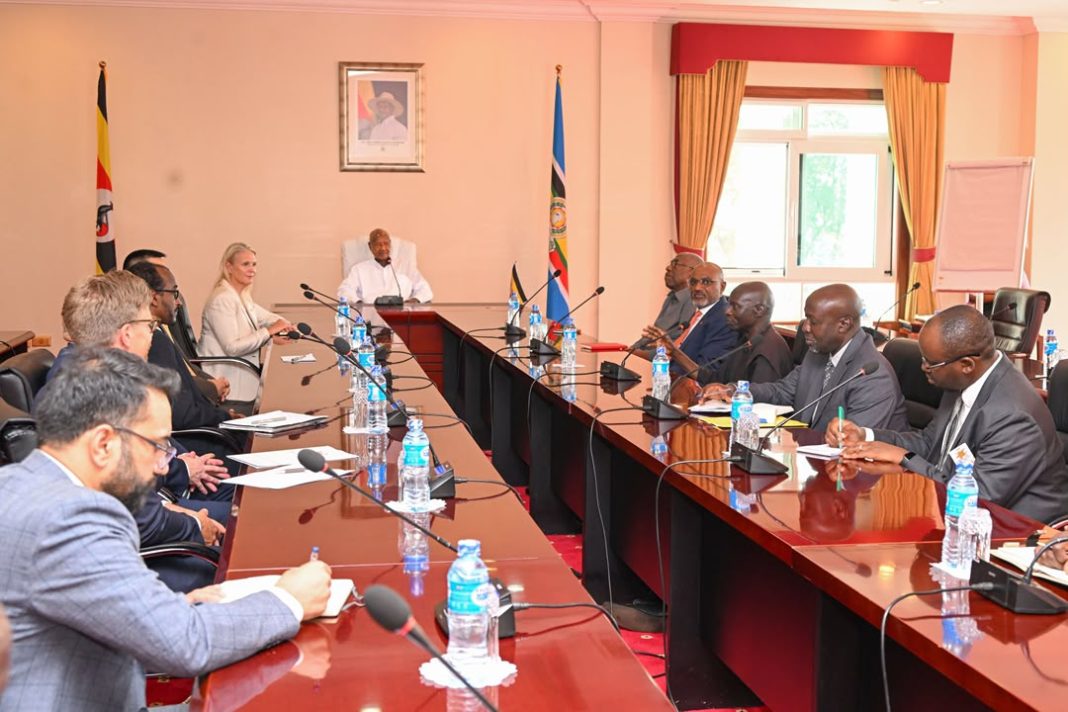
Museveni announced Uganda’s position during a meeting with ambassadors representing members of the United Nations Security Council at State House Entebbe, where he formally introduced Otunnu’s candidature and urged diplomatic representatives to communicate Uganda’s support to their respective governments.
“I met ambassadors representing members of the United Nations Security Council and formally presented Ambassador Olara Otunnu as Uganda’s candidate for the position of United Nations Secretary-General,” Museveni said.
“I urged them to convey Uganda’s endorsement to their respective governments. Ambassador Otunnu has the experience, integrity and diplomatic credentials to lead the UN,” he added.
The endorsement marks a significant step in Uganda’s attempt to secure a stronger voice in global diplomacy by seeking to place one of its most experienced international figures at the helm of the United Nations.
Museveni linked Otunnu’s candidature to Uganda’s wider foreign policy record, including its role in regional peace efforts and its hosting of millions of refugees, describing these experiences as consistent with the principles of international cooperation and humanitarian responsibility.
A Veteran Diplomat Returns to the Global Stage
Otunnu’s nomination was officially submitted earlier this year, with Uganda communicating his candidature to UN member states through the established selection process.
A joint letter by German Foreign Minister Annalena Baerbock and Zenon Ngay Mukongo confirmed that Uganda had presented Otunnu as its candidate for the position.
“We have the honour to jointly inform Member States that the Republic of Uganda has presented the nomination of Olara Otunnu as candidate for the position of Secretary-General,” the letter stated.
The nomination, dated July 24, 2026, was transmitted through Uganda’s Permanent Mission to the United Nations, beginning the formal process of consultations among member states.
Otunnu brings extensive experience from decades of engagement with international institutions. He served as Uganda’s Permanent Representative to the United Nations between 1980 and 1985, during which he gained prominence within the UN system.
During his diplomatic tenure, Otunnu served as President of the UN Security Council in 1981, where he presided over the election of Javier Pérez de Cuéllar as United Nations Secretary-General.
He is also associated with reforms in the UN leadership selection process through the introduction of the “straw polling” approach, commonly referred to as the Otunnu Formula, which became an informal tool used during secretary-general selection discussions.
Between 1982 and 1983, Otunnu served as Vice-President of the UN General Assembly and chaired the Contact Group on Global Negotiations. He later headed the UN Commission on Human Rights.
Uganda’s Diplomatic Ambition
Beyond his UN assignments, Otunnu served as Uganda’s Minister of Foreign Affairs from 1985 to 1986, participating in diplomatic efforts including negotiations linked to the Nairobi Agreement.
His international career continued when he became president of the International Peace Institute in 1990, a role he held until 1998, before being appointed by then UN Secretary-General Kofi Annan as Under-Secretary-General and Special Representative for Children and Armed Conflict in 1997.
Analysts say Uganda’s push for Otunnu reflects a broader effort by African countries to increase their influence in global institutions where leadership positions have historically been dominated by candidates from other regions.
The UN Secretary-General selection process involves consultations among Security Council members before a recommendation is submitted to the General Assembly for approval.
A successful bid would make Otunnu the first Ugandan to lead the United Nations and place the country at the centre of global decision-making at a time when the organisation faces challenges ranging from conflicts and climate change to humanitarian crises and calls for institutional reform.
For Uganda, the candidature represents not only a contest for an international position but also an opportunity to project its diplomatic history and ambitions onto the global stage.