
Kenya’s crackdown on foreign small-scale traders is putting pressure on its relations with neighbouring Burundi and highlighting tensions between domestic economic protection and East Africa’s push for closer regional integration.
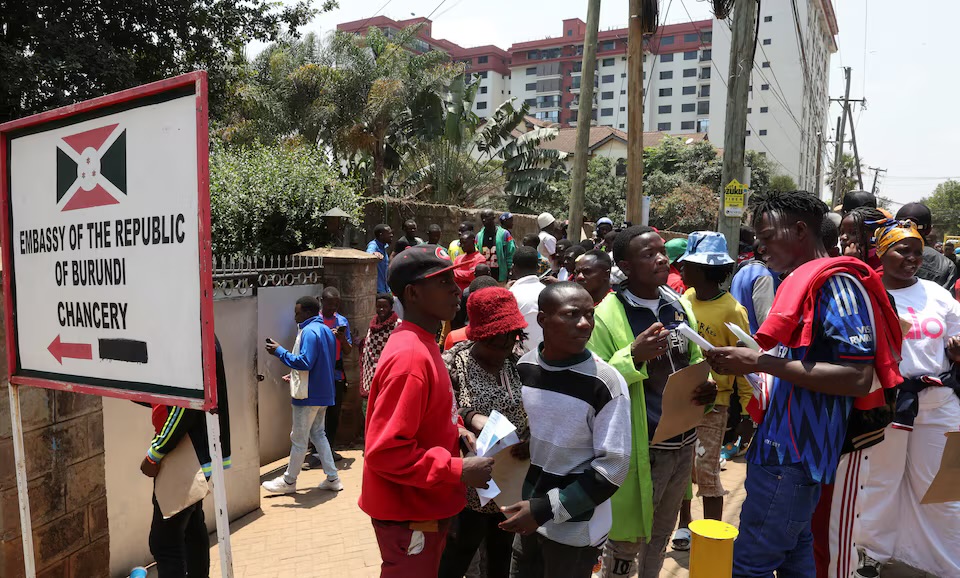
Hundreds of Burundians gathered outside their country’s embassy in Nairobi on Monday seeking travel documents to return home, after Kenyan President William Ruto ordered authorities to shut down small businesses operated by foreigners without work permits.
The move came after Kenyan traders protesting tax reforms called for greater protection from foreign competition. Ruto last week directed authorities to close foreign-owned small businesses from Monday, prompting concern among migrant traders in the capital.
There were no immediate signs of a broad crackdown in Nairobi on Monday, but some Burundians outside the embassy said they had received threats from neighbours following Ruto’s remarks.
“I am not going home by choice. I have been forced to go,” said Peter Nakumujango, 62, who was among those waiting outside the embassy.
Kenya and Burundi are both members of the East African Community, which seeks to deepen the movement of people, goods, services and capital across the region.
The episode underscores a recurring challenge for the bloc: governments are seeking to remove barriers to regional trade while facing domestic pressure to protect local businesses and jobs.
Kenya’s Trade Ministry has said the directive applies to foreigners operating without work permits, making the issue primarily one of immigration and business compliance rather than a formal ban on nationals of neighbouring countries.
But for Burundi, the treatment of its citizens carries diplomatic implications.
About 16,000 Burundian refugees and asylum seekers are in Kenya, according to the United Nations refugee agency. Many rely on small-scale businesses in Nairobi, including the sale of coffee and second-hand clothing.
“I have lived here for three years without even an ID and I was planning to go back next year,” said Munezero Farnke, 18. “They should give us at least a week to plan and go back to Burundi or help us cross the border.”
Burundi’s ambassador to Kenya was not immediately available for comment.
For the EAC, the challenge will be to balance Kenya’s right to enforce its immigration and labour laws with the bloc’s wider objective of encouraging cross-border economic activity.
Small traders are among the most visible beneficiaries of regional integration, but they are also vulnerable when governments respond to domestic economic pressure with tighter controls on foreign businesses.
The situation could therefore test whether East Africa’s integration agenda can withstand political demands for greater protection of national markets.
For Kenya and Burundi, avoiding an escalation will depend on distinguishing enforcement against undocumented or unlicensed businesses from measures that could be perceived as targeting foreign nationals more broadly.
That distinction could prove important in preserving both bilateral relations and confidence in the EAC’s promise of a more integrated regional economy.