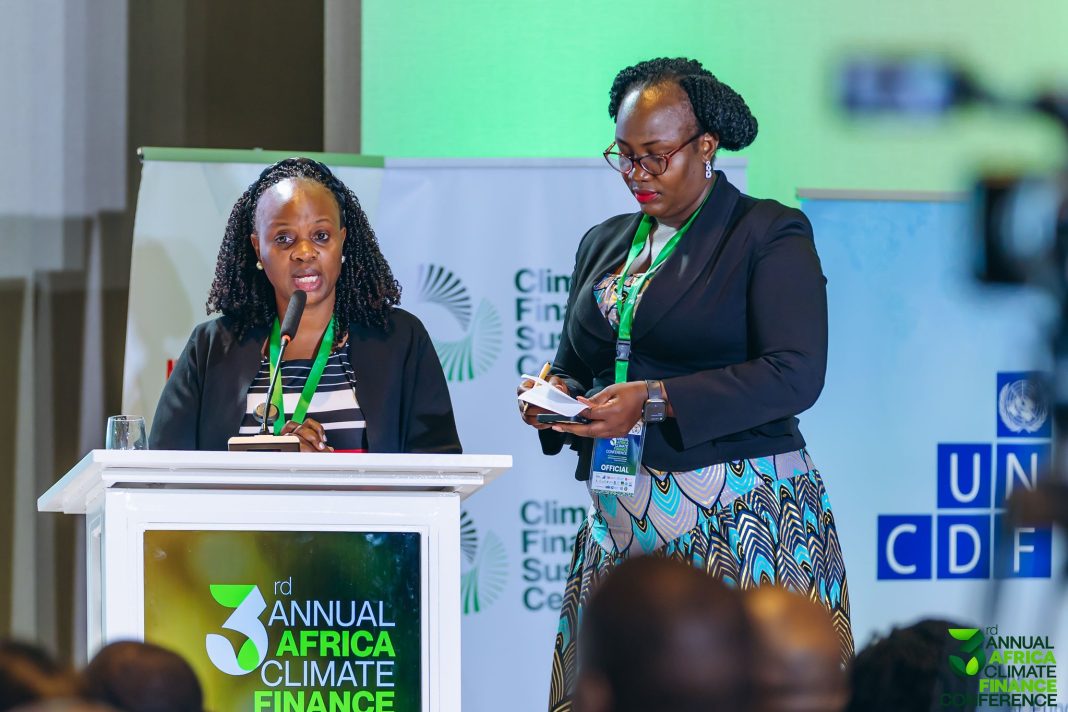

Uganda has channelled Shs36.2 billion into 440 climate-smart agricultural projects through the Agricultural Credit Facility (ACF), as the country seeks to turn climate-finance commitments into tangible investments for communities facing increasingly unpredictable weather.
The figures were disclosed by Dorothy Namarome of the Bank of Uganda’s Administered Funds Department during the 3rd Annual Africa Climate Finance Conference held in Kampala on September 1–2 under the theme, “From Commitments to Capital: Operationalizing Africa’s Climate Finance Architecture.”
The financing, accessed through 15 participating financial institutions, has supported investments including drip irrigation, solar power installations, rainwater harvesting systems, dam excavation and the purchase of drought-resilient seed varieties.
The interventions point to a shift in climate finance from broad commitments towards projects designed to help farmers withstand the practical effects of climate change, particularly changing rainfall patterns and prolonged dry spells.
At the centre of the approach is the ACF’s role in reducing the risks faced by commercial lenders when financing agricultural investments.
By providing more affordable financing and sharing part of the lending risk, the facility can encourage financial institutions to fund projects that may otherwise be considered too risky or commercially unattractive.
This is particularly important in agriculture, where climate shocks can undermine farmers’ ability to repay loans and discourage banks from extending credit to climate-vulnerable communities.
From climate pledges to bankable projects
The Shs36.2 billion allocation also illustrates one of the central challenges facing Africa’s climate-finance architecture: turning climate commitments into capital that reaches projects on the ground.
While governments and development partners increasingly commit resources to climate action, farmers and small businesses often face difficulty accessing financing for technologies that could make their operations more resilient.
Projects such as irrigation, water harvesting and solar energy require substantial upfront investment even when they can reduce vulnerability and operating costs over time.
The ACF therefore provides a potential bridge between climate policy and commercial finance by making such investments more viable for lenders and borrowers.
However, the scale of financing also underscores the size of the challenge. Shs36.2 billion spread across 440 projects averages about Shs82 million per project, although individual allocations would vary considerably.
For a largely agricultural economy exposed to climate risks, scaling such financing will be critical if climate adaptation is to move beyond isolated projects.
The conference’s focus on moving “from commitments to capital” therefore comes at a critical point. The question is increasingly not whether Africa needs climate finance, but whether existing financial systems can mobilise enough capital—and direct it efficiently—to communities and businesses that need it most.
For Uganda, expanding climate-smart lending through mechanisms such as the ACF could help make climate adaptation part of mainstream agricultural finance rather than a separate development intervention.
The bigger test, however, will be whether these financing mechanisms can be scaled sufficiently to match the growing cost of climate-related risks while ensuring that vulnerable farmers can access affordable capital.