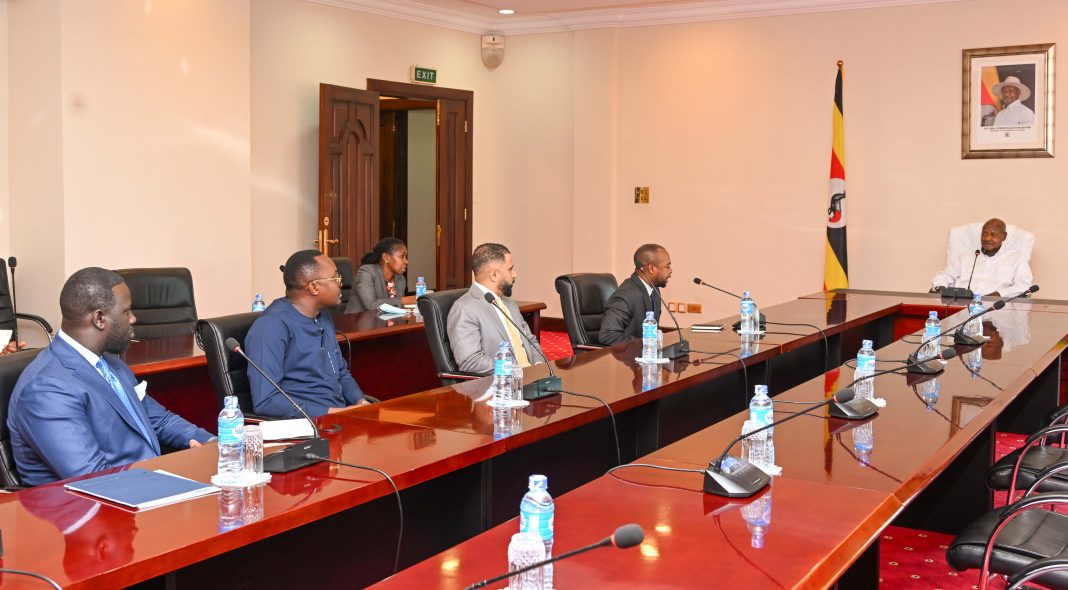

President Yoweri Kaguta Museveni has held talks with a Tanzanian delegation led by Abdulhalim Hafidh Ameir, the son of Tanzanian President Samia Suluhu Hassan, in a meeting focused on strengthening Uganda-Tanzania relations and expanding areas of bilateral cooperation.
The meeting took place on Monday, August 24, 2026, at State House, Entebbe, where President Museveni received the delegation and discussed matters of mutual interest between the two neighbouring countries.
The delegation included George Nkya, Amal Garang and Mundhir Mohammed Nassor.
Although the meeting was not accompanied by details of specific agreements or trade deals, its focus on bilateral cooperation comes as Uganda and Tanzania continue to deepen economic ties through trade, infrastructure, energy and regional integration.
The two countries have increasingly become important economic partners in East Africa, with Tanzania providing Uganda access to the Indian Ocean through the Dar es Salaam corridor. The route has gained strategic importance for Uganda’s import and export trade as the country seeks to diversify transport and logistics links.
Uganda’s latest trade data also points to the growing scale of its external commerce. The Uganda Bureau of Statistics reported that the country’s total trade reached $22.59 billion in 2024, up from $18.79 billion in 2023.
For Uganda and Tanzania, stronger bilateral cooperation could therefore have implications beyond diplomatic relations, particularly in reducing trade barriers, improving cross-border infrastructure and expanding opportunities for businesses operating across the two markets.
The relationship is also strategically important within the East African Community, where closer economic integration depends on the movement of goods, services, capital and people across national borders.
President Museveni welcomed the Tanzanian delegation and engaged with its members on the issues presented, according to the statement on the meeting.
The talks come at a time when East African countries are under increasing pressure to translate regional integration frameworks into practical economic gains for businesses and citizens.
For Uganda, deeper cooperation with Tanzania offers an opportunity to strengthen access to regional and international markets, while Tanzania stands to benefit from stronger economic links with Uganda’s growing consumer market and production base.
The meeting consequently places bilateral relations within a broader regional economic context: the ability of Uganda and Tanzania to turn political goodwill into easier trade, stronger infrastructure connections and expanded private-sector cooperation could become an important component of East Africa’s integration agenda.
Uganda’s official statistics show that total national trade increased by 20.26% in 2024, although the country continued to record a merchandise trade deficit.