
As Uganda draws closer to producing its first commercial oil, the government is asking a question that could shape the country’s petroleum future long after the first barrels leave the ground: Can its national oil company become financially self-sustaining?
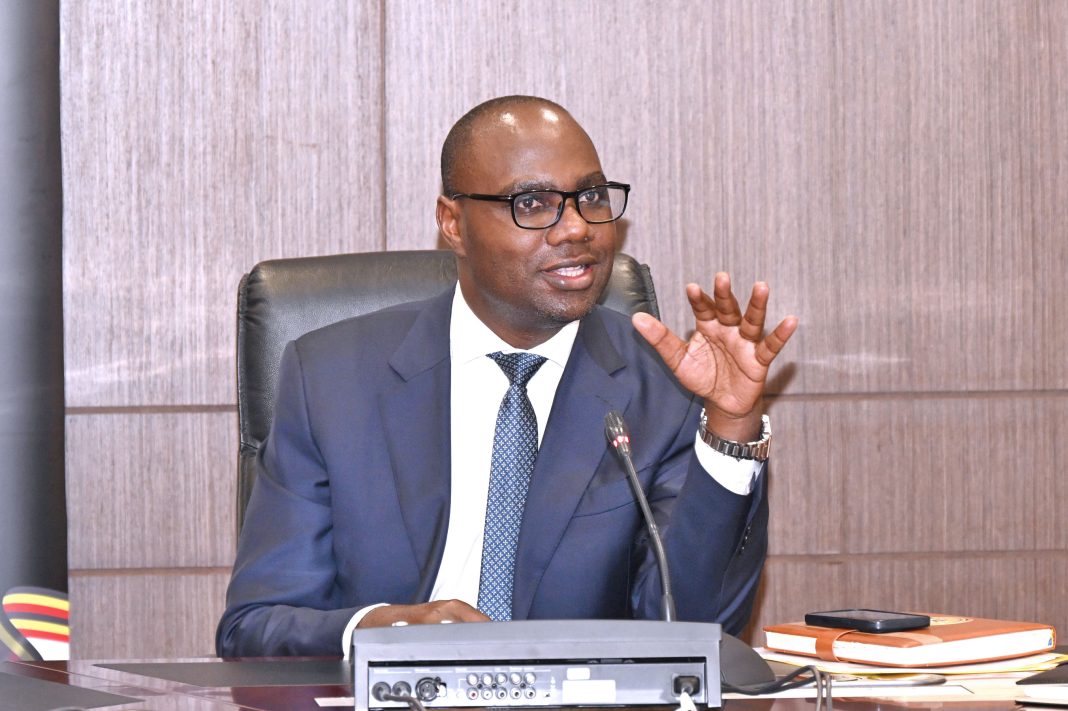
Finance Minister Henry Musasizi, accompanied by State Minister for Finance Amos Lugoloobi and Cissy Mulondo, has tasked the board of the Uganda National Oil Company with developing financing models that would allow the company to strengthen its operations while reducing its dependence on government budgetary support.
The request comes at a pivotal moment for Uganda’s oil industry. Projects that have been under development for years are approaching completion, while the government is preparing for the financial demands that will accompany commercial production.
For Uganda, the stakes extend beyond oil production itself. The country is attempting to build a petroleum industry in which storage, transportation, trading, refining and industrial infrastructure generate economic value alongside crude exports.
The challenge is financing that ambition without turning the national oil company into a permanent drain on public resources.
A company between two worlds
UNOC has already assumed a larger role in Uganda’s petroleum market, particularly after taking responsibility for the country’s sole petroleum-importation arrangement.
The company says sole importation increased by 39 per cent and that it now supplies 36 oil marketing companies. Its gross margins rose to 540 billion Ugandan shillings in the 2025-26 financial year, from 387 billion shillings previously.
Those figures have strengthened the argument that UNOC can use its commercial operations to finance part of its own expansion.
The company estimates that its sole-importation business generates about $3 million a month in administrative charges.
But UNOC is also becoming responsible for projects that require considerably more capital.
Under a $2 billion financing facility with Vitol Bahrain, $150 million had been disbursed, with 536 billion shillings transferred to the Finance Ministry. At the same time, UNOC expects about $72 million in cash-call obligations as Uganda moves toward first oil.
The numbers illustrate the difficult position facing the company: it is being asked to operate commercially while simultaneously carrying strategic national projects whose returns may take years to materialize.
The infrastructure bill
Uganda’s petroleum strategy is built around more than the wells in the Albertine region.
UNOC is advancing a 320-million-litre Kampala Storage Terminal and a 110-million-litre storage facility at Mombasa. It is also involved in plans for a refinery capable of processing 60,000 barrels of crude a day.
At Kabalega Industrial Park, the company says 37.96 billion shillings has been secured for Phase One infrastructure.
Together, the projects represent an attempt to create a domestic petroleum ecosystem rather than leave Uganda dependent on imported refined products and foreign infrastructure.
The strategy also reflects the government’s broader ambition to capture more economic value from its oil resources.
But infrastructure of this scale creates a financing dilemma. State capital can accelerate strategic projects, but continued dependence on the Treasury can limit the commercial independence expected of a national oil company.
First oil is getting closer
The financing debate comes as Uganda’s major oil developments advance toward production.
By the end of June 2026, UNOC reported that the East African Crude Oil Pipeline was 89.4 percent complete. The Kingfisher development stood at 79.36 percent, while Tilenga had reached 74.2 percent.
Earlier project updates had also pointed to the final stages of preparations for Uganda’s first oil, with Kingfisher drilling reaching a threshold considered sufficient for production once the associated infrastructure is ready.
The East African Crude Oil Pipeline is particularly important because it is intended to connect Uganda’s oil fields to the Tanzanian coast, providing the export route for the country’s crude.
For UNOC, however, first oil will not simply mark the beginning of petroleum revenues. It will also bring new financial responsibilities.
The price question
Musasizi also praised UNOC for maintaining petroleum supplies despite disruptions in major oil-producing regions and relatively stable fuel prices in Uganda.
But he questioned why consumers continue to face substantial differences in pump prices depending on where they live, highlighting variations between Kampala, Masaka, Mbarara and Kabale.
The question goes to the heart of Uganda’s petroleum ambitions.
A national oil company can secure supplies at the national level, but the final price paid by consumers is also shaped by transportation, storage, distribution and regional logistics.
As UNOC expands its storage and trading operations, the government will face growing pressure to demonstrate that greater state participation in petroleum markets produces tangible benefits for consumers as well as the Treasury.
A test of Uganda’s oil strategy
UNOC says government capitalisation remains critical to unlocking its potential.
That position reflects the unusual role the company occupies. It is simultaneously expected to behave like a commercial enterprise, serve strategic national interests and help build infrastructure that private investors may not otherwise finance at the required scale.
The government’s latest directive suggests that this model is being reconsidered.
The objective is not necessarily to withdraw public support, but to create a company capable of generating enough recurring income to finance a larger share of its operations and investments.
That could become increasingly important as Uganda moves into the production era.
Oil has been discussed in Uganda for nearly two decades as a potential engine of economic transformation. The more difficult task now is converting that potential into durable institutions, productive investment and public revenue.
For UNOC, becoming financially sustainable may be one of the first tests of whether Uganda can turn its oil wealth into something more than a resource beneath the ground.