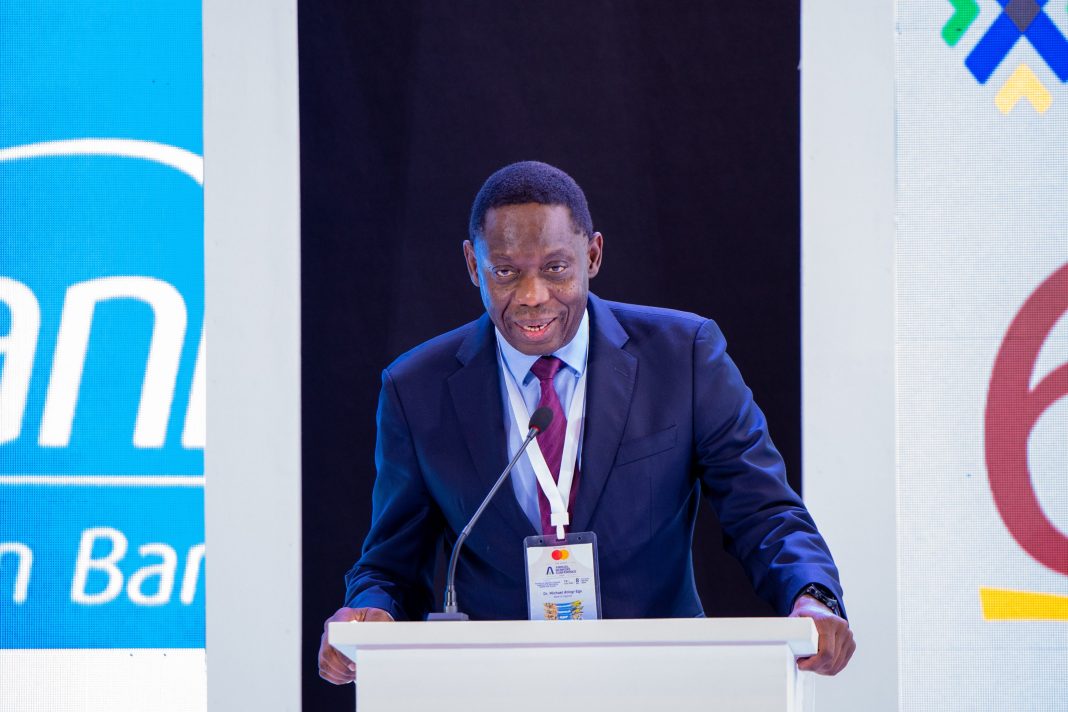

Bank of Uganda Governor Michael Atingi-Ego has reassured Uganda’s financial sector that the central bank has sufficient capacity to respond to the shilling’s recent depreciation, attributing the latest pressure largely to developments in global oil markets.
Speaking on Friday at the ninth Annual Bankers Conference in Kampala, Atingi-Ego acknowledged that the currency had weakened significantly in recent days but said the movement should be viewed against previous episodes of exchange-rate pressure that Uganda has managed. The conference was held under the theme of the role of financial institutions in facilitating Uganda’s tenfold economic growth.
“Bank of Uganda has what it takes to stabilise this exchange rate. So, be still. All will be fine,” Atingi-Ego told bankers.
The shilling was trading at about Sh3,920–Sh3,930 to the US dollar in mid-September, compared with around Sh3,740 at the end of August, according to market data reported on Friday. That represents a depreciation of roughly 4–5 per cent in less than three weeks.
Governor links pressure to global oil market
Atingi-Ego said Uganda’s exchange rate is market-determined and therefore responds to changes in the supply and demand for foreign currency. He pointed specifically to developments in global oil markets as one of the factors currently putting pressure on the shilling.
Uganda imports most of its petroleum products, meaning a sharp increase in international oil prices can raise domestic demand for US dollars as importers seek to finance fuel purchases.
Reuters reported on Thursday that Uganda’s currency was among several African currencies facing continued pressure, with increased demand for dollars from manufacturers and the energy sector contributing to the movement.
BoU has weathered previous shocks
The Governor used previous episodes of shilling weakness to illustrate the central bank’s experience in dealing with external shocks.
He recalled the period in 2022 when central banks in advanced economies began aggressively raising interest rates, triggering capital outflows from emerging and frontier markets. The shilling weakened from about Sh3,650 per dollar in February 2022 to close to Sh3,900, before subsequently stabilising, according to Atingi-Ego.
He also cited pressure in 2023 following the World Bank’s decision to halt new financing to Uganda, when the shilling approached Sh4,000 to the dollar.
Another episode came in early 2024, when a neighbouring country raised funds through international and infrastructure bonds. Atingi-Ego said the shilling again reached about Sh4,000 but later weathered the pressure.
“In September 2026, because of global oil developments, the currency is trading at about UGX3,930 right now,” he said.
Dollar demand remains a key pressure point
The latest depreciation has occurred alongside stronger demand for dollars from several parts of the economy.
Market participants have cited demand from manufacturers, energy companies and importers, while uncertainty surrounding the global oil market has also encouraged some businesses to secure dollars in advance.
The exchange-rate movement matters because a weaker shilling increases the local-currency cost of imported goods and services, including fuel, machinery and other inputs. Persistent depreciation can also increase the shilling value of foreign-currency obligations.
At the same time, Uganda’s inflation environment remains an important consideration for monetary policy. Daily Monitor reported on Friday that the central bank was tightening liquidity as the weakening shilling and rising prices created additional pressure.
‘We weathered it’
For Atingi-Ego, the recent movement is therefore another test of Uganda’s ability to absorb external financial shocks rather than an isolated currency event.
His message to the financial sector was that the central bank remains capable of responding while allowing market forces to determine the underlying value of the shilling.
“Why am I bringing all this?” he asked. “I am bringing all this to say the Central Bank has what it takes to stabilise this exchange rate.”
The remarks come as the shilling approaches the Sh4,000-per-dollar level seen during previous periods of heightened pressure, putting renewed attention on the central bank’s response as global oil and financial-market conditions evolve.