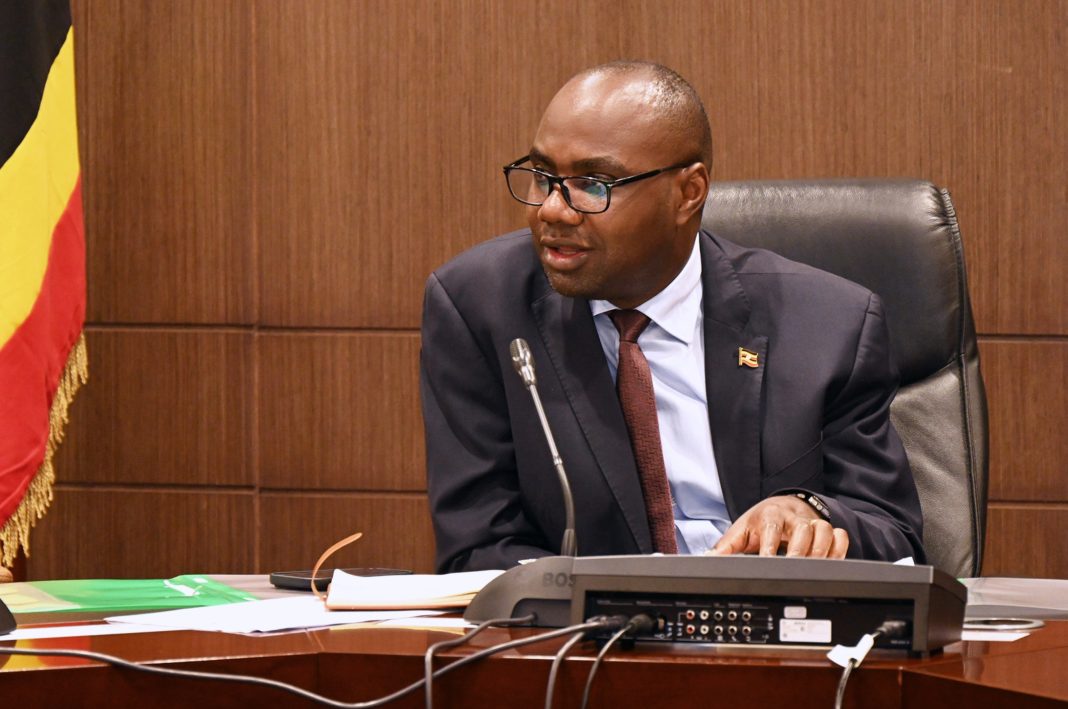

Bank of Uganda Governor Michael Atingi-Ego has urged university students to cultivate curiosity, critical thinking and teamwork, saying Uganda’s demographic advantage can only translate into economic prosperity if young people are equipped with the skills to drive the economy.
Bank of Uganda (BoU) Governor Michael Atingi-Ego has challenged Uganda’s university students to become bold thinkers and problem-solvers as the country seeks to turn its youthful population into a driver of economic transformation.
Atingi-Ego made the call on September 10, 2026, while launching the fourth season of The Ultimate University Quiz (TUUQ) at the Bank of Uganda headquarters in Kampala.
The competition, organised by Vision Group, brings together university students from across Uganda to test their knowledge, critical thinking, teamwork and ability to reason under pressure. BoU is the competition’s platinum sponsor.
Addressing the participating universities, Atingi-Ego said the central bank’s support for the quiz reflects a broader investment in Uganda’s intellectual capital.
“A nation’s true wealth is not only measured in shillings and reserves, but in the minds we nurture and the knowledge we cultivate,” he said.
He added that unlike financial resources, knowledge continues to generate value when it is shared and applied.
“Knowledge earns a kind of compound interest that has no ceiling—the more of it you spend, the more of it you keep,” Atingi-Ego said.
Economy needs critical thinkers
The Governor linked the skills tested through the quiz to Uganda’s wider economic performance, noting that the economy grew by 6.4% in the last financial year, with growth expected to accelerate to between 7% and 7.5% in the current financial year.
He also pointed to inflation remaining below the Bank’s 5% target and the relative stability of the Uganda shilling despite difficult global financial conditions.
According to Atingi-Ego, these economic outcomes are ultimately influenced by the quality of decisions made by people across the economy.
“None of this is accidental. It is the product of thousands of decisions made by people trained to reason under pressure, weigh evidence, and hold their nerve when answers are unclear,” he said.
He argued that these are precisely the capabilities that the Ultimate University Quiz seeks to develop among students.
The Governor said the investment is particularly important because more than 70% of Uganda’s population is under the age of 30, creating both an opportunity and a responsibility for the country.
“As our financial sector evolves with digital technologies, the need for a financially literate, innovative, and adaptable population has never been greater,” he said.
Atingi-Ego gives students three instructions
Atingi-Ego challenged the participating teams to approach the competition with three principles: ask boldly, reason rigorously and build together.
He urged students not to fear making mistakes when asking questions, arguing that curiosity is central to innovation and discovery.
“The student who fears being wrong will never discover what is true,” he said.
He also encouraged contestants to develop the habit of interrogating assumptions and relying on evidence rather than instinct.
“Speed under the studio lights will win you points. But the habits you build here—checking assumptions, questioning instinct, and working with the evidence—will win you a career,” Atingi-Ego said.
On teamwork, he reminded students that Uganda’s future cannot be built by individuals working in isolation.
“No team has ever won this quiz on the strength of one mind alone. Uganda’s future will not be built by one mind alone, either,” he said.
BoU opens career pathway for finalists
Beyond the competition itself, BoU has also introduced a career opportunity for the participating students.
Atingi-Ego announced that the team reaching the final would be offered four internship positions at the Bank of Uganda, creating a direct link between academic competition and professional development.
The move reinforces the Governor’s argument that employers and institutions must create pathways through which young people can convert academic knowledge into practical experience.
He called on the private sector to invest in young talent through mentorships, internships and practical exposure.
“Uganda’s demographic advantage will only become an economic dividend if institutions open pathways for young people to apply their knowledge productively,” he said.
From quiz competition to national intellectual community
Atingi-Ego also commended universities from different parts of the country for participating, saying their involvement strengthens Uganda’s intellectual community.
He cited last season’s champions, Uganda Christian University, alongside Ndejje University and Busitema University, for demonstrating the level of competition that the quiz can generate. UCU is the reigning champion after winning Season Three.
He encouraged the universities taking part in Season Four to view the competition as more than a contest for a trophy.
“The greater prize is what this competition will make of you—sharper, bolder, and more useful to Uganda than you were this morning,” he told the students.
He further called on policymakers to strengthen programmes connecting education with employability, financial capability and innovation, saying youth unemployment and underemployment require coordinated and sustained action.
The Governor also praised sponsors and partners for supporting the initiative, describing their contribution as a strategic investment in Uganda’s transformation rather than simply event sponsorship.
The Ultimate University Quiz has grown into a national platform for university students, combining academic competition with lessons in critical thinking, financial literacy, digital awareness and teamwork. BoU has supported the initiative since its first season, when the competition reached students across Uganda.
As Season Four begins, Atingi-Ego’s message was clear: Uganda’s next economic breakthrough will depend not only on capital and infrastructure, but on the quality of minds equipped to make decisions, innovate and solve the country’s problems.