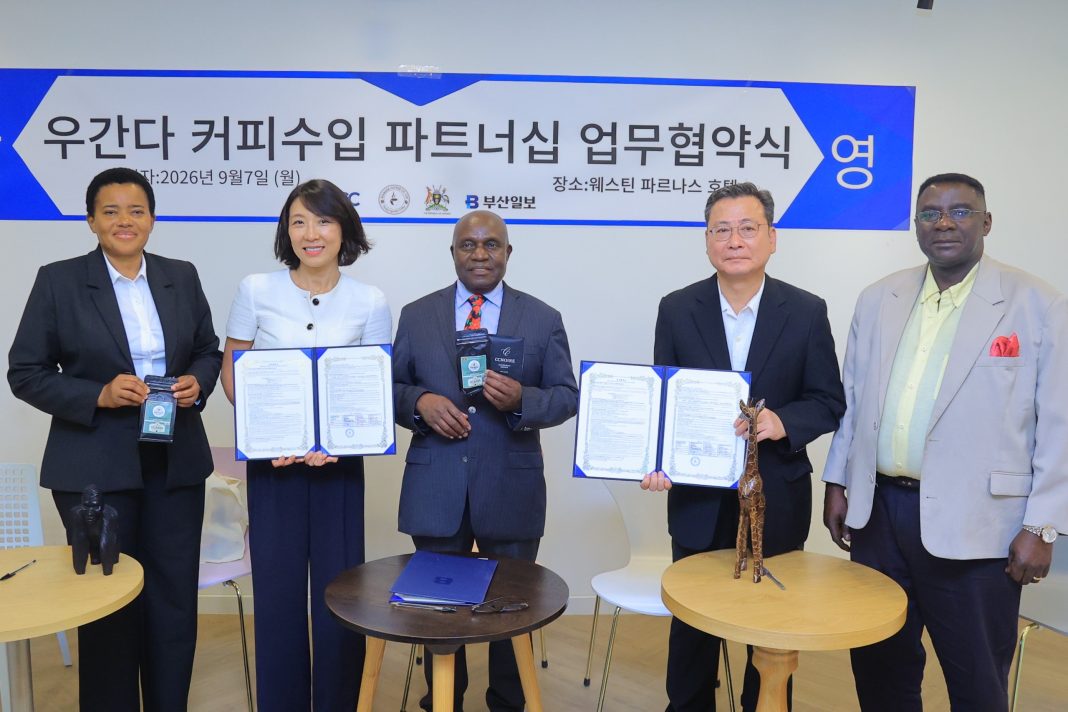

Uganda has signed a memorandum of understanding with a South Korean coffee company to supply Ugandan beans to the Asian market, with an initial shipment of two containers already on its way to Busan.
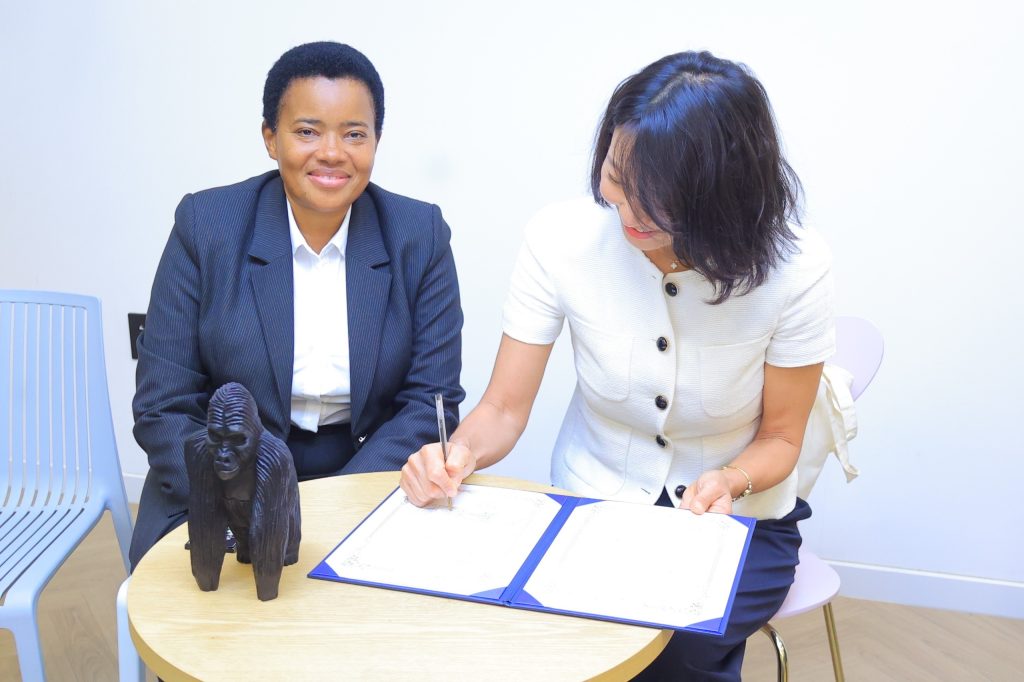
The agreement was signed on Monday, September 7, between Uganda’s Besmark Coffee Company Ltd and GVCC Co. Ltd, a coffee firm based in the South Korean port city of Busan, on the sidelines of the Uganda-Korea Trade and Investment Meeting.
Uganda’s Ambassador to Japan, Tophace Kaahwa, whose diplomatic mission is also accredited to South Korea, said the agreement marked an early commercial outcome of Uganda’s push to deepen trade with Asian markets.
Under the arrangement, Besmark will act as Uganda’s exclusive supply partner, while GVCC will serve as the exclusive distributor of the coffee in South Korea.
“The first consignment of two containers is already being shipped,” the Ugandan delegation said.
The partners also plan to develop Busan into a regional distribution and value-addition hub for Ugandan coffee, with the ambition of processing and re-exporting the beans to other Asian markets, including Japan and Southeast Asia.
Import volumes and pricing will be determined through separate commercial agreements between the companies.
South Korea seen as gateway to Asia
GVCC Chief Executive Soo-jung Lim said the company had developed a strong interest in Ugandan coffee following initial discussions with the Ugandan delegation at a coffee exhibition in Busan.
Lim said GVCC was ready to deepen its business relationship with Uganda, according to the delegation.
Ambassador Kaahwa said the South Korean company was targeting imports of one 20-tonne container of Ugandan coffee per day, equivalent to about 3,500 tonnes annually.
He appealed to Ugandan farmers to increase production to meet the potential demand.
The agreement also includes a promotional partnership with The Busan Media, which is expected to publish stories about Ugandan coffee and host promotional events aimed at increasing its visibility among South Korean consumers.
Uganda’s Second Deputy Prime Minister, Dr Crispus Kiyonga, who led the Ugandan delegation, welcomed the partnership and assured the South Korean company that the government would support efforts to maintain a reliable supply.
Kiyonga said Uganda’s longer-term ambition was to process more coffee domestically instead of exporting raw beans, while expanding the country’s presence in Asian markets.
“Uganda wants to add value to its coffee at home,” Kiyonga said, adding that Japan and other Asian markets were among the country’s targets.
He said President Yoweri Museveni had set a target of increasing national coffee production to 20 million bags annually.
Uganda produces mainly Robusta and Arabica coffee, with Robusta accounting for the bulk of its exports.
Trade imbalance
The coffee agreement comes as Uganda seeks to narrow its trade deficit with South Korea.
Kiyonga said Uganda currently exports about $10 million worth of goods to South Korea while importing roughly $100 million, creating a substantial trade imbalance.
Official data, however, put Uganda’s exports to South Korea at about $7.18 million in 2023. Coffee, tea and spices accounted for approximately $2.6 million of those exports.
Ugandan officials say expanding coffee exports could help increase foreign exchange earnings while diversifying the country’s export destinations beyond its traditional European markets.
Uganda’s Economic and Commercial Diplomacy strategy, launched in 2025, directs diplomatic missions to promote trade, investment and value-added Ugandan products.
The South Korea coffee agreement was coordinated by Uganda’s embassy in Tokyo, which is accredited to Seoul, and is being presented by officials as an early outcome of the strategy.
The government has linked the initiative to its broader ambition of transforming Uganda into a higher-value export economy as part of its target of building a $500 billion economy by 2040.
Ambassador Henry Mayega described the agreement as a significant step in expanding Uganda’s coffee exports, noting that coffee has a deep cultural significance in Uganda and features in traditional practices, including marriage and bride-price ceremonies.
Uganda’s growing coffee exports
Uganda has emerged as one of the world’s leading coffee exporters and overtook Ethiopia as Africa’s largest coffee exporter in 2025.
Ministry of Agriculture data show that Uganda exported 8.6 million 60-kilogramme bags of coffee worth about $2.3 billion in the 12 months to May 2026, compared with 7.4 million bags during the previous year.
Robusta accounts for about 80% of Uganda’s coffee exports, while Arabica represents a smaller share but has been gaining value.
During the 2024/25 coffee year, Europe accounted for about 62% of Uganda’s coffee exports, followed by Africa at 23% and Asia at 13%.
Coffee contributes more than a fifth of Uganda’s export earnings and provides income for millions of smallholder farming households.
Despite Uganda’s strong production position, its exports to South Korea remain relatively small.
South Korea, with a population of about 51.6 million people, is considered a potentially significant market for Ugandan coffee because of its established coffee culture and role as a regional trading hub.
Uganda does not have a resident diplomatic mission in Seoul. Its embassy in Tokyo is accredited to South Korea.
The Korea International Trade Association, which co-organised the Uganda-Korea Trade and Investment Meeting, has urged Uganda to consider opening a resident embassy in Seoul to strengthen commercial and diplomatic engagement.
For Uganda, the coffee deal offers an opportunity not only to increase direct exports to South Korea but also to use the country as a gateway into wider Asian markets.