
Finance Minister Henry Musasizi has challenged Uganda’s accountants to move beyond traditional bookkeeping and financial reporting, urging them to become strategic partners in strengthening fiscal discipline, accountability and economic development.
Musasizi said the accounting profession has a critical role in ensuring that public resources are properly managed and translated into tangible development outcomes.
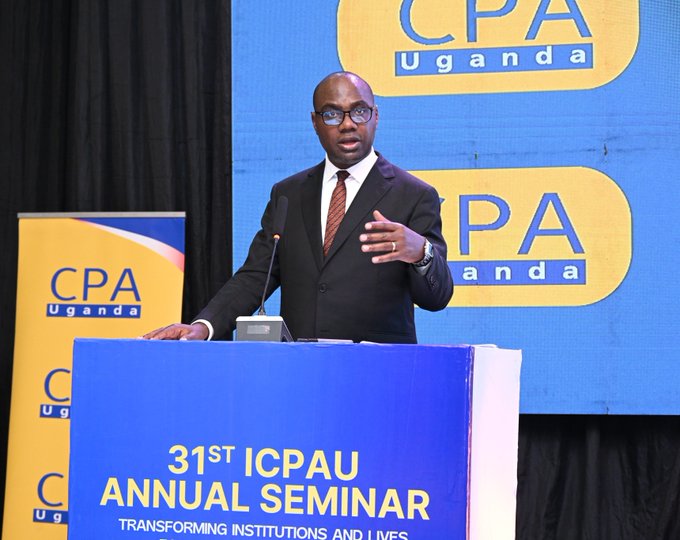
He made the remarks while officiating as Chief Guest at the 31st Annual Seminar of the Institute of Certified Public Accountants of Uganda (ICPAU) at Imperial Resort Beach Hotel in Entebbe, held under the theme “Transforming Institutions and Lives for Sustainable Growth.”
The minister said Uganda’s efforts to accelerate economic growth require decisions anchored in credible financial evidence rather than assumptions or incomplete information.
“Evidence-based decision making is fundamental to accelerating economic development, promoting sustainable business growth and avoiding costly policy and investment mistakes,” Musasizi said.
He noted that much of the evidence used to guide financial and policy decisions is generated, analysed and validated through the accounting function, placing accountants at the centre of institutional decision-making.
Musasizi urged accountants to therefore expand their role from recording and reporting transactions to interpreting financial information and providing insights that can improve decisions, strengthen accountability and enhance institutional performance.
“Accountants are strategic partners in ensuring prudent fiscal management, effective public service delivery, and sustainable economic development,” he said.
Accountants and public resource management
In the public sector, Musasizi said reliable and timely financial information is essential for government to track revenue and expenditure, protect public assets, manage liabilities and determine whether public funds are achieving their intended objectives.
He said accountants play a role throughout the national budget cycle — from planning and budget preparation to execution and control, and finally accountability and reporting.
The minister particularly highlighted the importance of real-time financial monitoring in preventing fiscal pressures.
According to Musasizi, accountants can help government track public resources, monitor cash flows and spending limits, and identify financial commitments before payments are made.
Such oversight, he said, is important in preventing the accumulation of domestic arrears and avoiding large fiscal deficits.
The remarks come as Uganda continues to place greater emphasis on fiscal discipline and improved management of public resources amid efforts to sustain economic growth and fund national development priorities.
Technology reshaping accounting
Musasizi also called on accountants to embrace technological change, including digital financial management systems, blockchain and artificial intelligence, which he said are transforming how financial information is generated, managed and applied.
The growing use of technology, he said, means accountants must continuously adapt their skills if they are to remain relevant in an increasingly data-driven economy.
ICPAU President CPA Timothy Ediomu similarly challenged professionals to look beyond numbers and adapt to the changing demands of the business environment.
Ediomu emphasised continuous professional development and integrity, urging accountants to build relevant skills while maintaining the trust placed in them as providers of financial information and strategic advice.
The message from Uganda’s finance leadership and the accounting profession points to a broader shift in the role of accountants — from custodians of financial records to key actors in policy, institutional governance and economic decision-making.