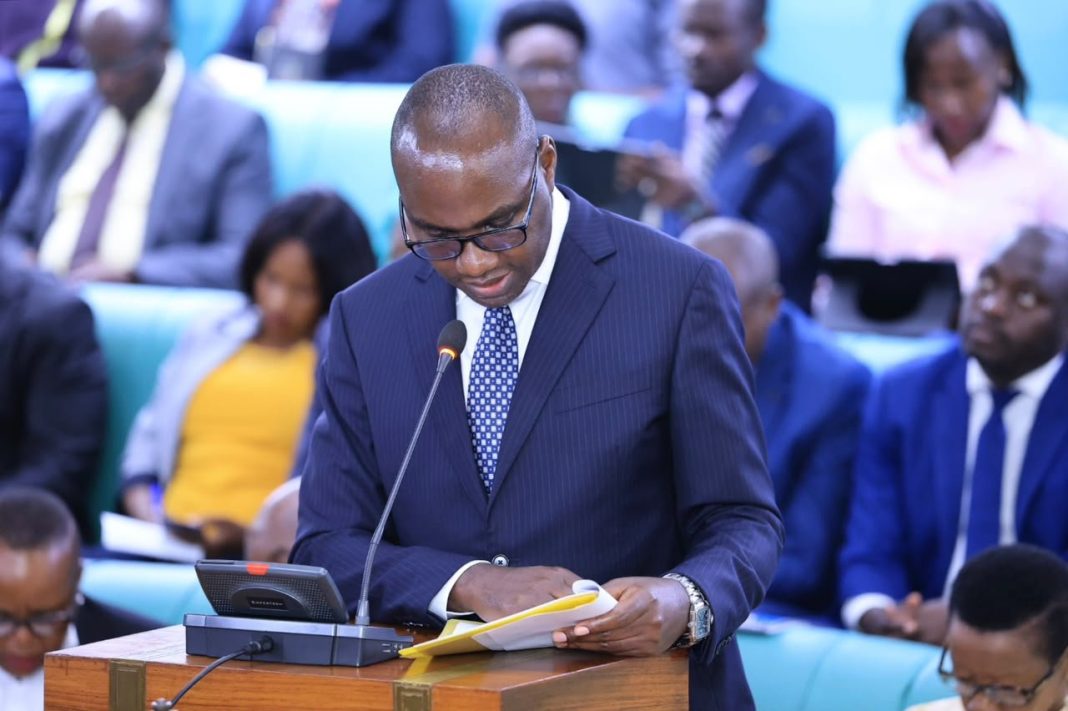

Uganda’s Finance Minister Henry Musasizi has outlined strict conditions under which taxpayers may have their tax liabilities remitted, stressing that the measure is reserved for exceptional cases where continued recovery would no longer serve the interests of sound tax administration.
Addressing Parliament on Tuesday, Musasizi said Section 43 of the Tax Procedures Code Act, Cap. 343, provides a structured process for taxpayers seeking relief from liabilities that cannot effectively be recovered because of hardship, impossibility, undue difficulty or excessive recovery costs.
The minister said the primary objective of tax administration remains the efficient, fair and consistent collection of lawfully assessed taxes.
“Tax remission is an important instrument of revenue administration rather than an exception to the tax laws,” Musasizi said, adding that it must be exercised objectively and transparently.
Before a liability can be considered for remission, the Uganda Revenue Authority (URA) is required to pursue available recovery measures. These include early intervention, payment by instalments, enforcement action, recovery from non-essential assets, offsetting liabilities against credits, deferred payment arrangements and temporary suspension of recovery where appropriate.
Under Section 43, the URA Commissioner General may refer a liability to the Finance Minister where it cannot be effectively recovered. The minister then reviews the case and, if satisfied that the statutory conditions have been met, submits the proposed remission to Parliament for approval.
The process starts with an application to the URA Commissioner General. The taxpayer must provide details of the outstanding liability, the grounds for seeking remission, the amount being requested and supporting evidence, which may include financial records, insolvency information and details of assets.
The Commissioner General evaluates the application and, where justified, forwards it to the minister together with the supporting evidence, proposed remission amount, reasons for the recommendation, fiscal implications and possible alternatives.
Musasizi said the minister subsequently reviews the proposal before presenting it to Parliament, which has the authority to determine whether the liability should be remitted in full or in part.
Once approved, the remission is gazetted and implemented by URA.
The criteria include genuine financial hardship where continued recovery would cause serious and demonstrable distress that is disproportionate to the revenue likely to be collected.
Other grounds include circumstances in which recovery is impossible, unduly difficult or would cost more than the revenue reasonably expected to be recovered.
Musasizi, however, drew a distinction between genuine hardship and ordinary business difficulties.
Temporary cash-flow constraints, declining profitability, commercial inconvenience, a taxpayer’s preference to deploy funds for expansion or investment, disagreement with a tax assessment or simple unwillingness to pay do not, on their own, qualify as grounds for remission.
The framework effectively places the burden on taxpayers to demonstrate that their circumstances meet the statutory threshold, while requiring URA and the Finance Ministry to consider whether other lawful recovery options remain available.
Musasizi said the safeguards are intended to ensure that remission is not used as a routine mechanism for avoiding tax obligations, but remains available where recovery is demonstrably impractical or contrary to sound revenue administration.
The minister’s explanation comes as Uganda seeks to strengthen domestic revenue mobilisation while balancing enforcement with provisions for taxpayers facing circumstances that make recovery unusually difficult or uneconomic.