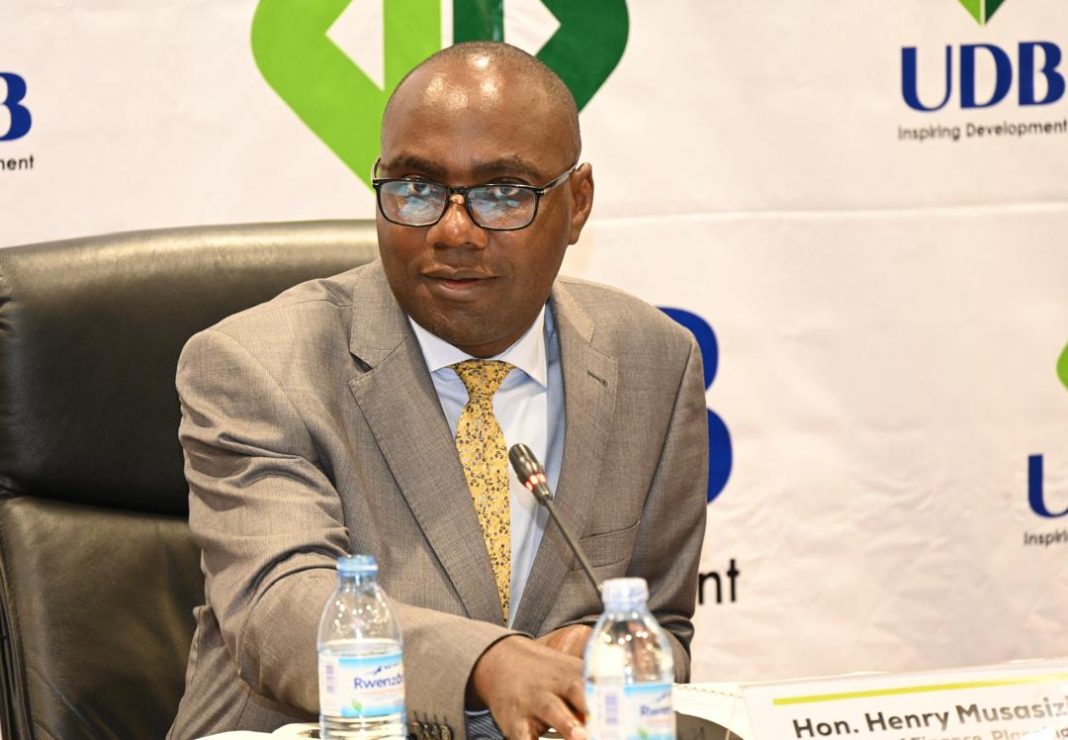

Finance Minister Henry Musasizi has challenged Uganda Development Bank (UDB) to make affordable, long-term credit a central tool for expanding productive businesses, creating jobs and strengthening the country’s industrial base.
Musasizi, together with Finance Minister of State for General Duties Aminah Mukalazi, commended UDB’s board and management, led by Board Chairman Geoffrey T. Kihuguru, for the bank’s strong financial performance in 2025. But he stressed that profitability alone should not define the institution’s success.
UDB reported Shs63.4 billion in profit after tax, with total assets rising to Shs2.26 trillion and gross loans reaching Shs1.77 trillion. The development bank said it disbursed Shs502.2 billion to 112,392 borrowers, with its interventions contributing to 69,202 jobs.
Musasizi said the figures must ultimately translate into tangible economic gains, including higher production, stronger enterprises and broader participation in economic growth.
“Every shilling deployed must translate into jobs, stronger businesses, increased production, exports and Uganda’s economic transformation,” Musasizi said.
Push for single-digit interest rates
At the centre of the minister’s message was the need to reduce the cost of borrowing for manufacturers, small and medium-sized enterprises and other productive businesses.
Musasizi said Government is pursuing single-digit interest rates as part of efforts to reduce the cost of capital and improve the competitiveness of Ugandan businesses.
The call comes as businesses continue to face financing constraints that can limit investment in machinery, expansion, working capital and productive assets. For manufacturers and SMEs in particular, the cost and tenor of credit can determine whether a business expands capacity or remains constrained by limited capital.
UDB, as Uganda’s national development finance institution, is expected to play a different role from conventional commercial lenders by providing financing that supports long-term productive investment.
Musasizi urged the bank to ensure that its lending is directed towards projects capable of generating measurable economic returns rather than focusing primarily on the volume of loans disbursed.
He also called for stronger project appraisal, greater support for priority sectors and more diversified mobilisation of financial resources to expand the bank’s lending capacity.
From lending to building bankable businesses
Kihuguru said UDB is shifting towards a more proactive development-finance model in which the bank does more than provide loans.
Under the approach, UDB intends to help develop bankable projects, reduce investment risks, strengthen enterprises and mobilise private capital around productive opportunities.
The model reflects the broader challenge facing development finance institutions: ensuring that capital reaches businesses with the capacity to expand production, generate employment and compete in domestic and international markets.
For Uganda, the emphasis on affordable and patient capital is particularly significant as the country seeks to accelerate industrialisation, increase exports and move businesses higher up the value chain.
Musasizi’s message therefore places the focus not simply on how much UDB lends, but on what that money produces.
The bank’s reported Shs502.2 billion in disbursements and 69,202 jobs linked to its interventions provide measurable indicators, but the minister wants such outcomes to remain central to how development-finance performance is assessed.
The challenge for UDB will be to expand access to cheaper capital while maintaining strong credit discipline, ensuring that affordable financing reaches viable productive enterprises and produces sustainable economic returns.