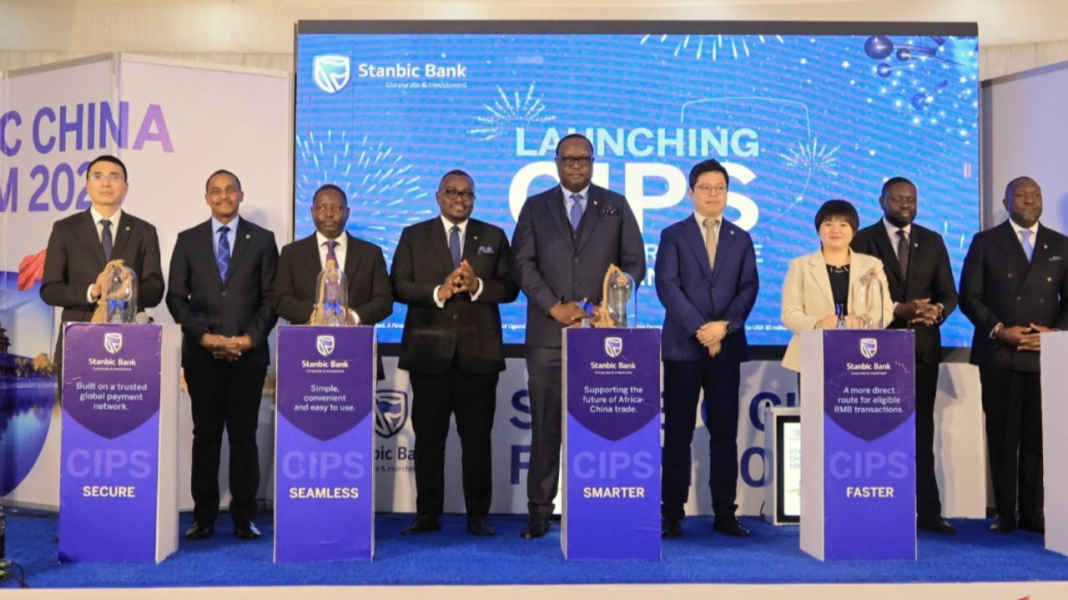

Uganda’s Stanbic Bank is finding a more direct method to connect to China’s yuan currency. Beijing’s Cross-Border Interbank Payment System (CIPS) will ease businesses trading with China.
CIPS gives Ugandan businesses a more direct route for settling transactions with the Chinese yuan. It is expected to reduce dependence on intermediary banks with the US dollar when paying Chinese suppliers.
That development matters because the scale of Uganda-China trade has created a financial relationship that is far larger than Uganda’s export base. According to figures cited, Uganda imported about $3.3 billion worth of goods from China in 2025, while exports to China stood at only about $118 million.
The numbers reveal an imbalance that shows Uganda deeply integrated into China’s manufacturing and supply chains, while its presence in the Chinese market remains comparatively small. The new payment channel is expected to make that relationship more efficient. But will it make it more balanced?
From Dollar to Yuan
For many Ugandan importers, a China-bound payment has traditionally involved a chain of financial institutions and currency conversions. A business earning or holding Ugandan shillings has to move through the US dollar before its Chinese supplier receives yuan. Every additional step can introduce costs, processing delays and exposure to exchange-rate movements.
CIPS is designed specifically for cross-border RMB payments and clearing. China describes it as a wholesale payment system intended to provide reliable, efficient and lower-cost renminbi (RMB) settlement while supporting the international use of the currency. For a Ugandan company importing machinery, electronics, construction materials or industrial inputs from China, therefore, the benefit is not merely technological but commercial, too.
A faster payment can mean a supplier receives funds sooner, goods are released earlier and working capital is tied up for less time.
Stanbic Uganda Chief Executive, Mr. Mumba Kalifungwa, said that direct RMB settlement would reduce foreign-exchange volatility and speed up payments, saying that the system could give Ugandan companies a competitive advantage.
That could be particularly relevant for small and medium-sized businesses, which tend to feel transaction charges and exchange-rate movements more sharply than large corporations.
Uganda’s development is also part of a wider shift across East Africa. The
Standard Bank, Stanbic parent group, has been expanding CIPS access across African markets. The group says it has already extended RMB settlement services to countries including Kenya and Tanzania, alongside South Africa, Angola, Ghana and Lesotho.
By July 2026, Standard Bank said transactions through CIPS had exceeded Yuan 8 billion, equivalent to about $1.2 billion. That suggests the development should not be viewed as an isolated Ugandan banking product. It is part of the emergence of a broader China-Africa payments corridor.
The trend became even more significant in June when Standard Bank and Industrial and Commercial Bank of China (ICBC), were authorized by the People’s Bank of China (PBC), to operate jointly as the RMB clearing Bank of Africa, with capacity to clear RMB across 19 African countries. For East African businesses, that could gradually make the yuan a more practical currency for China-related commerce.
This is not simply about “de-dollarization”, It would be tempting to describe the development as China replacing the dollar in African trade. That is too simplistic.
The more immediate issue for Ugandan businesses is currency efficiency.
If an importer owes a Chinese supplier, having a banking channel designed for yuan settlement can remove unnecessary conversion steps. That does not mean the US dollar suddenly becomes irrelevant to Uganda’s international trade. Instead, businesses can increasingly have another settlement option when dealing specifically with Chinese counterparts.
And there is a strategic reason Beijing is encouraging this. CIPS was launched in 2015 and forms part of China’s broader effort to expand international use of the RMB. The system has continued to expand its global network, with CIPS reporting participation from banking institutions across numerous countries and regions.
The expansion into Africa, therefore, serves both commercial and strategic purposes: making trade with China easier while gradually embedding the yuan deeper into international commerce.
What does Uganda Sell to China?
This is where the banking becomes an economic-policy story. Lower transaction costs are useful. Faster payments are useful. Better access to Chinese financial infrastructure is useful. But none of them automatically solves Uganda’s trade deficit. Uganda cannot close a multi-billion-dollar trade gap simply by making it easier to pay Chinese suppliers.
The real opportunity would be to use better financial connectivity to move Ugandan companies further up the value chain. Uganda can competitively sell into China processed agricultural products, minerals with greater value addition, manufactured goods, services and other products capable of meeting Chinese demand.
The Minister of State for Industry, Mr. David Bahati, described China as one of Uganda’s most significant bilateral partners and argued that the new payment infrastructure could remove barriers to deeper industrial and commercial cooperation. That distinction is important. “The objective should not simply be cheaper importing. It should be cheaper importing of productive inputs that help Ugandan businesses produce more for domestic, regional and international markets,” he said.
Another dimension deserving attention is that China is not merely Uganda’s source of finished consumer products. It is also a major source of machinery, industrial equipment, technology and intermediate goods. If payment friction falls, Ugandan manufacturers and businesses could potentially access Chinese equipment and inputs more efficiently. That could support investment in sectors where Uganda wants to build domestic capacity.
There is a danger, however: if easier yuan payments simply increase the volume of finished Chinese products entering Uganda, the country could deepen its import dependence without developing a corresponding export capacity. That is why Mr. Andrew Mashanda, Standard Bank Group’s Head of Business and Commercial Banking for Africa Regions and Off-shore, framed the next stage of Africa-China relations around more than trade volumes.
He argued, that it is “what Africa and China can build together”—particularly in manufacturing, value addition and infrastructure. This is the more important test of the new payment infrastructure.
There is also a potential East African Community angle. Ugandan companies do not operate solely within Uganda’s borders. Many import from Asia and distribute products across neighbouring markets, while regional manufacturers source machinery and inputs from China. As more East African financial institutions develop direct or more efficient RMB channels, the region could become a more integrated commercial corridor between China and East Africa. Kenya and Tanzania are already part of Standard Bank’s expanding CIPS footprint.
At the same time, African regional institutions are pursuing their own efforts to reduce the cost of cross-border payments. COMESA – the Community of East and southern Africa – for example, launched a digital retail payments platform designed to facilitate cross-border transactions using local currencies and reduce dependence on foreign-currency conversions. These developments point towards a more fragmented but potentially more flexible African payments landscape—one in which businesses can increasingly choose settlement mechanisms suited to particular trading corridors.
Opportunity for Uganda’s Banks
For Stanbic, the move also represents a significant commercial opportunity. A bank that can make China-related payments faster and easier will capture more of the trade-finance relationship around those transactions. That includes foreign exchange, working-capital finance, letters of credit, guarantees and other services required by importers and exporters.
CIPS itself has also expanded beyond straightforward payments. In 2025, it introduced an RMB-denominated international letter-of-credit service, designed to facilitate trade-finance transactions through the RMB eco-system. The long-term significance may be much greater than simply replacing one payment route with another. It could gradually create a broader financial eco-system around China-Africa trade.
Stanbic’s CIPS connection should ultimately give Uganda a more measured number or value of yuan transactions processed. And the questions which will be pertinent are:are Ugandan manufacturers using the system to acquire productive equipment? Are exporters using it to receive Chinese payments more efficiently? Are banks providing financing that enables Ugandan companies to enter Chinese supply chains? And, most importantly, is Uganda’s export capacity growing alongside its imports from China?
Where the answers are; ‘Yes’, the new payment infrastructure will become an important piece of Uganda’s industrialization story. If not, it risks becoming little more than a more efficient financial highway for a trade relationship that already heavily favours Chinese exports.
The immediate gain is clear: faster, potentially cheaper and more efficient China-Uganda payments. The strategic opportunity is much bigger. Uganda now needs to ensure that the financial bridge being built to China carries “more than imported goods on the way in—it must eventually carry more Ugandan products, services, investment and value-added exports on the way out.”