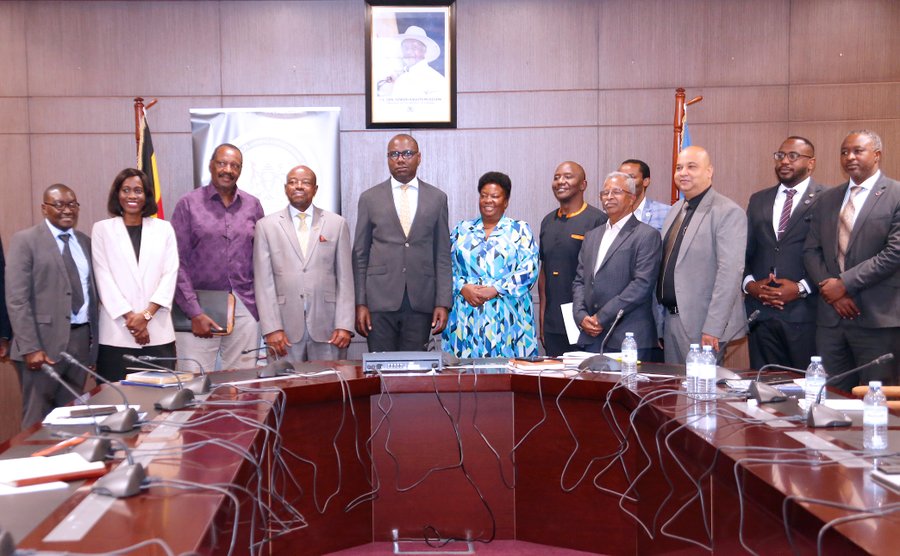

The government has renewed its commitment to strengthening Uganda’s manufacturing sector as a central driver of economic transformation, job creation, export growth and increased domestic revenue mobilisation.
The commitment was made during an engagement between the Ministry of Finance, Planning and Economic Development and the Uganda Manufacturers Association (UMA), where Finance Minister Hon. Henry Musasizi, alongside State Ministers Hon. Amos Lugoloobi and Hon. Cissy Mulondo, held discussions with manufacturers on measures to build a more competitive industrial sector.
Musasizi said manufacturing remains a key pillar of Uganda’s 10-fold economic growth strategy, which seeks to expand production capacity, increase exports, create employment opportunities and reduce reliance on external borrowing.
He said government is focused on creating a favourable environment for businesses through investments in peace and security, infrastructure development, supportive policies, improved market access and maintaining a stable investment climate.
“Manufacturing is critical to Uganda’s economic future because it drives production, creates jobs, expands exports and strengthens domestic revenue,” Musasizi said, adding that a stronger industrial base would help position Uganda as a competitive player in regional and global markets.
The meeting comes as Uganda seeks to accelerate industrialisation under its long-term development agenda, with manufacturers pushing for policies that address challenges affecting production costs and business growth.
UMA Chairman Aga Sekalala Junior said the manufacturing sector is already making a significant contribution to the economy, accounting for more than 16.5% of Uganda’s Gross Domestic Product (GDP), supporting about 2 million direct jobs, contributing 25% of manufactured exports, and generating more than 33% of domestic tax revenues.
Sekalala described manufacturers as strategic partners in Uganda’s economic transformation, saying the sector requires stronger collaboration between government and the private sector to unlock its full potential.
“Manufacturers are not only producers of goods but also key contributors to employment creation, exports and national revenue,” he said.
To strengthen engagement with government, UMA proposed the establishment of a MoFPED–UMA Technical Coordination Committee to provide a structured platform for dialogue and allow manufacturers to participate in discussions on fiscal, tax and economic policies before implementation.
The association also presented its “Big Five Agenda”, highlighting priority areas requiring urgent attention, including high energy costs, industrial infrastructure gaps, access to affordable financing, market expansion, skills development and improved trade facilitation.
Both sides agreed that a stronger public-private partnership is essential for accelerating Uganda’s industrial growth and building a resilient economy capable of competing regionally and internationally.
The government said supporting manufacturing growth remains critical to achieving economic independence, expanding Uganda’s export base and creating sustainable employment opportunities.
“As manufacturing grows, Uganda grows. What is good for manufacturing is good for the economy,” stakeholders noted during the engagement.